

Process AHU Specification Guide: GMP, EN 1886 & Hygienic Design
Key fact: A process air handling unit supplier must be evaluated on airflow accuracy, casing leakage class (EN 1886), filtration capability (ISO 16890 + EN 1822), coil performance, hygienic construction, pressure stability, validation documentation and regulatory traceability – not just price-per-cubic-metre. Industrial and process rooms place fundamentally different demands on an AHU than offices, hotels or shopping malls.

Scope: this is a process-AHU technical specification guide, not another general AHU supplier page. It translates EN 1886 casing classes, EU GMP Annex 1, ISO 14644, hygienic construction, filtration, pressure stability and validation evidence into RFQ requirements. For general supplier and product capability, use SongXin’s air handling unit supplier overview.
Key fact: A process air handling unit supplier must be evaluated on airflow accuracy, casing leakage class (EN 1886), filtration capability (ISO 16890 + EN 1822), coil performance, hygienic construction, pressure stability, validation documentation and regulatory traceability – not just price-per-cubic-metre. Industrial and process rooms place fundamentally different demands on an AHU than offices, hotels or shopping malls.
Practical rule: the distinction is tolerance and traceability. Comfort AHUs serve people, where ±2 K is acceptable. Process AHUs serve production limits – ±0.5 °C, ±5% RH, defined pressure cascades, cleanroom classifications, hygienic CIP/SIP, exhaust balance, 24/7 duty. The supplier must understand the room duty and the regulatory framework (EN 1886, EU GMP Annex 1 (2022), ASHRAE 170, ISO 14644, SEMI) before quoting fan size, filters, coils, controls or even casing material.
This guide supports buyers comparing SongXin’s air handling unit supplier, modular air handling unit supplier, modular AHU selection guide, comfort AHU vs process AHU, AHU filter selection guide and AHU cooling coil selection resources.
Quick Answer for Buyers
A process AHU supplier is the right partner when the room has production-driven limits: required airflow, temperature band, humidity range, pressure cascade, filtration grade, exhaust balance or continuous operation. The RFQ should state room purpose, process heat and moisture loads, supply air condition, return/exhaust air volume, external static pressure, filter requirement, hygienic construction needs, regulatory framework and control sequence.
Buyer’s 30-second rule (by industry):
| Industry | Required AHU type | Key features |
|---|---|---|
| Office, retail, hotel | Comfort AHU | Standard panel filter, basic controls, EN 1886 L3/D3 casing |
| Industrial workshop | Industrial AHU | Heavy-duty coil, dust filter, robust drain pan, possibly ATEX/explosion-proof |
| Hospital general ward | Hygienic AHU | EN 1886 L2/D2, smooth interior, easy cleaning, ASHRAE 170-2021 alignment |
| Pharmaceutical (sterile) | GMP-grade hygienic AHU | Stainless 304/316L, EN 1886 L1/D1, EU GMP Annex 1 (2022) compliant, full IQ/OQ/PQ |
| Food & beverage | Hygienic + washdown | Stainless 304/316, IP55 motors, sanitary drain pan, HACCP-aware |
| Cleanroom (ISO 14644) | Cleanroom AHU | HEPA H13/H14 per EN 1822, low-leakage L1, vibration isolated |
| Laboratory | Process/lab AHU | Variable exhaust, ±5 Pa pressure stability, fume hood integration |
| Semiconductor fab | Cleanroom + specialty | ULPA U15/U16, ISO 5/6, particle count monitoring |
| Hospital operating theatre | Hygienic + HEPA | EN 1886 L1/D1, HEPA H13/H14, laminar-flow capability per ASHRAE 170-2021 |
| Data center | Industrial precision / DOAS | High SHR, EC fans, modular, ASHRAE TC 9.9 ranges |
Industrial vs Comfort AHU – The Six Key Differences
| Attribute | Comfort AHU | Industrial / Process AHU |
|---|---|---|
| Air tolerance | ±2 °C, ±10% RH | ±0.5 °C, ±5% RH typical |
| Operating hours | 1,500–3,000 hrs/year | 6,000–8,760 hrs/year |
| Casing leakage (EN 1886) | Class L3 typical | L1 or L2 (tighter) |
| Casing strength (EN 1886) | Class D3 typical | D1 or D2 (stiffer) |
| Filter class | Coarse + ePM2.5 typical | ePM1 + HEPA / ULPA / specialty |
| Interior surface | Painted galvanized | Stainless 304/316 + smooth radius corners |
| Drain pan | Sloped, drained | Sloped + sanitary + double-skin |
| Coil materials | Cu tube + Al fin | Cu/Cu, SS 316, or coated for chemistry |
| Documentation | Datasheet + manual | GMP / HACCP / SEMI / FDA validation |
| Hygienic design | Optional | Mandatory in pharma, food, hospital |
| Vibration & sound | Standard mounts | AVI mounts + acoustic enclosure |
| Redundancy | Single unit common | N+1 or 2N for critical applications |
EN 1886 Casing Classification (The Foundation)
EN 1886 – *Ventilation for buildings – Air handling units – Mechanical performance* – defines four classification dimensions every process AHU buyer should specify on the RFQ.[5]
1. Air leakage class
Test conditions and limits (per DIN EN 1886, confirmed by Eurovent REC 6/15):[11]
| Class | Max leakage at −400 Pa (L/s · m²) | Max leakage at +700 Pa (L/s · m²) | Typical application |
|---|---|---|---|
| L1 | 0.15 | 0.22 | Cleanrooms, pharma (Annex 1 Grade A/B), semiconductor |
| L2 | 0.44 | 0.63 | Hospital wards, food, laboratory |
| L3 | 1.32 | 1.90 | Office comfort (default) |
2. Casing strength (mechanical deflection)
| Class | Max deflection at design pressure | Typical application |
|---|---|---|
| D1 | ≤ 4 mm/m | Very stiff – cleanroom, high external static pressure |
| D2 | ≤ 10 mm/m | Process, hospital, hygienic AHU |
| D3 | Less stringent | Office comfort |
3. Thermal bridging (TB)
| Class | k-factor (W/m·K equivalent) | Typical application |
|---|---|---|
| TB1 | < 0.30 | Very low (cold/freezing rooms, condensation risk) |
| TB2 | 0.30–0.45 | Standard process / cold air handling |
| TB3 | 0.45–0.75 | Standard comfort |
4. Thermal insulation (T)
| Class | Thermal transmittance U (W/m²·K) | Typical application |
|---|---|---|
| T1 | < 0.5 | Very high (cold storage, freezer rooms) |
| T2 | 0.5–1.0 | Process / hygienic AHU |
| T3 | 1.0–1.4 | Standard comfort |
Practical procurement rule: specify EN 1886 D, L, TB and T class on every process AHU RFQ. A reputable supplier provides certified third-party test results (e.g., TÜV, Eurovent, VDI-aligned laboratory), not just a self-declaration on a datasheet.
EU GMP Annex 1 (2022) – What Pharma AHU Buyers Must Know
The European Commission published the revised EU GMP Annex 1 on 25 August 2022, with most provisions in force from 25 August 2023 (lyophilisation provisions from 25 August 2024).[7] This replaced the 2008 version and is the single most important regulatory update for sterile-product AHU specification in the last decade.
Key implications for AHU design and supplier selection:
| Annex 1 (2022) requirement | Impact on AHU specification |
|---|---|
| Contamination Control Strategy (CCS) is now mandatory and must be documented holistically | AHU supplier must provide validation documents that integrate into the site’s CCS, not just per-unit datasheets |
| Stricter monitoring of 5 µm particles in Grade A and B at-rest and in-operation | HEPA integrity scan testing (per ISO 14644-3) is non-negotiable; sealed gel-frame filter housings strongly preferred |
| Grade A unidirectional airflow must be demonstrated by smoke studies and air visualization | AHU + terminal box design must support visualization tests during qualification |
| Energy and sustainability considerations explicitly recognised | EC plug fans, demand-controlled ventilation, low-leakage L1 casing now expected on new builds |
| Single integrated lifecycle approach (URS → DQ → IQ → OQ → PQ → continuous monitoring) | Supplier must deliver full lifecycle documentation, not just an OQ report |
Grade to ISO 14644-1 reference (at-rest):
| Annex 1 grade | ISO 14644-1 equivalent (at-rest) | Typical use |
|---|---|---|
| Grade A | ISO 5 | Critical zone for sterile filling, aseptic connections |
| Grade B | ISO 5 (at-rest) / ISO 7 (in-operation) | Background for Grade A |
| Grade C | ISO 7 (at-rest) / ISO 8 (in-operation) | Less critical aseptic-process stages |
| Grade D | ISO 8 (at-rest) | Clean area for less critical steps |
10 Industry-Specific AHU Specifications
1. Pharmaceutical Manufacturing (EU GMP Annex 1, 2022 revision)
| Item | Required specification |
|---|---|
| Casing | EN 1886 D1, L1, T2, TB2 (Grade A/B); D2/L2 may suffice for Grade D |
| Interior surface | Stainless 304 (general) or 316L (corrosive/critical) |
| Filter (final) | HEPA H13 (Grade C/D) / H14 (Grade A/B) per EN 1822 |
| Filter housing | Sealed gel-frame or dovetail, with HEPA scan-test port |
| Interior corners | Radius ≥ 50 mm – no flat right angles |
| Drain pan | SS 316L, sloped, sanitary |
| Validation | EU GMP Annex 1 (2022) + FDA 21 CFR Part 11 (if applicable) |
| Pressure cascade | Documented, alarmed, integrated into site CCS |
| Air change rate (cleanroom) | Grade A unidirectional; Grade B ~40–60 ACH; Grade C ~20–40 ACH; Grade D ~6–20 ACH |
| Redundancy | N+1 minimum on critical lines |
| Documents | URS → DQ → IQ → OQ → PQ + HEPA scan test reports + CCS-aligned data |
2. Food & Beverage Processing
| Item | Required specification |
|---|---|
| Casing | EN 1886 D2, L2 |
| Interior | SS 304 or 316 (acid resistance for citric, lactic, etc.) |
| Drain pan | Stainless, sloped, sanitary, removable |
| Coil | Cu/Cu or SS 316 (wash-down resistant) |
| Filter | ePM2.5 + ePM1 (ISO 16890), HEPA in critical packaging zones |
| Wash-down | IP55+ motors, food-grade lubricants, no exposed insulation |
| Validation | HACCP-aware design, allergen segregation if needed |
| Antimicrobial coating | Optional on interior surfaces |
3. Hospital – General Wards & Specialty Areas
| Item | Required specification |
|---|---|
| Casing (wards) | EN 1886 D2, L2, smooth interior |
| Casing (OR / ICU / isolation) | EN 1886 D1, L1 |
| Filter (wards) | ePM2.5 ≥80% (≈ MERV 14) per ISO 16890 |
| Filter (OR / ICU) | HEPA H13/H14 per EN 1822, plus activated carbon where required |
| Pressure cascade | OR positive (≥ +2.5 Pa), isolation negative (≤ −2.5 Pa) – alarmed |
| Air change rate | OR: typically 20–25 ACH; ICU: 6–15 ACH; ward: 4–6 ACH – per ASHRAE 170-2021 Table 7.1[6] |
| Standards | ANSI/ASHRAE/ASHE 170-2021, ISO 14644 where cleanroom-classified |
| Sound limit | NC 25–35 typical |
4. Laboratory (Research / Wet Lab / BSL)
| Item | Required specification |
|---|---|
| Casing | EN 1886 D2, L2 |
| Filter | ePM1 + activated carbon for chemical fume control |
| Fume hood integration | Variable exhaust + matched make-up air |
| Pressure stability | ±5 Pa with sub-second response |
| Air change rate | 6–12 ACH typical; higher for BSL-3/4 |
| Outdoor air | 100% outdoor air common for wet labs (no recirculation) |
| Sash control | DCV linked to fume hood sash position |
5. Cleanroom (ISO 14644-1:2015)
ISO 14644-1 itself does not prescribe ACH – the following are typical industry design values per IEST and ISPE guidance:
| ISO class | Particles ≥ 0.5 µm/m³ | Typical filter | Typical ACH range (non-unidirectional) |
|---|---|---|---|
| ISO 5 (Class 100) | 3,520 | ULPA U15 (or HEPA H14) | 240–600+ (often unidirectional flow) |
| ISO 6 (Class 1,000) | 35,200 | HEPA H14 | 60–150 |
| ISO 7 (Class 10,000) | 352,000 | HEPA H13/H14 | 30–60 |
| ISO 8 (Class 100,000) | 3,520,000 | HEPA H13 | 5–20 |
| ISO 9 (industrial CR) | room air | ePM1 ≥80% | < 5 |
6. Semiconductor Fab
| Item | Required specification |
|---|---|
| Casing | EN 1886 D1, L1 |
| Filter | ULPA U15 (99.9995% @ MPPS) or U16 (99.99995% @ MPPS) per EN 1822 |
| Class | ISO 5 / ISO 6 for fab; ISO 4 or better for lithography |
| Particle monitoring | Continuous online, integrated with FFU/CDU |
| Temperature stability | ±0.5 °C typical, ±0.1 °C at lithography tools |
| Humidity stability | ±5% RH, tighter at photoresist/coater stations |
| Vibration isolation | < 50 µm peak displacement at sensitive tools |
| Standards | SEMI S2/S23/E168, ISO 14644-1/-2/-3, FED-STD-209E (legacy reference only) |
7. Industrial Workshop (Plastic, Rubber, Metal Working)
| Item | Required specification |
|---|---|
| Casing | EN 1886 D2, L2 or L3 |
| Filter | Coarse + ePM10 (ISO 16890) |
| Coil | Cu/Cu with epoxy or e-coating against dust and lubricant mist |
| Drain pan | Removable for cleaning |
| Service access | Wide doors for filter change in dusty environments |
| Redundancy | N+1 on continuous production lines |
8. Brewery / Distillery
| Item | Required specification |
|---|---|
| Casing | EN 1886 D2, L2 |
| Interior | SS 304 or 316 (CO₂ and organic-acid resistance) |
| Filter | ePM2.5 base, HEPA in bottling/packaging |
| Drain pan | Sanitary, sloped, easy CIP |
| Coil | Cu/Cu protected against organic acids |
9. Data Center
| Item | Required specification |
|---|---|
| Architecture | Often DOAS + CRAH/CRAC per row, not single AHU |
| Casing | EN 1886 D2 |
| Filter | ePM1 ≥50% per ISO 16890 |
| Sensible heat ratio | 0.95+ (sensible-heavy load) |
| Fan | EC plug fans, low SFP, VFD or constant-speed |
| Standards | ASHRAE TC 9.9 *Thermal Guidelines for Data Processing Environments* (incl. W17–W45 liquid-cooling classes for AI/HPC)[8] |
| Redundancy | N+1 minimum, often 2N for Tier IV facilities |
10. Operating Theatre (Detail per ASHRAE 170-2021)
| Zone | ACH | Pressurization | Filter | Notes |
|---|---|---|---|---|
| Conventional OR (Class B/C) | 20 ACH minimum | Positive (+2.5 Pa) | HEPA H13 | Mixed-flow |
| Ultra-clean / orthopaedic OR | 25–60 ACH | Positive (+5 Pa) | HEPA H14 | Laminar-flow ceiling |
| Recovery / step-down | 6–10 ACH | Slightly positive | ePM1 80% (MERV 14) | – |
| Airborne infection isolation (AII) | 12 ACH | Negative (−2.5 Pa) | HEPA H13 + activated carbon | Exhaust direct outdoors, no recirculation |
Reference: ANSI/ASHRAE/ASHE Standard 170-2021, Table 7.1.[6]
Process AHU Supplier Capability Checklist
Beyond ISO 9001, a credible process AHU supplier should demonstrate:
| Capability | Pass signal |
|---|---|
| EN 1886 casing certification | Third-party tested (TÜV, Eurovent, VDI-aligned lab) |
| Stainless steel fabrication | In-house production line, not subcontracted |
| Cleanroom-grade assembly bay | Dedicated assembly area for ISO 7/8 AHUs |
| HEPA filter installation experience | Gel-seal or dovetail frame, in-house scan testing per ISO 14644-3 |
| GMP / HACCP / SEMI documentation | Sample IQ/OQ/PQ + CCS-aligned validation reports |
| AHRI certified rating | AHRI 410 (coils), AHRI Standard for AHU where applicable |
| Acoustic test capability | Sound power per ISO 3744 / ISO 5136 |
| URS / DQ workflow | Project examples and traceable design documentation |
| BIM / 3D coordination | Revit MEP family, BIM Level 2 capability |
| Local installation & training support | In-country engineering team or qualified partner |
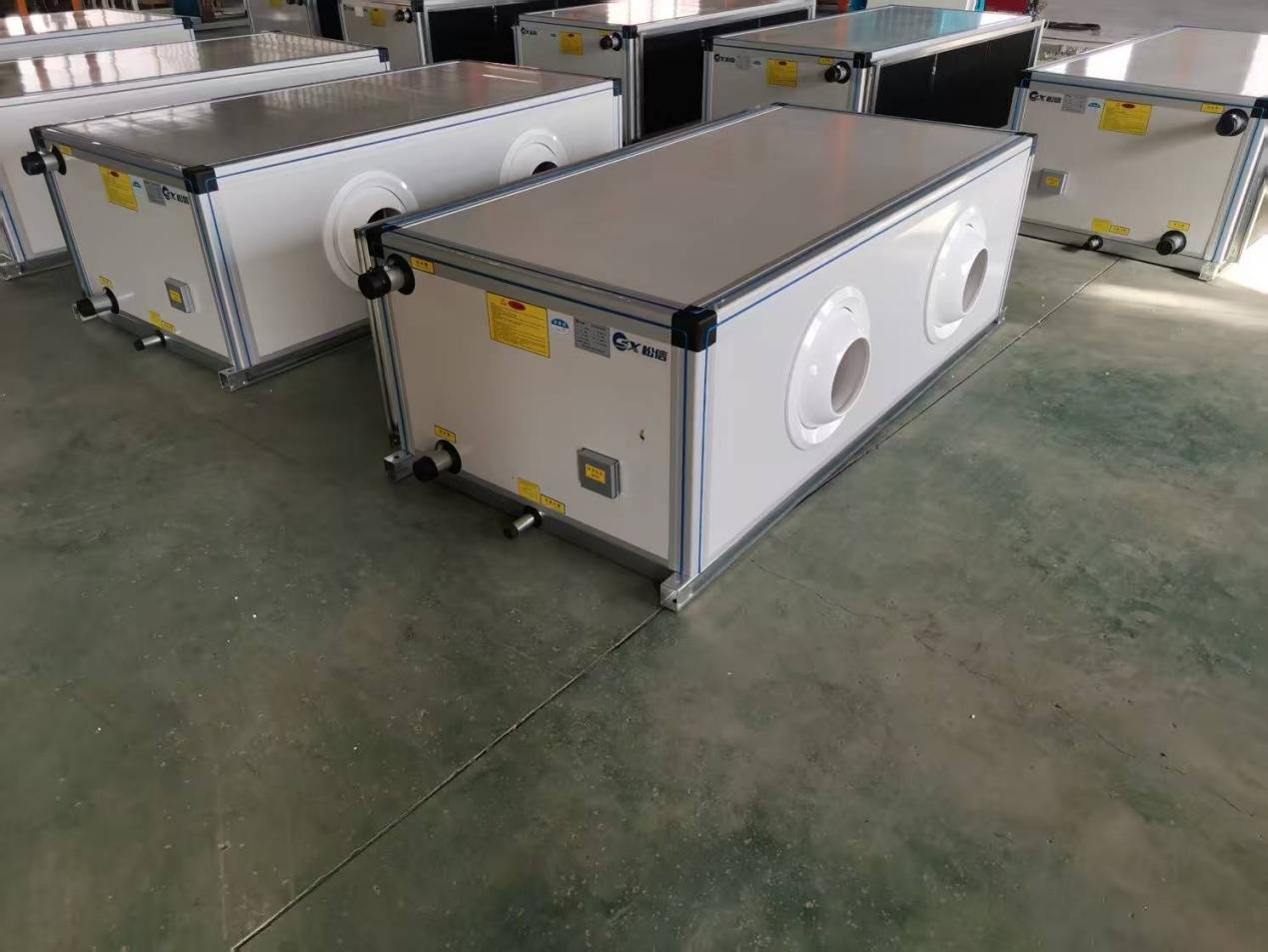
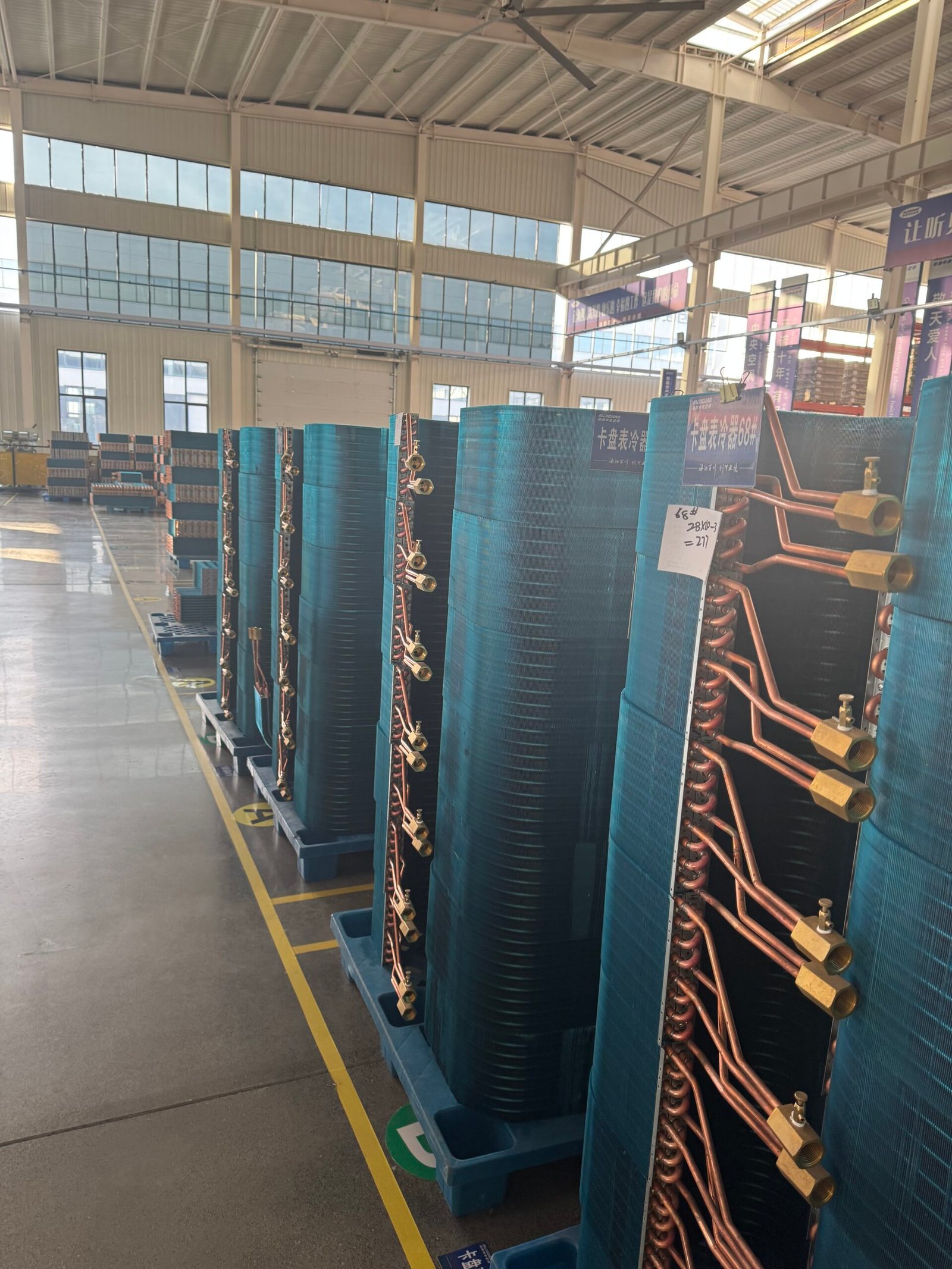
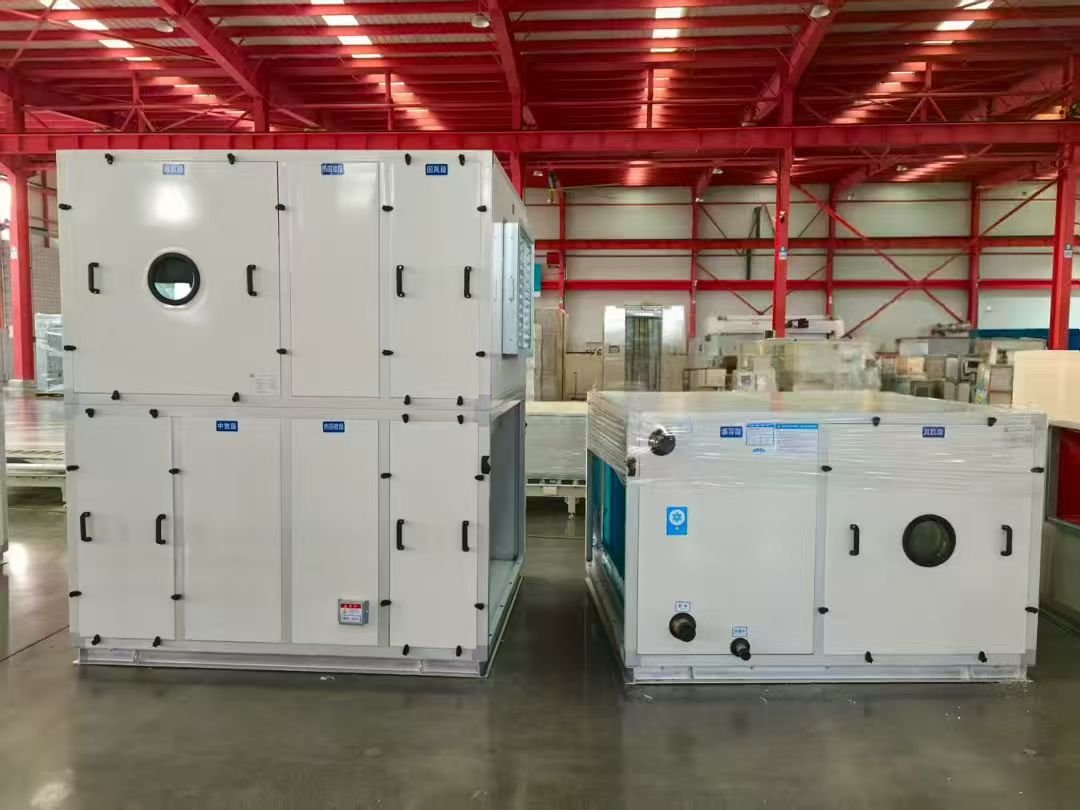
SongXin’s AHU production line includes precision CNC fabrication, 100% per-unit factory testing (airflow, external static pressure, sound, casing leakage), copper-aluminium and Cu/Cu coil manufacturing under per-coil leak detection and pressure testing, HEPA section integration, panel/bag/HEPA filter section support, ISO 9001 quality management, and customizable casing for CE compliance per EU customer requirements.[9][10]
Worked Example: Pharma Tablet Coating Room AHU (GMP Grade D / ISO 8)
Scenario: a pharmaceutical solid-dose tablet coating room of 200 m², 3.0 m ceiling height, designed to EU GMP Annex 1 (2022) Grade D (ISO 8 at-rest) with 20 ACH.
Step 1 – Supply airflow.
200 m² × 3 m × 20 ACH = 12,000 m³/h supply air.
Step 2 – Cooling load.
Process heat 35 kW + lighting 4 kW + envelope 6 kW + outdoor-air load 15 kW = 60 kW total (sensible 45 kW, latent 15 kW, SHR 0.75).
Step 3 – AHU specification.
| Item | Specification |
|---|---|
| Type | GMP hygienic AHU |
| Casing | EN 1886 D1, L1, T2, TB2 (overspec vs minimum, reduces leakage risk) |
| Interior material | Stainless 304 (interior surfaces); SS 316L drain pan |
| Pre-filter | ePM2.5 ≥80% (MERV 14) per ISO 16890 |
| Final filter | HEPA H13 per EN 1822, sealed gel-frame, in-place scan test port |
| Cooling coil | 6-row Cu/Cu, drain pan SS 316L sloped |
| Heating coil | Electric or LPHW |
| Humidifier | Clean steam (pure-steam generator) for GMP duty |
| Fan | EC plug fan, VFD control, redundant variant available |
| Leakage test | Per-unit factory test, report archived |
| Validation | URS → DQ → IQ → OQ → PQ documentation set |
| Sound | ≤ NC 45 in occupied corridor |
| Redundancy | N+1 (parallel standby AHU on critical line) |
Step 4 – Pressure cascade.
Coating room +15 Pa relative to airlock, airlock +10 Pa relative to general corridor, alarmed differential-pressure sensors logged into the site’s Contamination Control Strategy (CCS) per Annex 1 (2022).
In a recent SongXin RFQ for a 12,000 m³/h pharma cleanroom AHU, the buyer’s lowest-bid alternative supplier offered an EN 1886 D2/L2 casing instead of the specified D1/L1 – the bid was rejected at the EN 1886 verification stage despite a USD 8,000 lower price. The D2/L2 casing would have failed the in-operation particle requirements of Annex 1 (2022) for Grade B background.
Common Mistakes
The first mistake is buying a “process AHU” that is actually a comfort AHU with a stainless-steel skin. Demand EN 1886 third-party certified leakage and strength results, not a self-declaration.
The second mistake is specifying HEPA without scan-test capability. HEPA filters must be installation-leak-tested per ISO 14644-3 – most comfort-AHU suppliers do not own the scan-test equipment or training to perform this.
The third mistake is mixing materials silently. Pharma rooms typically need SS 316L wetted parts plus SS 304 casing – painted galvanized with a polished cover sheet is not equivalent and will not pass an FDA or EMA inspection.
The fourth mistake is omitting validation documents. EU GMP Annex 1 (2022) demands URS → DQ → IQ → OQ → PQ traceability integrated into the site Contamination Control Strategy. Suppliers who cannot provide these documents cannot serve sterile manufacturing.
The fifth mistake is single AHU on critical processes. Pharmaceutical sterile lines and operating theatres need N+1 minimum, often with auto-switchover.
The sixth mistake is ignoring acoustic specifications. ORs target NC 35; cleanrooms NC 40–45. Comfort-grade AHUs often default to NC 50+ and cannot meet healthcare or laboratory criteria.
The seventh mistake is accepting screwed-in filter housings. Terminal HEPA in critical zones must be installed in dovetail or gel-seal frames, scan-testable in place.
FAQ
What is a process air handling unit?
A process AHU is purpose-built for industrial, pharmaceutical, cleanroom, hospital or laboratory applications with tighter tolerances than HVAC comfort: ±0.5 °C, ±5% RH, EN 1886 D1/D2 casing, L1/L2 leakage, stainless interior, HEPA-ready filter sections, and traceable validation documentation per EU GMP Annex 1 (2022), ASHRAE 170, ISO 14644 or SEMI standards.
How does a process AHU differ from a comfort AHU?
Process AHUs have tighter temperature/humidity tolerance, longer operating hours, tighter EN 1886 casing leakage class (L1/L2), higher casing strength (D1/D2), stainless interior, hygienic design (radius corners, sanitary drain pan), HEPA/ULPA filter capability, and industry-specific documentation (GMP, HACCP, SEMI, FDA, ASHRAE 170).
What is EN 1886 and which class do I need?
EN 1886 is the European standard for *Mechanical Performance of Air Handling Units*. It defines casing air leakage (L1 best – 0.22 L/s·m² at +700 Pa; L2 0.63; L3 1.90 – comfort default), casing strength (D1/D2/D3), thermal bridging (TB1/TB2/TB3) and insulation (T1/T2/T3). For pharma cleanroom and operating theatre AHUs, specify L1/D1; for hospital wards and food, L2/D2; for office comfort, L3/D3.
What does EU GMP Annex 1 (2022) change for AHU buyers?
The revised Annex 1 came into force on 25 August 2023. Key AHU-relevant changes: a documented Contamination Control Strategy (CCS) is now mandatory; stricter monitoring of 5 µm particles in Grade A/B; smoke-study visualization of unidirectional airflow in Grade A; explicit recognition of energy and sustainability; and a single lifecycle approach from URS through continuous monitoring. Practically, this means tighter casing leakage (L1), sealed gel-frame HEPA housings, HEPA scan testing on installation, and full lifecycle validation documentation.
What filter classes are used in process AHUs?
Industrial workshop: Coarse + ePM10 to ePM2.5 per ISO 16890. Hospital wards: ePM2.5 ≥80% (≈ MERV 14). Hospital OR / ICU / isolation: HEPA H13/H14 per EN 1822. Pharma cleanroom Grade C/D: HEPA H13. Pharma Grade A/B and operating theatres: HEPA H14. Semiconductor fab: ULPA U15 (99.9995%) or U16 (99.99995%) at MPPS per EN 1822.
What is a hygienic AHU?
A hygienic AHU has smooth interior surfaces with radius corners ≥50 mm, stainless 304 or 316L wetted parts, sloped sanitary drain pan, double-skin construction, internal HEPA frames with gel or dovetail seal, easy-clean access, and typically EN 1886 D1/L1 casing. It is required for pharmaceutical sterile manufacturing, food contact zones, hospital operating theatres and high-grade laboratory environments.
What documentation is needed for GMP pharma AHUs?
Under EU GMP Annex 1 (2022): URS (User Requirement Specification), DQ (Design Qualification), IQ (Installation Qualification), OQ (Operational Qualification), PQ (Performance Qualification), per-unit factory test records (airflow, ESP, sound, leakage, HEPA scan-test reports per ISO 14644-3), and a traceable link into the site Contamination Control Strategy. FDA 21 CFR Part 11 electronic records apply where computerized control systems are in use.
Cleanroom AHU vs HVAC AHU – what is the real difference?
Cleanroom AHU: HEPA/ULPA filter housing with scan-test capability, vibration-isolated, EN 1886 L1 low-leakage casing, particle-count-aware design, often paired with terminal HEPA boxes at the ceiling. HVAC AHU: serves comfort spaces, lower spec across all dimensions. Cleanroom AHUs typically cost 2–4× a comparable comfort unit, and only a subset of AHU suppliers have the cleanroom fabrication and scan-test capability to build them properly.
How long does a process AHU last?
Properly maintained process AHU lifetime is 15–25 years for the casing and structure, and 10–15 years for fans and coils. Stainless construction in pharma and food applications extends both. Hygienic AHUs require periodic interior sanitization (often weekly to monthly) but otherwise show similar lifetimes to standard process units.
How do I verify supplier capability?
Beyond ISO 9001: ask for EN 1886 third-party test reports (not self-declaration); request sample GMP / HACCP / SEMI validation document sets; ask for factory tour photos of the cleanroom assembly bay and stainless fabrication line; confirm in-house HEPA scan-test equipment; review BIM coordination capability (Revit MEP families); and check references for projects of similar scope and regulatory framework.
What should I send for a process AHU RFQ?
Industry type, room area + ceiling height + ACH target, supply airflow (m³/h), external static pressure target, indoor T/RH tolerance, fresh-air requirement, filter class per ISO 16890 + EN 1822, EN 1886 classification (D/L/TB/T), wetted-part material (304/316L/galvanized), redundancy strategy, sound limit (NC or LpA), regulatory framework (GMP Annex 1 2022 / HACCP / SEMI / ASHRAE 170-2021 / ISO 14644 / ASHRAE TC 9.9), validation document scope (URS/DQ/IQ/OQ/PQ), BMS protocol and INCOTERMS.
Review Record
Technical review: SongXin HVAC Engineering Team, process AHU specification review, 2026-08-27. SongXin’s AHU production line supports stainless 304/316L fabrication, HEPA section integration with scan-test interface, EN 1886-aligned casing design, 100% per-unit factory testing under ISO 9001 quality management, and customizable hygienic-grade construction for pharmaceutical (EU GMP Annex 1 2022), food, hospital and cleanroom applications.[9][10] Next scheduled review: 2027-08-27.
Sources
- ASHRAE Standard 62.1 and 62.2 – Ventilation for Acceptable Indoor Air Quality, https://www.ashrae.org/technical-resources/bookstore/standards-62-1-62-2
- ISO 16890-1:2016, “Air filters for general ventilation – Part 1: Technical specifications, requirements and classification system based upon particulate matter efficiency (ePM)”, https://www.iso.org/standard/57864.html
- EN 1822-1:2019, “High efficiency air filters (EPA, HEPA and ULPA) – Part 1: Classification, performance testing, marking”, https://standards.iteh.ai/catalog/standards/cen/dc543da7-38c7-4354-aa68-d73b542caece/en-1822-1-2019
- ISO 14644-1:2015, “Cleanrooms and associated controlled environments – Part 1: Classification of air cleanliness by particle concentration”, https://www.iso.org/standard/53394.html
- BS EN 1886:2007, “Ventilation for buildings – Air handling units – Mechanical performance”, https://landingpage.bsigroup.com/LandingPage/Standard?UPI=000000000030195809
- ANSI/ASHRAE/ASHE Standard 170-2021, “Ventilation of Health Care Facilities”, https://www.ashrae.org/file%20library/technical%20resources/standards%20and%20guidelines/standards%20addenda/170_2021_h_20220930.pdf
- European Commission, “EudraLex Volume 4 – EU Guidelines for GMP, Annex 1: Manufacture of Sterile Medicinal Products” (2022 revision, in force 25 August 2023), https://health.ec.europa.eu/system/files/2022-08/20220825_gmp-an1_en_0.pdf
- ASHRAE Technical Committee 9.9, “Thermal Guidelines for Data Processing Environments” (5th Edition, 2021 / 2024 updates, W17–W45 liquid-cooling classes), https://tc0909.ashraetcs.org/
- SongXin HVAC, “Air Handling Unit” (1,000–40,000 m³/h, 12–610 kW, HEPA section support, ISO 9001), https://sxinhvac.com/products/terminal-units/air-handling-unit/
- SongXin HVAC, “Quality Control & Testing”, https://sxinhvac.com/company/quality-control-testing/
- Eurovent REC 6/15, “Air Leakages in Air Handling Units – Guidelines for Improving Indoor Air Quality” (First Edition, 2021), https://www.eurovent.eu/wp-content/uploads/publications-files/eurovent-rec-6-15-air-leakages-in-air-handling-units-first-edition-2021-en_1.pdf