
SongXin HVAC is a Chinese modular air handling unit manufacturer and supplier for commercial buildings, industrial facilities, process HVAC, hospitals, hotels, laboratories and public infrastructure worldwide. Manufacturing since 2009 and shipping to 40+ countries, SongXin builds modular AHUs from configurable functional sections, with a range of 1,000–40,000 m³/h airflow and 12–610 kW cooling capacity.
This page focuses on custom modular AHUs, where casing, section order, filter grade, coil conditions and fan pressure are engineered per project. For the broader AHU product-family overview, see the SongXin air handling unit supplier page.
A modular AHU is built from functional sections — mixing, filtration, cooling, heating, humidity control, heat recovery, fan, silencer, access and controls — arranged to match the project. As a modular AHU supplier, SongXin helps buyers select by real air-side conditions rather than nominal airflow alone, because the same airflow can require very different fan pressure, coil depth, filter grade, casing strength and control logic.
Units are 100% factory tested and carry ISO 9001, ISO 14001, CE, AHRI, RoHS and 3C certification.
Quick Answer for Buyers
SongXin modular AHUs cover 1,000–40,000 m³/h and 12–610 kW across three frame types: ceiling-suspended (1,000–20,000 m³/h, 12–196 kW, ≤68 dB(A)) for offices, malls and smaller rooms; vertical and horizontal (2,000–40,000 m³/h, 18–610 kW, ≤75 dB(A)) for large halls, factories, exhibition centers, basements and technical rooms. Casings use aluminum frames with thick insulation, sealed low-leakage joints and IP54 protection.
A reliable modular AHU supplier should confirm airflow, external static pressure, fresh air ratio, cooling and heating source, coil conditions, filter grade, humidity target, casing requirement, installation space, noise limit, voltage and control interface before quoting.
What Is a Modular Air Handling Unit?
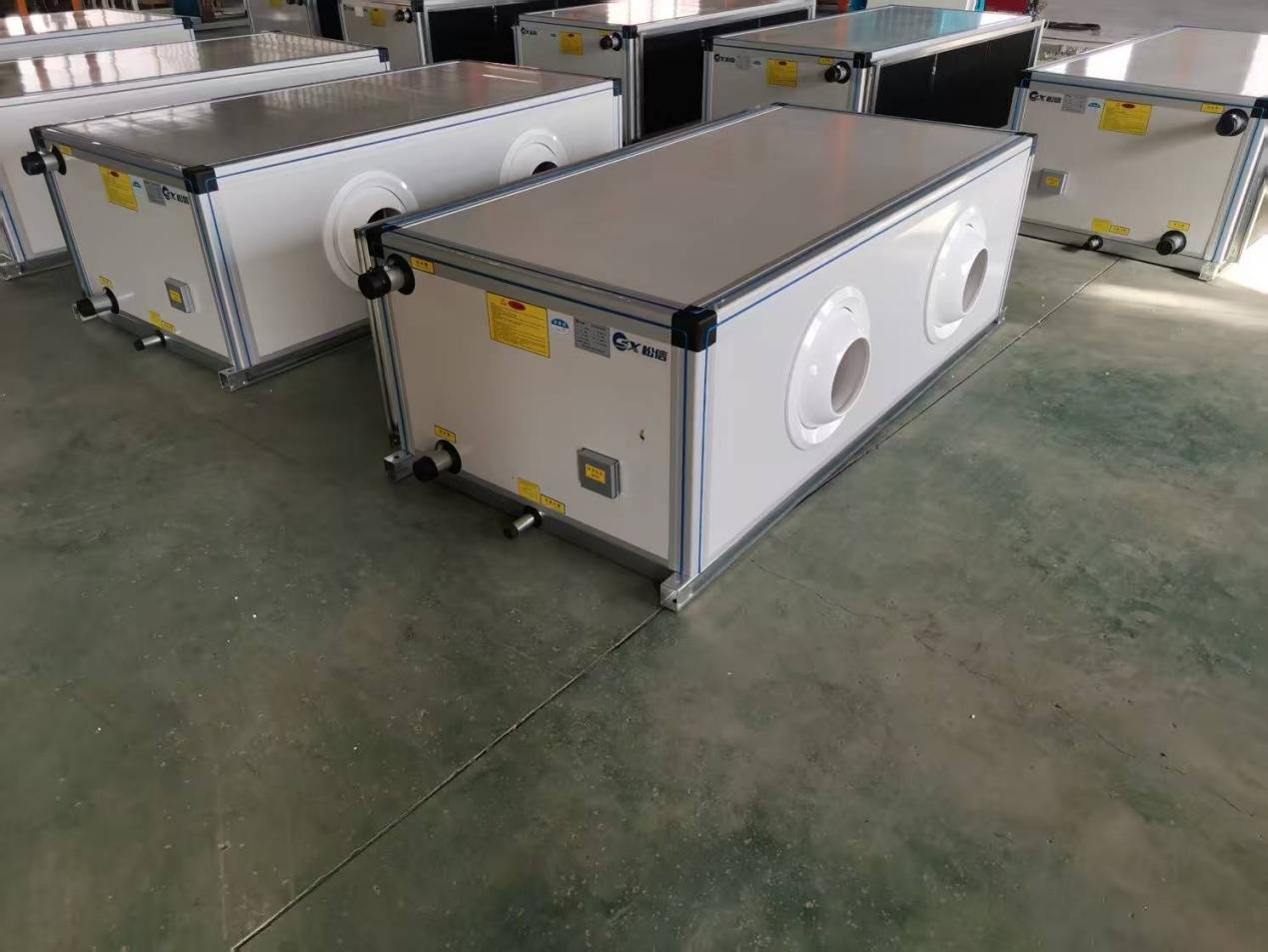
A modular air handling unit is an AHU made from configurable functional sections that handle ventilation, filtration, cooling, heating, humidity control, air mixing, heat recovery, sound control and air delivery. Instead of one fixed structure, the unit is built around the project’s requirements.
A modular AHU is the right choice when a standard unit cannot fully match the project. It lets engineers combine the exact sections needed into one coordinated air-side system, with an aluminum-frame, IP54-rated, low-leakage casing suited to demanding environments.
For very tall or large-volume spaces, SongXin also offers a dedicated high and large-space AHU. In projects where individual zones also need local comfort, modular AHUs handle fresh air while fan coil units serve each room.
SongXin Modular AHU Range
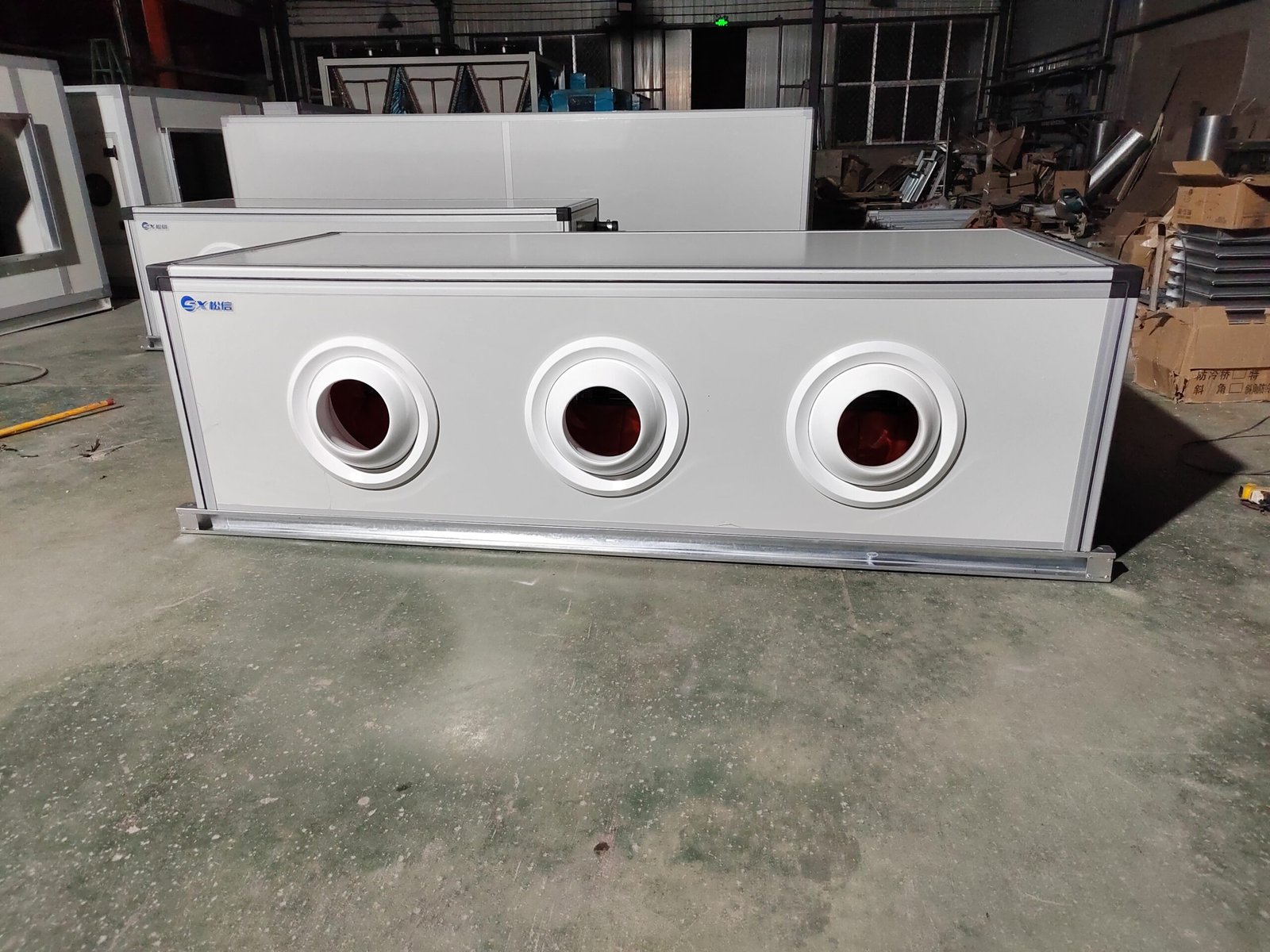
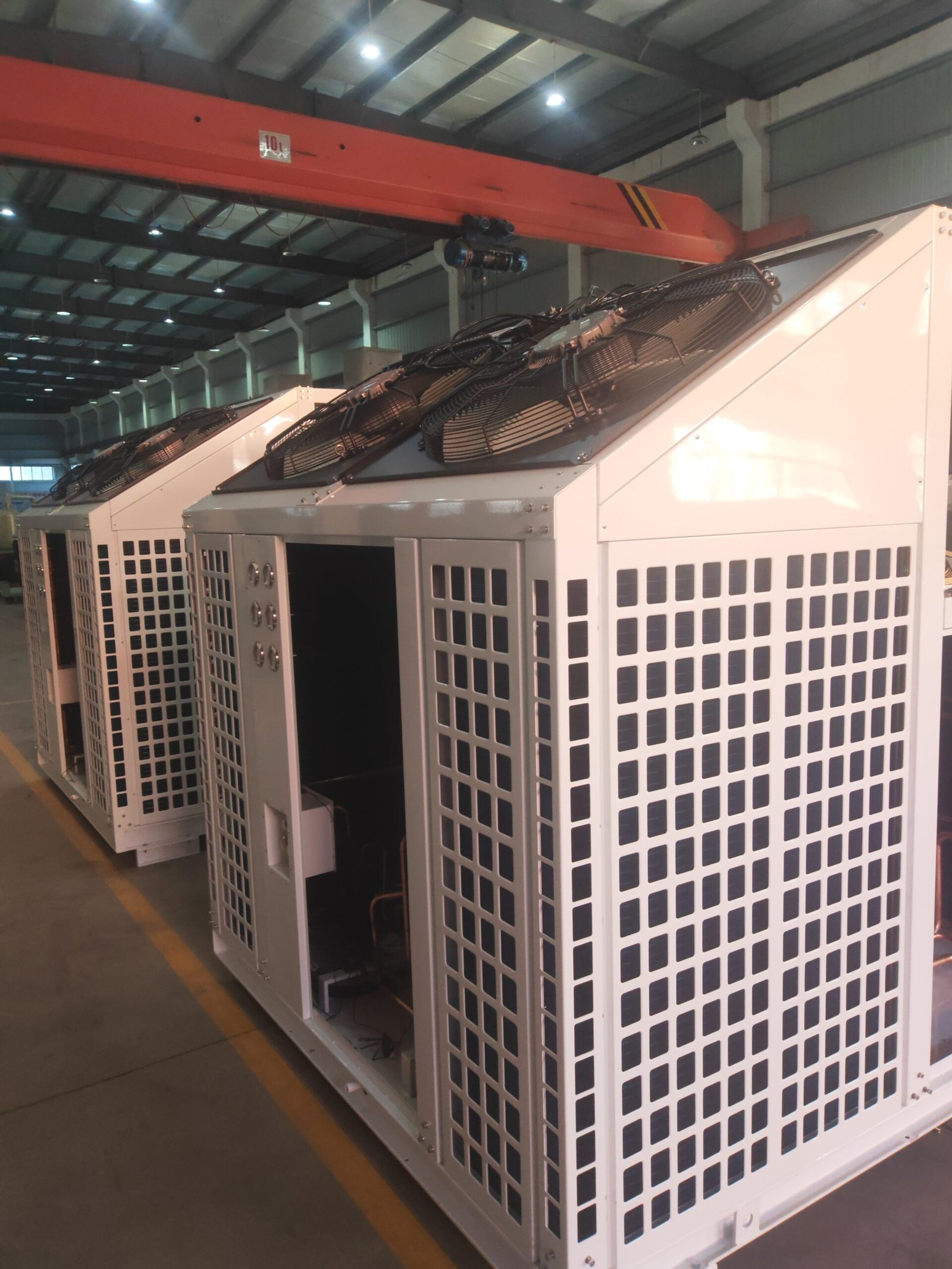
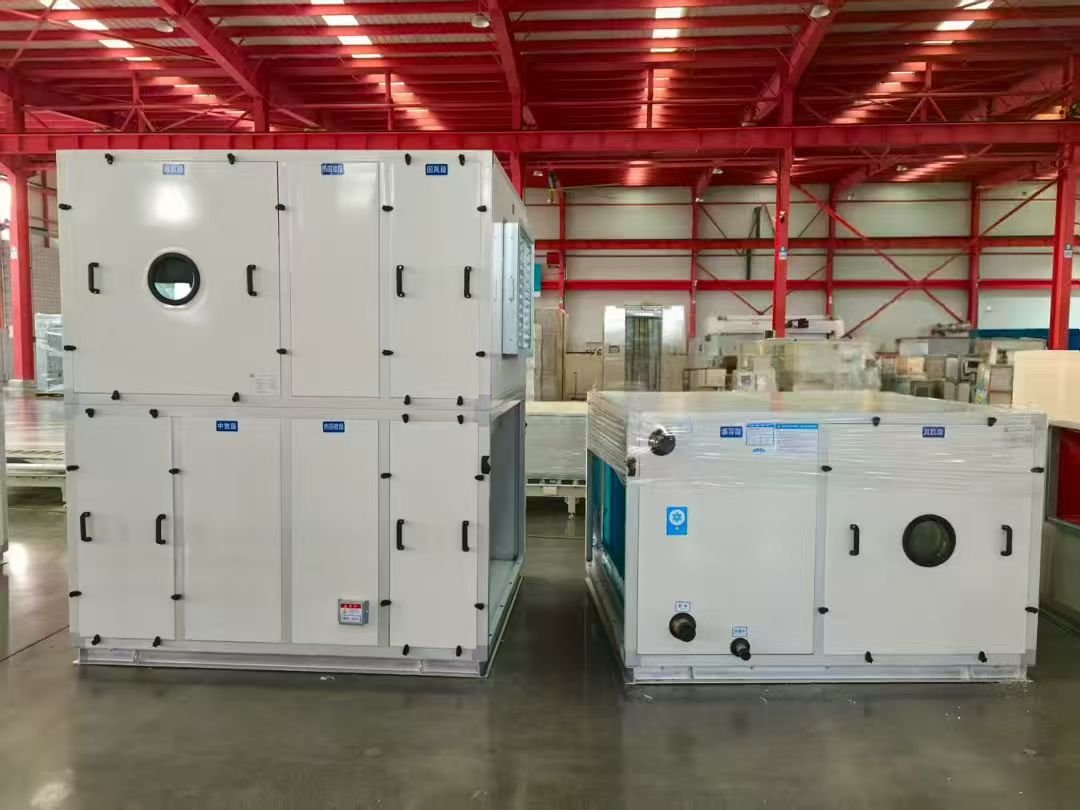
| AHU Frame | Airflow | Cooling Capacity | Noise | Best For |
|---|---|---|---|---|
| Ceiling-suspended | 1,000–20,000 m³/h | 12–196 kW | ≤68 dB(A) | Offices, shopping malls, smaller rooms |
| Vertical | 2,000–40,000 m³/h | 18–610 kW | ≤75 dB(A) | Large halls, factories, exhibition centers |
| Horizontal | 2,000–40,000 m³/h | 18–610 kW | ≤75 dB(A) | Basements, technical rooms, low-ceiling spaces |
Cooling capacities depend on coil rows, water or refrigerant conditions and air conditions. Final selection should always be confirmed at the project’s entering-air and water conditions.
Common Modular AHU Sections
Not every project needs every section. SongXin matches the section arrangement to the actual application.
Casing, Frame and Leakage
The casing is a functional part of AHU performance, not just an enclosure. For humid export markets, casing insulation and leakage control directly affect condensation risk and energy use, so they should be specified rather than assumed.
Resists corrosion in humid and coastal climates; lighter than steel for easier installation.
Controls heat gain/loss and prevents external condensation on casing surfaces.
Protects pressure relationships, air quality and energy balance — critical for cleanroom and hospital applications.
Dust and water ingress resistance for demanding environments including rooftop, basement and outdoor-adjacent installations.
Modular AHU vs Standard AHU
| Factor | Modular AHU | Standard AHU |
|---|---|---|
| Configuration | Built from project-specific sections | Fixed or limited structure |
| Best use | Larger, technical or custom projects | Simple comfort ventilation |
| Filtration | Multi-stage possible | Usually limited to one or two grades |
| Coil options | Chilled water, DX, hot water, steam or electric | Depends on standard model |
| Maintenance access | Planned by section layout | Often fixed; may be limited |
| Engineering input | Requires more project data for accurate selection | Faster for simple, standard needs |
Key Selection Data for a Modular AHU
| Selection Item | Why It Matters |
|---|---|
| Airflow | Decides AHU size and fan selection |
| External static pressure | Ensures the fan overcomes duct, filter and diffuser resistance |
| Fresh air ratio | Affects coil load, ventilation and energy use |
| Cooling source | Chilled water, DX coil or other — defines coil and circuit design |
| Heating source | Hot water, steam, electric or heat pump — defines heating section |
| Entering/leaving air conditions | Required for coil sizing and humidity control |
| Filter grade | Affects air quality, pressure drop and maintenance frequency |
| Humidity requirement | Decides coil design, reheat or humidification sections |
| Casing requirement | Affects leakage, insulation, strength and corrosion resistance |
| Noise limit | Important for hotels, offices, hospitals and public buildings |
| Installation space | Determines section arrangement and service access planning |
| Control requirement | Local control, BMS interface, sensors and actuator logic |
Engineering Selection Workflow
See SongXin’s air handling unit supplier page for configuration and selection details. The core steps:
-
Confirm airflow. Based on ventilation requirement, cooling load, occupancy, air changes or process requirement. Express clearly in m³/h, CFM or L/s.
-
Confirm external static pressure. To overcome ducts, filters, dampers, coils, silencers and terminals. Underestimating ESP means the AHU under-delivers after installation.
-
Confirm air conditions. Entering and leaving temperature and humidity, plus chilled-water or DX conditions, for coil selection and psychrometric analysis.
-
Confirm filtration grade. Sets indoor air quality, pressure drop and maintenance interval. Must match the application (office, hospital, cleanroom, etc.).
-
Confirm layout and access. Fit the mechanical room, roof or ceiling space, with coil pull, filter and drain access planned before production begins.
Airflow, Static Pressure and Fan Selection Logic

A correct fan selection considers design airflow and total pressure — not airflow alone. Internal pressure drop comes from filters, coils, heat recovery, dampers, mixing boxes, humidifiers, silencers and internal transitions. External static pressure comes from supply and return ducts, diffusers, fire and volume dampers and terminal devices.
Coil Selection and Psychrometric Requirements
Cooling-coil selection depends on air conditions and water or refrigerant conditions. SongXin needs entering-air dry-bulb and wet-bulb (or relative humidity), leaving-air target, chilled-water supply/return temperature and face velocity to size the coil correctly.
Face velocity must also be controlled to avoid water carryover, wet filters and hygiene problems. The coil section must be coordinated with the chilled-water supply temperature, flow and pressure drop.
Filter Strategy and Pressure Drop Control
Higher filter grades improve air quality but increase pressure drop and maintenance. Always specify both initial and final (dirty-filter) pressure drop — a fan sized only for clean filters loses airflow after a few weeks of operation.
Application-Specific Recommendations
Prioritise comfort, ventilation, noise and energy efficiency. Ceiling-suspended or horizontal frames with medium filtration, low-noise fans and BMS control.
Stronger filtration, hygienic casing, drainage design and humidity control. Pressure-relationship management between zones is critical.
Corrosion-resistant casing, higher-pressure fans, special filtration and rugged panels for factories and process environments.
Low noise is paramount for guest rooms and public areas. Maintainability and reliable drainage are equally important for fresh-air systems.
Procurement Risks in Modular AHU Projects
-
Selecting by airflow only. Static pressure, coils, filters, casing and controls make two same-airflow AHUs perform very differently on site.
-
Underestimating filter pressure drop. Filters add resistance as they load; the fan must be sized for realistic dirty-filter conditions.
-
Weak condensate drainage design. Cooling coils produce condensate; poor drain-pan and drainage design causes carryover, leakage and hygiene issues.
-
No service space. Filters, coils, fans and motors need access, or maintenance becomes difficult and costly after installation.
-
Poor coordination with the chiller or DX system. The coil must match chilled-water temperature, flow, DX circuit or heat-pump conditions. See water-cooled chiller selection.
Why Choose SongXin as Your Modular AHU Supplier
SongXin has manufactured commercial and industrial HVAC equipment since 2009, with multiple production bases, national-level testing laboratories (verified from −40°C to +55°C) and more than 100 patents.
ISO 9001:2015, ISO 14001:2015, CE, AHRI, RoHS and 3C with test reports and traceability for tender and project approval.
Performance, pressure/leak and noise testing before every shipment; no exceptions for custom units.
Mixing, filter, chilled-water/DX/steam/electric coils, humidifier, heat recovery, silencer, access and control sections; IP54 aluminum frame; OEM/ODM branding.
Free pre-sales selection, CAD drawings, air- and water-side data, and project design guidance — typical 24-hour response to technical inquiries.
Export and Logistics for Overseas Buyers
| Item | Detail |
|---|---|
| Power supply | 380/400/415V 3Ph 50/60Hz standard; other voltages on request |
| Trade terms | EXW, FOB, CIF and DDP |
| Lead time | Confirmed per project — custom modular AHUs are production-scheduled at order |
| Packaging | Reinforced export-standard protection; large units shipped in coordinated sections |
| Payment | T/T, L/C, or Western Union for small orders; typically 30% deposit, 70% balance before shipment |
| Documentation | Test reports, compliance records and serial traceability for customs and approvals |
Because modular AHUs are large, section arrangement, container loading and on-site reassembly should be discussed early. SongXin coordinates packing and section breakdown for long-distance shipment.
Modular AHU Specification Language for RFQ
Define the AHU by performance, not just model name. A complete specification prevents buyers from comparing a robust modular AHU against a basic low-price box:
- Design airflow and tolerance; external static pressure at design airflow
- Cooling coil entering/leaving air conditions and chilled-water supply/return temperatures
- Heating coil source (hot water, steam, electric) and winter design conditions
- Filter grade, arrangement and access side (front, side or rear)
- Fan type, motor power, drive type and speed control requirement
- Casing: indoor/outdoor, insulation value, leakage class, corrosion resistance
- Noise limit or acoustic treatment (sound power or pressure level)
- Controls: local panel, BMS interface type, sensor scope
- Service door direction and coil/filter pull clearance
- Factory testing scope and required documentation
Frequently Asked Questions
Standards and Review Notes
Author: SongXin HVAC engineering content team. Updated: July 1, 2026. Technical review: modular AHU airflow, coil, filtration, casing and RFQ requirements reviewed by SongXin HVAC application engineering.
Final AHU selection should be based on the project schedule of airflow, external static pressure, filter grade, coil conditions, leakage requirement and service access. The references below provide engineering context; local code and approved project submittals remain the controlling documents.
- ANSI/ASHRAE Standard 62.1 for ventilation and indoor-air-quality design context.
- ISO 16890-1:2016 for general-ventilation air-filter classification context.
- ANSI/AMCA 210 / ASHRAE 51 for fan aerodynamic performance rating context.
- SongXin certification and compliance records for company-level ISO, CE, AHRI, RoHS and 3C evidence used on this page.

SongXin HVAC Equipment Co., Ltd. is a global manufacturer of commercial and industrial HVAC systems, manufacturing since 2009 and supplying projects in 40+ countries. The range covers modular air handling units, high and large-space AHUs, fan coil units, water-cooled chillers, heat pumps, DX and VRF systems and precision cooling.
SongXin supports project buyers with selection discussion, technical data, certification documents, export packing and delivery coordination.
Request Modular AHU Selection
Send your airflow, static pressure, coil conditions, filter grade and installation layout. SongXin will review your project data and recommend a modular AHU configuration within 24 hours.
Quick start: Not ready for a full RFQ? Just send three things — project location, building or process type, and design airflow in m³/h (or room/area to estimate it).
Quotation note: Prices are project-based and confirmed after SongXin reviews airflow, static pressure, coil conditions, filter grade, casing specification, quantity, destination and documentation requirements.
Get in Touch