


DX Air Handler RFQ Checklist: Airflow, ESP, Coil & Controls
An RFQ checklist for industrial buyers — airflow, ESP, DX coil sizing, filtration, controls, the DX-vs-chilled-water decision, and a real project case study.
A direct expansion air handler is the right choice when the project needs air treatment and DX refrigeration in one engineered package instead of a simple comfort air conditioner. It suits factories, equipment rooms, laboratories, clean support areas, temporary industrial buildings and retrofit spaces where chilled water is not available or the project wants a simpler standalone system.
For buyers, selection should start with cooling load, airflow, external static pressure, fresh-air ratio, filtration level, humidity target, outdoor ambient temperature and service access. A low-price unit with the wrong fan pressure or coil condition will fail because the air side and refrigerant side are not matched.
This guide connects the selection logic to SongXin’s direct expansion unit, air handling unit, air handling unit supplier catalog and the DX unit load calculation worksheet.
Start HereQuick Answer for Buyers
A direct expansion air handler should be selected when a standard DX unit cannot meet the project’s air-side requirements. Choose it when the space needs ducted air distribution above 500 Pa ESP, outdoor air above 20%, special filtration such as ISO 16890 ePM1 class, or humidity control coordinated with coil leaving-air temperature.[1]
The practical rule is simple: use a packaged DX unit for straightforward comfort cooling, and use a DX air handler when the air path is the project risk. The air handler gives more control over coil face velocity, fan selection, filters, drain pan, casing, mixing box and controls — and that control matters because pressure drop, wet-coil behavior and condensate drainage can reduce real capacity even when the compressor size looks correct.
- Cooling load < 35 kW + ESP < 300 Pa → packaged DX or DX rooftop unit
- Cooling load 35–600 kW + ESP 500–1200 Pa + ducted air → DX air handler (this guide)
- Multiple zones, central plant, or run hours > 4000 → compare with air-cooled screw chiller + AHU
Decision LogicWhen a Direct Expansion Air Handler Fits
A direct expansion air handler fits projects where air treatment is more important than only nominal cooling capacity. It combines an evaporator coil using direct refrigerant expansion with AHU sections for fan, filter, mixing, drainage, casing and control logic.
| Project condition | Better fit | Decision rule |
|---|---|---|
| Basic room cooling below 300 Pa ESP | Packaged DX or split DX | Use a simpler DX unit when duct resistance is low. |
| Ducted industrial air above 500 Pa ESP | Direct expansion air handler | Select AHU fan and coil together because fan heat and pressure drop affect capacity. |
| Fresh air above 20% of supply airflow | DX air handler with mixing & dehumidification review | Outdoor air adds sensible and latent load, which changes coil duty. |
| Filter pressure allowance above 150 Pa | Direct expansion air handler | Filters must be included in the external static pressure budget.[1] |
| Process support or clean support room | DX air handler or process AHU | Use AHU sections for filtration, access, drain pan and control stability. |
This matrix matters because a direct expansion air handler is not just a bigger indoor unit — the coil, fan and refrigerant circuit must work as one system. If a filter bank loads from 80 Pa clean pressure to 200 Pa final pressure, airflow can drop because the fan operating point moves left on the fan curve.
Product RangeSongXin DX Air Handler Configurations
SongXin’s air handling unit production line covers three main DX-ready configurations. Each is built on an aluminum-frame, polyurethane-foamed galvanized panel casing with copper-aluminum coils, 100% leak-tested and assembled under ISO 9001 quality management.[9]
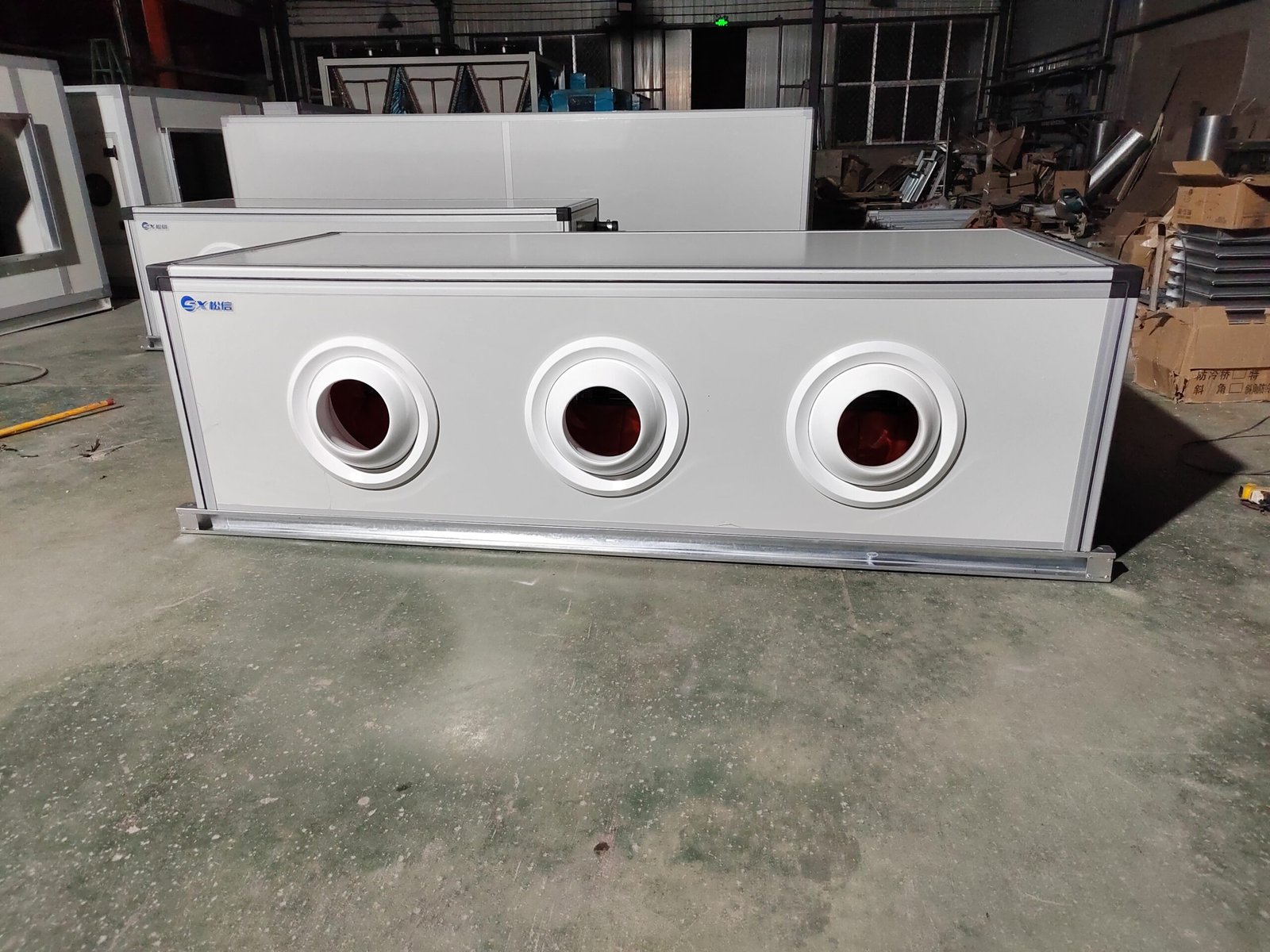
Ceiling-suspended DX AHU
Offices, retail and small workshops; saves floor space with a low-profile suspended design.
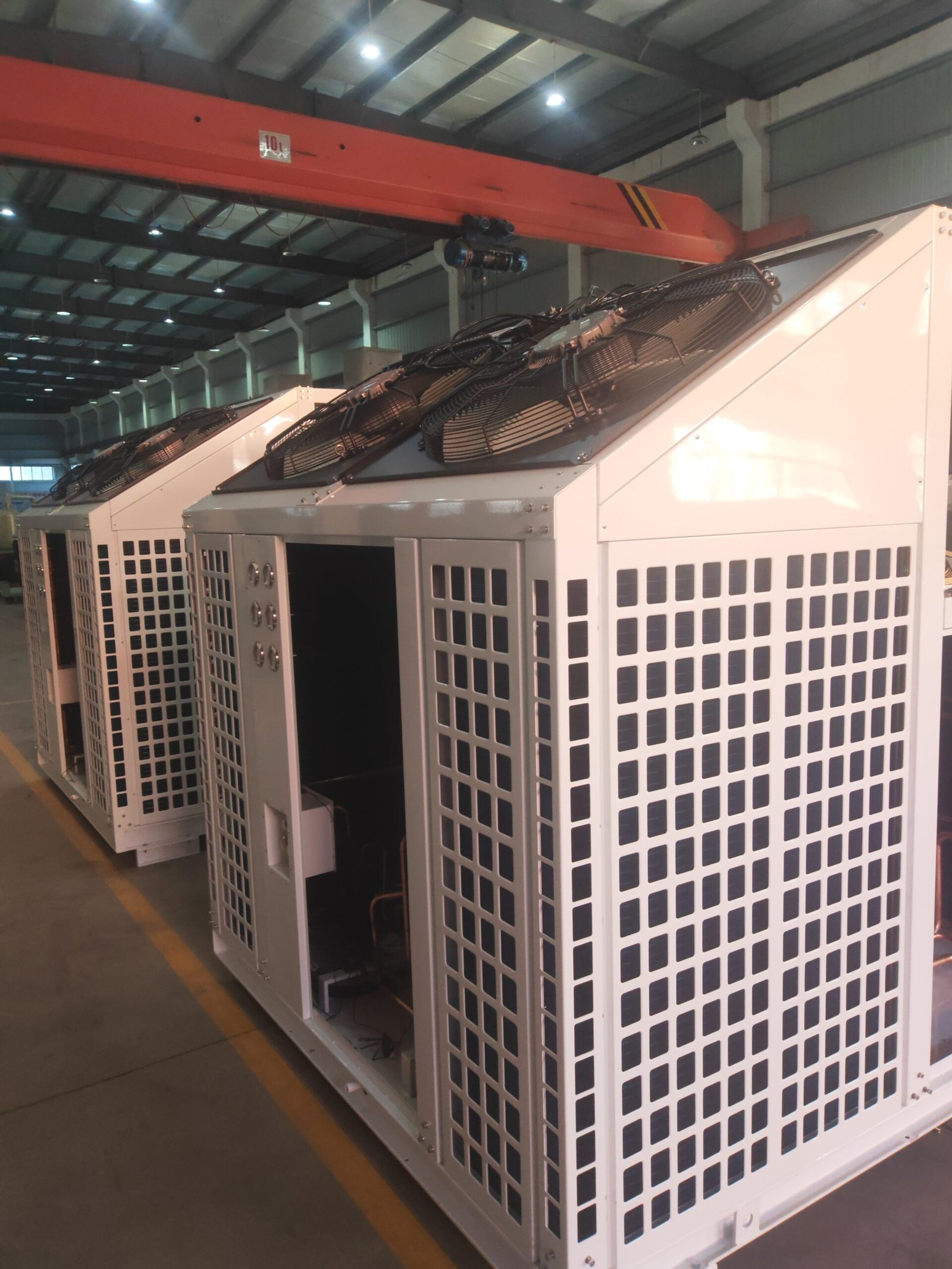
Vertical DX AHU
Halls, factories and exhibition centers; powerful airflow for open floor areas.
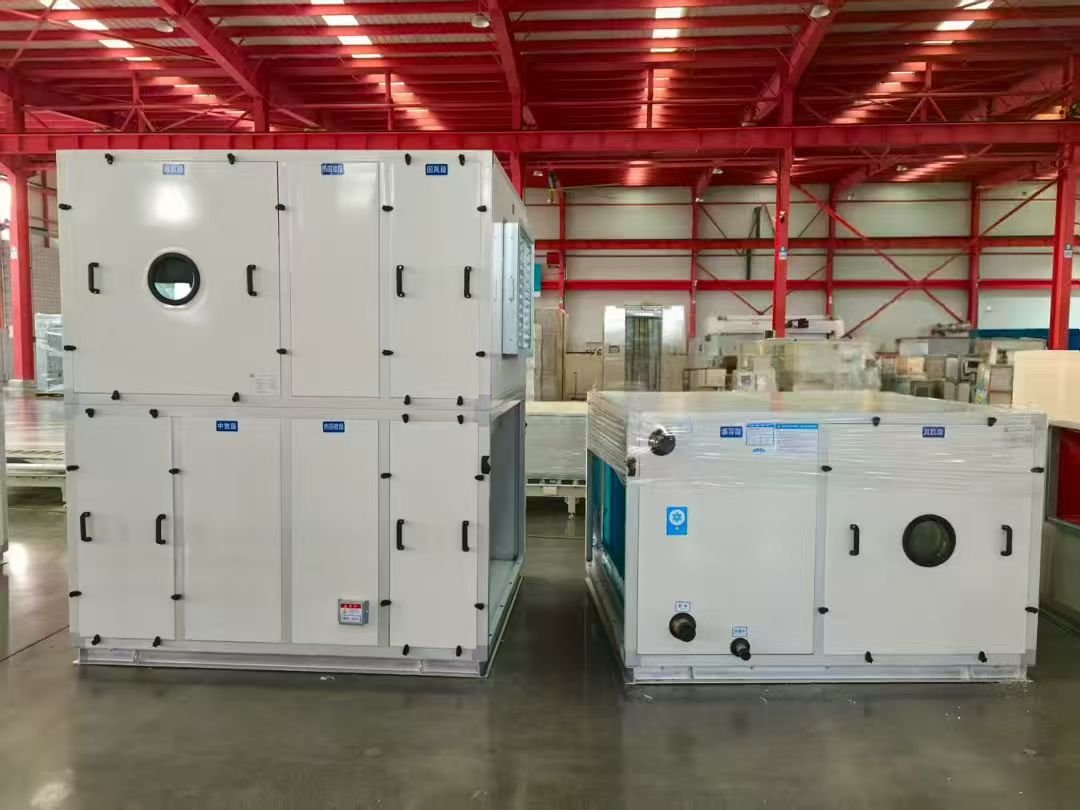
Horizontal DX AHU
Basements, technical rooms and low-ceiling plant rooms where height is limited.
All three platforms can be specified with multi-stage filtration (panel / bag / HEPA), optional UV sterilization, IP54 protection and IoT-ready BMS controls. Energy efficiency on optimized configurations reaches 94%, with reference projects across 40+ countries and reported uptime around 99.8%.[9]
Cross-reference: see modular air handling unit supplier for split-shipment large units, and modular AHU selection guide when site access limits transport size.
RFQ FoundationsCore Selection Parameters
A reliable direct expansion air handler RFQ should define the real operating envelope before model selection. The supplier needs air-side data and refrigerant-side data, not only the room area.
| Parameter | Practical value to send | Why it changes selection |
|---|---|---|
| Total cooling load | kW or RT at design condition | Sets compressor and DX coil duty. |
| Sensible heat ratio | 0.70–0.90 for comfort / light industrial rooms | Lower SHR means more latent load and more condensate. |
| Supply airflow | m³/h or L/s | Determines coil face velocity and room air distribution. |
| External static pressure | 300–1200 Pa for ducted industrial AHU projects | Drives fan motor, casing leakage and noise. |
| Fresh-air ratio | 0–30% for mixed-air projects | Outdoor air adds heat and moisture to the coil. |
| Filtration class | ISO 16890 coarse, ePM10, ePM2.5 or ePM1 | Higher filtration increases pressure drop. |
| Outdoor ambient | 35 °C, 43 °C or 46 °C design dry-bulb | Hot condenser air reduces DX refrigeration margin. |
| Maintenance interval | 1–3 months (filters); 6–12 months (major inspection) | Access panels and filter sections must match service reality. |
Numbers should be distributed across the air side, refrigeration side and maintenance plan because one missing value can change the final configuration. A 90 kW air handler at 600 Pa ESP is not the same selection as a 90 kW air handler at 1000 Pa ESP.
The Heart of the UnitDX Coil Sizing: Face Velocity, Rows & Fin Spacing
The DX coil is the bridge between the air side and the refrigerant side. Three coil parameters drive whether the unit will reach its nameplate capacity in the room.
| Coil parameter | Typical range for DX AHU | Engineering effect |
|---|---|---|
| Face velocity | 2.0–2.6 m/s (comfort); 2.6–3.0 m/s (industrial) | Above 2.8 m/s on a wet coil → condensate carry-over; below 2.0 m/s → larger casing, higher cost. |
| Coil rows | 4–8 rows for DX | More rows = higher capacity and lower SHR, but higher air pressure drop. |
| Fin spacing | 1.8–2.5 mm pitch (12–14 FPI) | Tighter fins increase heat transfer but trap more dust and raise cleaning frequency. |
| Refrigerant circuiting | Interlaced (multi-compressor); face-split (staged) | Interlaced circuiting helps keep coil temperature uniform at part load. |
| Coil pressure drop (dry) | 80–180 Pa | Must be added to the fan ESP budget before filters and ductwork. |
A practical buyer’s check: if the supplier quotes the coil at 3.2 m/s face velocity to “fit a smaller cabinet”, ask for the wet-coil carry-over test result. SongXin’s coil section follows 100% leak and pressure tests before assembly, and selection sheets state face velocity, rows, fin pitch and dry/wet pressure drop on every offer.[9]
Worked ExampleAirflow, ESP & Coil Screening
A simple calculation helps the buyer see whether a direct expansion air handler is needed. Assume an industrial support room has 96 kW total load, 72 kW sensible load and a target supply-air temperature difference of 10 K.
Supply airflow
Formula: supply airflow = sensible load / (1.2 × 1.006 × ΔT). Substitution: 72 / (1.2 × 1.006 × 10) = 5.96 m³/s → ×3600 = 21,456 m³/h.
Sensible heat ratio check
SHR = 72 / 96 = 0.75. This is mixed sensible/latent load, so the coil must be specified for dehumidification, not just sensible cooling.
Fan ESP budget
| Pressure component | Allowance (Pa) |
|---|---|
| Duct system (supply + return) | 650 |
| Filter final pressure (ePM1) | 180 |
| Coil (wet) | 120 |
| Casing, mixing box, dampers | 50 |
| Fan total pressure target | 1,000 |
Coil face area
Target face velocity 2.5 m/s → required face area = 5.96 / 2.5 = 2.38 m² (e.g. 1.45 m × 1.65 m). This rules out a small ceiling unit and moves selection to a vertical or horizontal DX AHU in the 21,000–25,000 m³/h band — within SongXin’s 18–610 kW range.[9]
RFQ recommendation
Request a direct expansion air handler with about 21,456 m³/h airflow, 96 kW total cooling duty (SHR 0.75), 1,000 Pa fan total pressure target, plus the outdoor design temperature, filter class and condensate drainage requirement.
For this 96 kW industrial support room, the first red flag was not compressor size — it was the 1,000 Pa fan-pressure target paired with ePM1 filtration. Three of five bidders had quoted fans rated at clean-filter pressure only, which would have lost about 15% airflow within six months of filter loading.
By Room TypeConfiguration Matrix
A direct expansion air handler should be configured by room duty, not by a generic catalog name. The matrix below gives a buyer-facing starting point.
| Application | Airflow/ESP focus | Filtration & coil focus | Inspection interval | Typical lifecycle risk |
|---|---|---|---|---|
| Equipment room | 300–700 Pa ESP | Medium filtration, stable cooling | Filter every 1–3 months | Heat buildup from continuous equipment load. |
| Factory support room | 500–1000 Pa ESP | Higher dust allowance, washable prefilter | Filter every 1 month (dusty) | Airflow loss as filters load faster than expected. |
| Laboratory support area | 600–1200 Pa ESP | Better casing, drain pan, control accuracy | Coil & drain every 3–6 months | Condensate / humidity drift if latent load underestimated. |
| Temporary industrial building | 300–800 Pa ESP | Rugged casing, fast access | Filter every 1–2 months | Hot-weather derating from harsher condenser air. |
| Clean support space | 800–1200 Pa ESP | ISO 16890 ePM1 or higher class | Filter DP monthly; full check 6 months | Pressure-drop rise if fine filters selected without fan margin. |
The key mechanism is pressure loss. Filters, coils and ducts convert fan energy into pressure drop. As resistance increases, airflow falls, and lower airflow can reduce sensible capacity because less room air passes across the coil.
Cost DecisionDX Air Handler vs Chilled Water AHU
Many buyers ask whether a DX air handler is “cheaper” than a chilled-water AHU. The honest answer: only when the project is small or standalone. Once the building has multiple zones, central energy management, or run hours above ~4,000 per year, chilled water usually wins on lifetime cost.
The table below is a procurement-planning model for a single 96 kW load running 2,500 vs 5,000 hours per year. Use it as a screening tool; replace with site-specific quotes before purchase.
| Cost element | DX air handler (single package) | Chilled-water AHU + central chiller |
|---|---|---|
| CAPEX – equipment | Lower (one supplier, one package) | Higher (chiller + AHU + pumps + piping) |
| CAPEX – installation | Lower (refrigerant lines only) | Higher (insulated water piping, pumps, expansion) |
| CAPEX – controls | Standard BMS integration | Plant control + zone control |
| Energy efficiency (full load) | Good for standalone (94% AHU efficiency)[9] | Better at part load with VFD pumps + screw chiller IPLV |
| Refrigerant charge | Higher (long DX lines) | Lower (refrigerant stays in chiller) |
| Maintenance access | One unit, one trade | Multiple trades, but central plant easier to service |
| Best ROI window | 1–3 zones, run hours < 3,500 / yr | 4+ zones or run hours > 4,000 / yr |
| Typical lifetime | 12–15 years | 15–20 yrs (chiller) + 15–20 (AHU) |
Procurement guidance. For a single 96 kW industrial support room at 2,500 hrs/yr, a DX air handler is usually right. For a campus of 6 zones × 80 kW running 5,000 hrs/yr, the air-cooled screw chiller + multiple AHU layout (see the 50 ton air-cooled screw chiller selection guide) is the safer long-term choice. On the boundary, ask the supplier to quote both and compare 10-year total cost.
Climate DeratingHigh-Ambient & Part-Load Behavior
DX systems lose capacity as outdoor ambient temperature rises, because condenser heat rejection becomes harder. This is a critical RFQ point in Middle East, South Asia and African projects.
| Outdoor design ambient | Capacity factor vs 35 °C | RFQ implication |
|---|---|---|
| 35 °C | 1.00 (baseline) | Standard rating point |
| 43 °C | ~0.90 – 0.93 | Specify high-ambient compressor + larger condenser |
| 46 °C | ~0.85 – 0.88 | Confirm continuous operation, not derated trip |
| 50 °C+ | ~0.78 – 0.82 | Special compressor selection; review with engineering |
A common mistake is rating the unit at 35 °C and installing it in a 46 °C climate. The same dynamic applies to air-cooled chillers — see air-cooled screw chiller ambient temperature capacity for the equivalent chiller behavior. At part load, a DX air handler with multiple compressors and interlaced coil circuiting keeps coil temperature uniform; single-compressor DX units cycle on/off, causing humidity swing and reduced equipment life. For continuous-process rooms, request a minimum 2-stage compressor configuration.
Send ThisRFQ Data & Specification Checklist
A direct expansion air handler RFQ should make the supplier responsible for a measurable operating point. Send the data below when asking SongXin for engineering support or a quote.
- Cooling load in kW or RT, split into sensible and latent load if available.
- Required supply airflow in m³/h, L/s or CFM.
- External static pressure target, including duct, filter, coil and diffuser allowance.
- Outdoor design dry-bulb temperature and installation altitude.
- Indoor temperature, relative humidity target and fresh-air ratio.
- Filter class, final pressure allowance and replacement interval.
- Power supply, control requirement, BMS protocol and alarm output.
- Casing material, corrosion exposure, drainage route and service clearance.
- Shipping terms (EXW / FOB / CIF / DDP) and target delivery week.
Specification checklist
| Item | Minimum answer before purchase |
|---|---|
| Rated capacity | Capacity at project outdoor ambient and indoor entering-air condition. |
| Airflow and ESP | Airflow delivered at the specified external static pressure (not clean-filter only). |
| Coil data | DX coil circuiting, face velocity, rows, fin pitch, condensate load and drain pan material. |
| Filter data | ISO 16890 class, clean pressure and final pressure allowance. |
| Casing | Aluminum frame, panel construction, insulation, IP rating, leakage class. |
| Safety basis | ISO 5149-1, ISO 5149-2 and ISO 817 alignment where required. |
| Certifications | ISO 9001 (manufacturing); CE for EU; AHRI rating basis; ASHRAE alignment.[10] |
| Test reports | Airflow + pressure drop + noise + leakage rate, per-unit. |
| Documents | Datasheet, wiring diagram, installation manual, O&M notes and packing list. |
When you send your project conditions, SongXin can compare a direct expansion air handler with a standard air handling unit supplier solution or with a chilled-water system using how to select a water cooled chiller and single screw vs twin screw chiller for plant-side selection.
Field StoryProject Case Study: 21,456 m³/h DX AHU

How the cheapest “96 kW DX” quote was not a 96 kW solution
Original spec: “96 kW DX rooftop, 21,500 CMH, ePM1 filtration.”
What the RFQ review found
- The 96 kW packaged rooftop was rated at 35 °C and 250 Pa ESP. At the site’s 38 °C and the real 1,000 Pa ESP target, delivered capacity would have dropped to roughly 78 kW, with airflow falling another ~12% as ePM1 filters loaded.
- SHR was actually 0.75 (latent load from outdoor air), not the 0.85 the rooftop catalog assumed — condensate drain sizing was wrong by a factor of 1.5.
- No mixing box in the rooftop — 25% fresh air would have entered unfiltered.
Final SongXin solution
- Horizontal DX air handler, 22,000 m³/h rated, 1,050 Pa fan total pressure at final-filter condition.
- 6-row DX coil, 2.2 mm fin pitch, interlaced circuiting for 2-stage capacity (50% / 100%).
- ePM1 filter section with 250 Pa final pressure budget.
- Mixing box with motorized fresh-air damper, BMS-controlled.
- Aluminum frame, polyurethane-foamed galvanized panel casing, IP54.
- 100% factory leak and airflow test per ISO 9001 procedure.[9]
The decision the project nearly missed: the cheapest “96 kW DX” quote was not actually a 96 kW solution at site conditions. This is the most common failure pattern in DX air handler procurement.
Avoid TheseCommon Mistakes
- Buying the compressor size and forgetting the fan. A 96 kW DX air handler that cannot deliver 21,456 m³/h at 1,000 Pa will not perform like a 96 kW system in the room.
- Ignoring fresh-air moisture. Outdoor air above 30 °C and 60% RH adds latent load, increasing condensate and pushing the coil toward a colder leaving-air condition. State the fresh-air ratio before the coil is finalized.
- Treating filtration as an accessory. Fine filters raise pressure drop because smaller particles need denser media or deeper banks. If the fan is selected only for clean-filter pressure, airflow falls as filters load.
- Using a DX air handler where chilled water is better. For a campus with 10+ large zones or continuous operation above 4000 hrs/yr, compare a chiller plant first — see SongXin’s air-cooled screw chiller content.
- Accepting a rating at 35 °C when the site is 43 °C or hotter. Always ask for the capacity table at the actual site design temperature — not the catalog reference.
Why It WorksWhy Buyers Choose Direct Expansion
Compact, one-package design
Reduces pumps, cooling towers and long water loops — useful where mechanical space is limited.
Fast response to load
Refrigerant cools the air coil directly, so the system reacts quickly to occupancy and demand changes.
Flexible installation
Ceiling, vertical and horizontal layouts match outdoor space, duct routing, power and ambient range.
Standalone reliability
A simpler standalone solution for site offices, equipment rooms and temporary buildings — no central plant required.
Easier maintenance
Easier to isolate and service than a large central system; one offline unit has limited impact.
Quick deployment
Factory-tested equipment shortens site work and commissioning — critical for tight project schedules.
ComplianceCertifications & Quality Documentation
A DX air handler is a regulated piece of equipment in most export markets. Ask for the supplier’s certifications before placing the order, not after delivery.
| Certification / standard | Scope | Why it matters for DX AHU procurement |
|---|---|---|
| ISO 9001 | Quality management system | Confirms documented design, production and inspection processes.[9][10] |
| CE marking | European market compliance | Required for EU sale; covers EMC, LVD and machinery directives. |
| AHRI 340/360 basis | Unitary equipment performance rating | Standard reference for capacity and EER/IEER comparison.[2] |
| ASHRAE 62.1 | Ventilation for indoor air quality | Aligns fresh-air ratio and filter class with design intent.[4] |
| ISO 16890 | Air filter classification | Defines coarse / ePM10 / ePM2.5 / ePM1 filter performance.[1] |
| ISO 5149-1 / 5149-2 | Refrigerating system safety | Covers refrigerant safety classification and installation.[5][6] |
| ISO 817:2024 | Refrigerant designation | Identifies refrigerant by safety group (A1, A2L, etc.).[8] |
| RoHS / REACH | Hazardous substance control | Required for many EU and international tenders.[10] |
| CCC | China compulsory certification | Required for sale within China for specific scopes.[10] |
| ATEX (optional) | Explosion-proof zone equipment | Required for petrochemical, oil & gas and some pharma rooms.[10] |
SongXin’s manufacturing follows ISO 9001 with 100% per-unit leak, pressure and airflow testing, supports CE-compliant builds for European projects, and keeps documentation aligned with AHRI, ASHRAE, RoHS and REACH frameworks for export tenders.[9][10] Detailed references and audit-ready files are on the certification and compliance page and quality control testing page.
Q & AFrequently Asked Questions
What is a direct expansion air handler?
When should I choose a DX air handler instead of a packaged DX unit?
When is a chilled-water AHU better than a DX air handler?
What RFQ data is needed for a direct expansion air handler?
How does a direct expansion air handler control humidity?
What airflow and capacity ranges does SongXin’s DX air handler cover?
Is a DX air handler suitable for industrial rooms?
What certifications should I ask the supplier to provide?
Related SongXin engineering resources
Continue your selection with these matched guides and product pages.
ReferencesSources
- ISO 16890-1:2016, “Air filters for general ventilation — Part 1,” iso.org/standard/57864.html
- AHRI 340/360, “Performance Rating of Commercial and Industrial Unitary Air-conditioning and Heat Pump Equipment,” ahrinet.org
- European Commission policy reference for EN 14511-2 rating conditions, ec.europa.eu
- ASHRAE Standard 62.1 and 62.2 overview, ashrae.org
- ISO 5149-1:2014, “Refrigerating systems and heat pumps — Safety and environmental requirements — Part 1,” iso.org/standard/54979.html
- ISO 5149-2:2014, “Refrigerating systems and heat pumps — Safety and environmental requirements — Part 2,” iso.org/standard/54980.html
- Engineering ToolBox, “Calculating Cooling Loads,” engineeringtoolbox.com
- ISO 817:2024, “Refrigerants — Designation and safety classification,” iso.org/standard/83452.html
- SongXin HVAC, “Air Handling Unit” product page, sxinhvac.com/products/terminal-units/air-handling-unit/
- SongXin HVAC, “Certification and Compliance” overview, sxinhvac.com/company/certification-and-compliance/