An 8-step engineering method covering load, water temperatures, tower coordination, part-load and controls — built on real SongXin chiller capacity and compressor data.
Selecting a water-cooled chiller is not only a capacity calculation. The final performance depends on cooling load, chilled-water temperature, condenser-water temperature, cooling tower conditions, water flow, compressor type, part-load operation, controls, water treatment and the real application.
This guide explains how to select a water-cooled chiller for commercial HVAC and industrial process cooling. It is written for buyers, contractors, consultants and facility teams preparing to request a quotation, and uses real data from SongXin’s chiller lineup so the selection logic maps to actual equipment. For supplier capability, model range and procurement context, see Water-Cooled Chiller Supplier Selection for Industrial Cooling.
To select a water-cooled chiller, first confirm the real cooling load, then define chilled-water supply/return temperature, condenser-water entering/leaving temperature, chilled-water and condenser-water flow, application type, operating schedule, cooling tower conditions, power supply, control requirements and maintenance plan. Do not select by nominal tonnage alone, and match the chiller with the full plant — cooling tower, pumps, AHUs, fan coil units, pipe system, water treatment and controls.
For commercial HVAC, comfort, energy efficiency, part-load performance and BMS integration matter most. For industrial process cooling, temperature stability, operating hours, fluid conditions, redundancy and downtime risk may matter more.
Water-cooled chiller selection requires cooling load, chilled-water supply/return temperature, condenser-water
entering/leaving temperature, chilled-water and condenser-water flow, cooling tower conditions, application
type, part-load profile, power supply, controls and maintenance planning. The early flow check is
chilled-water flow (m³/h) = cooling capacity (kW) / (1.163 × ΔT °C). Water-cooled screw chillers
suit medium to large loads (SongXin 190–3600 kW, screw compressor, flooded or falling-film evaporator);
centrifugal water-cooled chillers suit very large central plants (350–2000 kW, peak COP up to 6.6 kW/kW). Both
must be coordinated with cooling towers, pumps, water treatment and building controls. Nominal tonnage
alone is not enough for final selection.
Send cooling capacity in kW or refrigeration tons, chilled-water supply/return temperature, condenser-water entering/leaving temperature, tower condition, water flow, application, operating hours, voltage, BMS protocol, redundancy requirement and site location.
Define the real cooling duty first. For commercial HVAC, use the building load calculation; for process cooling, use the process heat load, target fluid temperature and operating schedule. Include sensible and latent building load, fresh air load, process and equipment heat, a justified safety margin and any future expansion. Avoid large safety factors without engineering reason — oversized chillers cost more and run poorly at part load.
Chilled-water temperature directly affects capacity and efficiency. A common comfort condition is around 7/12 °C, but many projects differ. Confirm supply and return temperature, the resulting ΔT (which sets pump flow and pipe size), any process-fluid requirement, and the minimum operating temperature for anti-freeze or glycol planning. Lower temperatures reduce efficiency and may require special evaporator or compressor selection.
One of the most important inputs for a water-cooled chiller, because the chiller rejects heat to condenser water and the tower rejects it to outdoor air. Confirm entering and leaving condenser-water temperature, condenser-water flow, cooling tower design wet-bulb, any existing tower condition, the water treatment plan and tower location/airflow. If the tower cannot deliver the assumed temperature, the chiller loses capacity or uses more power.
Match the chiller type to the project — see the type-comparison and real product range in section B below. At 1000–2000 kW both a screw and a centrifugal can fit, so the decision turns on operating hours and part-load profile: screw chillers are practical and easy to maintain for stable loads, while variable-speed centrifugals reward plants with many part-load hours.
Most buildings rarely run at full load. Ask how the chiller unloads, its part-load performance, whether multiple chillers can be staged, its minimum stable load, and how the control system handles changing demand. SongXin offers inverter screw and variable-speed centrifugal options that improve real annual energy use. For large projects, part-load performance often matters more than full-load efficiency.
A chiller plant is more than the chiller. Coordinate chilled-water and condenser-water pumps, cooling towers, AHUs, fan coil units, valves and balancing, expansion tanks, water treatment, the BMS and the pipe network. Poor system coordination makes a good chiller perform badly.
Confirm local control panel, fault alarms, chilled-water temperature control, pump interlock, cooling tower fan control, multi-chiller staging, remote monitoring, BMS communication and energy monitoring. SongXin chillers ship with a microprocessor controller and are BMS-ready; confirm the protocol your project requires.
Before ordering, review plant-room space and clearance, tube-cleaning access for shell-and-tube heat exchangers, the lifting and delivery route, foundation and vibration, water connections, electrical cabinet access, drainage and water treatment. Service access should be planned before equipment ships.
| Chiller type | SongXin range | Best for |
|---|---|---|
| Water-cooled screw chiller | 190–3600 kW | Medium to large commercial & industrial loads; practical maintenance |
| Centrifugal water-cooled chiller | 350–2000 kW | Very large central plants; high efficiency at scale (peak COP up to 6.6 kW/kW) |
| Oil-free air-bearing centrifugal | Large central plants | Lifecycle energy priority; strong part-load efficiency |
| Multiple chillers staged (N+1) | Any capacity via parallel units | Redundancy, phased projects and critical facilities |
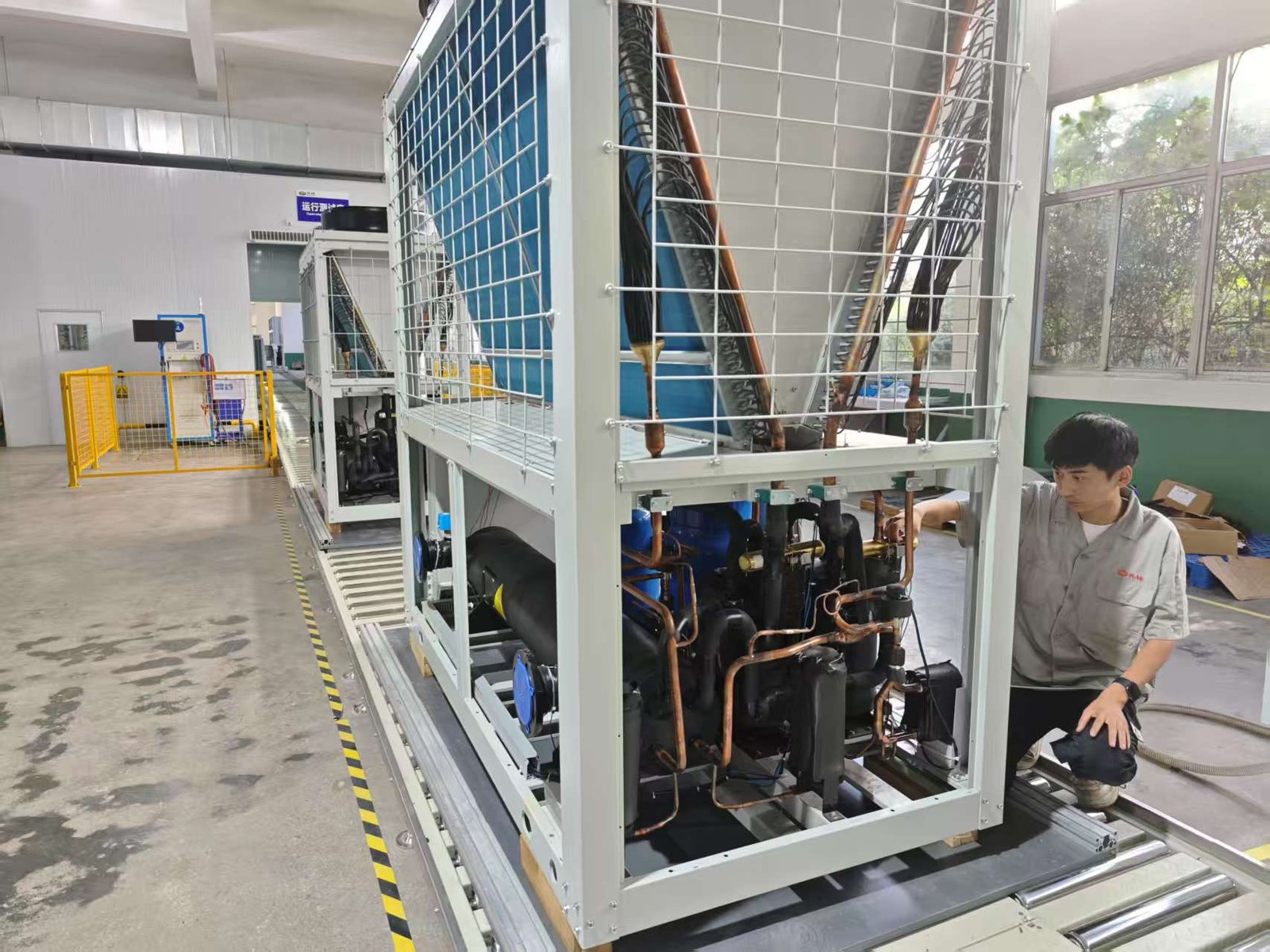
Screw compressors deliver reliable, easy-to-maintain operation across a wide capacity band, in flooded or falling-film evaporator configurations, fixed-speed or inverter-driven.

For very large central cooling plants — hospitals, malls, factories and district cooling — with stepless 10–100% capacity control and peak COP up to 6.6 kW/kW at favorable conditions.

Oil-free magnetic/air-bearing compressors eliminate lubricant contamination and reward plants with many part-load hours — ideal for hospitals, data centers and metro stations needing continuous, ultra-quiet cooling.
Comparing against air-cooled? A screw air-cooled chiller avoids the tower and condenser-water loop, trading some efficiency for simpler installation and maintenance. Water-cooled systems are less attractive when tower space, water treatment, maintenance staff or condenser-water piping are not available.
Assume a commercial building needs 1050 kW of cooling at 7/12 °C (a 5 °C chilled-water ΔT). For quick unit conversion, 1 refrigeration ton equals 3.517 kW, and 1 kW equals 0.284 refrigeration tons:
| Item | Value |
|---|---|
| Cooling capacity | 1050 kW |
| Chilled-water ΔT | 5 °C |
| Estimated chilled-water flow | 1050 / (1.163 × 5) ≈ 181 m³/h |
| Capacity in tons | 1050 / 3.517 ≈ 299 tons |
At 1050 kW, SongXin can supply either a water-cooled screw chiller (within its 190–3600 kW range) or a centrifugal chiller (within 350–2000 kW). A screw chiller is the simpler, easy-maintenance choice for a stable load; a variable-speed centrifugal is worth considering if the building has many part-load hours and energy cost dominates.
Either way, confirm condenser-water conditions: if the supplier rates the unit at 30 °C entering condenser water but the tower can only deliver 32 °C at peak season, real efficiency and capacity will differ. Always request performance at the actual project condition.
Many quotation problems come from scope differences. Clarify exactly what each quotation includes:
| Item | Typically included? |
|---|---|
| Chiller unit | Usually yes |
| Cooling tower | Often separate |
| Chilled-water pump | Often separate |
| Condenser-water pump | Often separate |
| Control panel | Basic included; plant control may be separate |
| BMS communication / flow switch & sensors | Confirm per project |
| Water treatment equipment | Usually separate |
| Valves & strainers | Often separate |
| Installation & commissioning | Confirm scope |
COP or kW/ton is useful but not enough. A chiller with strong full-load COP may not be best if the project runs mostly at part load. Compare full-load efficiency at the same rating condition, part-load efficiency at realistic points, minimum stable load, unloading method, cooling tower and pump energy, control strategy, and expected seasonal operating hours.
For offices and hotels, part-load hours dominate annual energy; for industrial process cooling, near-full-load operation may dominate. SongXin states a peak centrifugal COP up to 6.6 kW/kW at favorable conditions, and provides full-load and part-load data at the project rating point on request.
The cooling tower determines condenser-water temperature, which drives chiller energy use. Ask whether the tower is new or existing, the design wet-bulb, expected approach, available condenser-water flow, whether the tower is selected for the same heat rejection as the chiller, airflow clearance, and the water treatment method. For replacement projects, an existing tower can be the limiting factor — a new efficient chiller on a weak tower still gives poor plant performance.
Process cooling needs more detail than comfort cooling. Before selecting, ask whether the load is constant or variable; what fluid is cooled (water, glycol or process fluid); the allowed temperature tolerance; whether 24/7 operation is required; what happens if cooling stops; whether the process water is dirty or corrosive; and whether future expansion is expected.
SongXin has supplied process cooling plants such as a 600 TR (≈2110 kW) two-chiller installation with a pump station in Southeast Asia, where staging provided partial backup for continuous production. An industrial chiller should be selected around production risk, not only equipment price.
A professional submittal should include model and capacity at project conditions; full-load and part-load performance; chilled-water and condenser-water flow; evaporator and condenser pressure drop; compressor type and motor data; refrigerant type and charge; electrical data and starting method; control interface and BMS protocol; protection functions; dimensions, weight and service clearance; and noise and vibration data if required. SongXin refrigerant options include R134a, R407C and low-GWP R513A and R1234ze to meet F-gas and import regulations.
Verify performance with field measurements: chilled-water and condenser-water temperatures, water flow, compressor loading/unloading, pump and tower interlock, alarm and protection tests, BMS communication, vibration and noise, leakage, and stable operation under partial load. These checks confirm the chiller is integrated into a working plant, not just delivered.

Send your cooling capacity, chilled-water and condenser-water conditions, tower data and application. SongXin will review the working conditions and recommend a suitable configuration within 24 hours.
Request Water-Cooled Chiller Selection