

By SongXin HVAC Engineering Team. SongXin HVAC engineering and technical sales teams support commercial and industrial DX unit selection, air handling equipment review, RFQ checking and export documentation for project buyers.
A good DX unit load calculation starts with three numbers: cooling capacity, supply airflow and external static pressure. For early commercial HVAC selection, calculate the sensible load, add the latent load, convert the result into kW or refrigeration tons, then match the selected DX rooftop unit, ducted DX unit or split DX system against the real duct and filter resistance.
This worksheet is for engineers, contractors and overseas buyers who need a practical pre-RFQ sizing screen before asking for a Direct Expansion Air Conditioners and DX Units quotation. It does not replace a project load calculation by a licensed local engineer. It helps you send cleaner data, avoid undersized equipment and make supplier discussions faster.
Scope boundary: this page is a DX equipment pre-selection worksheet, not a whole-building HVAC design method. Use the broader commercial HVAC system design guide for envelope, zoning, ventilation, system architecture and commissioning decisions; use this worksheet when the project team is ready to turn those loads into DX capacity, airflow and ESP inputs.
Quick answer: For a preliminary DX unit selection, calculate total cooling capacity from sensible plus latent load, select airflow from the sensible heat equation, add a 10–15 percent capacity margin only when the design assumptions are not final, and size the fan against calculated external static pressure instead of catalog nominal airflow.
DX Unit Load Calculation Worksheet
The worksheet below gives buyers a compact structure for early DX sizing before a full submittal is prepared. Fill in the design values first, then ask the supplier to state the unit selection, fan curve, rating condition and control logic.
| Input | Recommended worksheet value | Why it matters |
|---|---|---|
| Outdoor design dry-bulb temperature | Project weather data, e.g. 35 °C or 46 °C | Higher outdoor temperature reduces air-cooled condenser heat rejection. |
| Indoor target condition | e.g. 24 °C dry bulb & 50–60% RH | Indoor condition drives sensible and latent load. |
| Sensible cooling load | kW from room, envelope, lighting, people, process heat | Determines the air temperature drop and supply airflow. |
| Latent cooling load | kW from fresh air, occupants, infiltration or process moisture | Determines coil moisture removal and drain design. |
| Total cooling load | Sensible kW + latent kW | Minimum cooling capacity before rating correction. |
| Safety margin | 0–15% after assumptions are defined | Use 0% for final engineered loads; up to 15% for early estimates. |
| Supply air temperature difference | 8–12 K for many comfort DX systems | Smaller ΔT needs more airflow; larger ΔT needs colder supply air. |
| Supply airflow | m³/h from sensible heat formula | Fan and duct selection cannot be checked without airflow. |
| External static pressure | Pa from duct, filter, coil and terminal losses | A unit with enough kW can still fail if the fan cannot overcome ESP. |
| Power supply | Voltage, phase and frequency | Electrical compatibility affects motor, compressor and control selection. |
| Standard / rating reference | AHRI 340/360, EN 14511 or local requirement | Rating references make supplier quotations comparable. |
Step 1: Define the Design Conditions
DX unit selection should start with actual project design conditions, not the nearest catalog model. The minimum worksheet set is project city, outdoor design temperature, indoor temperature, indoor relative humidity, operating schedule, fresh-air requirement, installation type and power supply.
For a DX rooftop unit, outdoor ambient temperature is especially important because the condenser rejects heat directly to outdoor air. A unit rated at moderate ambient conditions will not deliver the same effective capacity on a hot roof unless the condenser, compressor operating envelope and controls are selected for that condition.
For a DX Split System, refrigerant pipe length and elevation difference must be stated early. Long pipe runs increase pressure drop and oil return risk, so the supplier needs the indoor-to-outdoor distance before final selection.
For Ducted DX Units, the duct layout matters as much as the cooling capacity. If the airflow and ESP are underestimated, the indoor coil will not receive enough air, the supply temperature will drift and compressor protection trips become more likely.
DX Rooftop Units
Roof-mounted packaged cooling.Explore →
Ducted DX Units
Concealed coil with duct distribution.Explore →
DX Split System
Separated indoor & outdoor sections.Explore →
Step 2: Estimate Sensible Cooling Load
Sensible cooling load is the heat the DX unit must remove to reduce dry-bulb temperature. It includes building envelope gain, solar gain, lighting, people, motors, equipment, fresh-air sensible load and process heat.
Use this early worksheet structure. The kW values should come from the project load calculation, equipment schedule or consultant’s design file.
| Sensible load item | Required input | Load value to enter |
|---|---|---|
| Building envelope & solar gain | Roof, wall, glass and orientation | Project kW |
| Internal equipment | Machines, IT equipment or kitchen devices | Project kW |
| Lighting | Installed lighting power | Project kW |
| People sensible load | Occupancy schedule | Project kW |
| Fresh-air sensible load | Outdoor to indoor dry-bulb difference | Project kW |
| Process / safety allowance | Verified heat source only | Project kW |
| Estimated sensible load | Sum of verified items | Project kW |
Do not add a blanket margin before the loads are separated. A 15% margin on a load that already includes conservative people, lighting and weather assumptions can oversize the DX unit and create short cycling. Oversizing matters because a larger compressor can satisfy temperature quickly while leaving humidity control unfinished.
Step 3: Add Latent Load
Latent load is the moisture removal duty that keeps relative humidity under control. It comes from outdoor air, people, infiltration, wet products, open doors, pools, kitchens, laundries and industrial processes.
For comfort cooling, latent load is often smaller than sensible load. For humid climates, fresh-air systems, kitchens, gyms, medical spaces and process rooms, latent load can become the deciding factor. If a buyer sends only room area and target temperature, the supplier cannot confirm coil selection or condensate drain design.
RFQ rule: If the project has outdoor air above 30 °C and 60% RH, a high fresh-air ratio above 20%, or a humidity target below 55% RH, include entering-air dry-bulb, entering-air wet-bulb or enthalpy data. ASHRAE Standard 62.1 is commonly referenced for ventilation design coordination, while actual airflow values must follow the local project code and occupancy schedule.
Step 4: Convert Cooling Capacity
Cooling capacity should be shown in kW and refrigeration tons so engineering and procurement teams can compare international quotations. One refrigeration ton is commonly converted as 12,000 Btu/h, equal to about 3.517 kW, as summarized in the Engineering ToolBox cooling-load conversion reference.
Cooling capacity (TR) = Cooling capacity (kW) / 3.517
Cooling capacity (kW) = Cooling capacity (TR) x 3.517
For early selection, round to the nearest practical model only after rating correction. If the project is in a high ambient region, the selected unit must deliver the required kW at the project outdoor temperature rather than only at a standard catalog rating condition.
Step 5: Calculate Supply Airflow
Supply airflow should be calculated from the sensible load and the planned air temperature difference across the room or coil. A useful SI estimate for early selection is:
Sensible cooling (kW) = 1.2 x airflow (m3/s) x temperature difference (K)The constant 1.2 is an early design approximation based on air density and specific heat near ordinary comfort conditions. Use psychrometric software or the project consultant’s load calculation for final design.
Rearrange the formula:
Airflow (m3/s) = Sensible cooling (kW) / [1.2 x temperature difference (K)]
Airflow (m3/h) = airflow (m3/s) x 3600
Common early airflow ratios (formula outputs from the sensible heat equation above):
| Sensible load | Supply–return ΔT | Estimated airflow |
|---|---|---|
| 30 kW | 10 K | 9,000 m³/h |
| 60 kW | 10 K | 18,000 m³/h |
| 90 kW | 10 K | 27,000 m³/h |
| 120 kW | 10 K | 36,000 m³/h |
A lower ΔT raises airflow. For the same 60 kW sensible load, 8 K needs about 22,500 m³/h, while 12 K needs about 15,000 m³/h. This is why a DX quote must include both capacity and airflow; kW alone does not tell the engineer whether air distribution will work.
Step 6: Build the ESP Budget
External static pressure is the fan resistance outside the unit casing that the DX unit must overcome at the required airflow. Include supply duct, return duct, filters, dampers, grilles, diffusers, silencers, flexible connectors and any field-installed accessories.
| ESP component | Typical early-budget value | Final source |
|---|---|---|
| Supply duct and fittings | 150–350 Pa | Duct calculation |
| Return duct and fittings | 80–250 Pa | Duct calculation |
| Filter final pressure allowance | 100–250 Pa | Filter submittal, often aligned with ISO 16890 class |
| Cooling coil & internal section impact | Mfr. internal | Unit submittal |
| Grilles and diffusers | 30–100 Pa | Terminal device submittal |
| Dampers or VAV devices | 50–200 Pa | Accessory submittal |
| Site uncertainty allowance | 10% of external losses | Only before final duct design |
An undersized fan creates two failure modes. First, airflow drops, so the room does not receive the designed sensible cooling. Second, low airflow across the evaporator coil can reduce coil temperature, increase condensate risk and trigger compressor or freeze protection. A DX unit selected without ESP is not a complete selection.
Worked Example
This example shows how to prepare a first-pass RFQ for a commercial ducted DX unit. It uses simplified values for supplier screening; final design should use the project consultant’s load calculation.
Project Inputs
| Item | Value |
|---|---|
| Application | Commercial hall, ducted distribution |
| Indoor target | 24 °C, 55% RH |
| Outdoor design condition | 35 °C dry bulb |
| Sensible load | 60 kW |
| Latent load | 15 kW |
| Total load before margin | 75 kW |
| Supply–return ΔT | 10 K |
| Preliminary ESP | 650 Pa |
| Power supply | 380 V, 3-phase, 50 Hz |
Complete End-to-End Calculation
Formula 1 — total cooling load
Total cooling load = sensible load + latent load
                   = 60 kW + 15 kW
                   = 75 kW
If the loads are early estimates, apply a 10% margin:
Formula 2 — preliminary selection capacity
Preliminary selection capacity = 75 kW x 1.10
                               = 82.5 kW
Formula 3 — kW to refrigeration tons
82.5 kW / 3.517 = 23.5 TRAirflow Calculation
Airflow = sensible cooling / [1.2 x delta T]
        = 60 / [1.2 x 10]
        = 5.0 m3/s
        = 5.0 x 3600
= 18,000 m3/hESP Calculation
Supply duct and fittings        = 250 Pa
Return duct and fittings        = 150 Pa
Filter final pressure allowance = 150 Pa
Diffusers and grilles           =  50 Pa
Damper allowance                =  50 Pa
Total ESP = 650 PaWhen to Choose DX Rooftop, Ducted DX or Split DX
The installation type should follow airflow path, service access, space limits and control requirements. Do not choose the product type only by capacity.
| Project condition | Better DX format | Selection threshold |
|---|---|---|
| Roof space available, indoor plant room limited | DX rooftop unit | State roof load, service platform, condensate route and ESP before order. |
| Indoor ceiling space available, ducts needed | Ducted DX unit | State airflow and ESP; use a higher static fan when ESP exceeds the standard catalog value. |
| Indoor and outdoor sections must be separated | DX split system | State pipe length, height difference, oil return requirement and service access. |
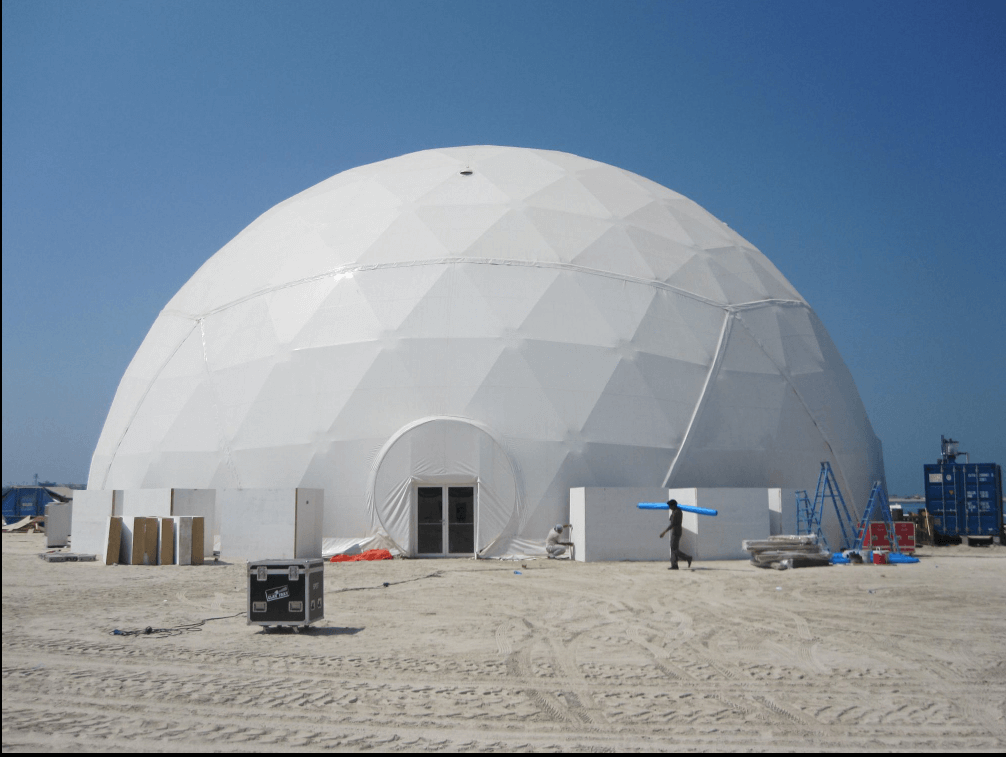
| Temporary structure or event tent | Tent air conditioner / packaged DX | State outdoor ambient, door opening frequency and fast installation needs. |
| Remote equipment room | Rugged DX split or packaged unit | State redundancy, filtration, alarm output and remote monitoring points. |
SongXin’s DX product pages cover rooftop, ducted, split, tent and other direct expansion configurations for commercial and industrial projects. Use the worksheet above to make the first supplier conversation specific.
Common Load Calculation Mistakes
DX unit selection fails when the buyer sends area only. Square meters or square feet are insufficient because they do not define solar gain, equipment heat, fresh air, humidity, operating schedule or duct resistance.
Another mistake is mixing sensible and total load. Airflow is driven by sensible load and temperature difference; coil capacity is driven by total load and entering-air condition. When these values are blended into one number, the supplier cannot judge whether the unit will control both temperature and humidity.
A third mistake is ignoring rating standards. AHRI 340/360 is commonly used for commercial and industrial unitary air-conditioning and heat pump equipment, while EN 14511 is commonly used in European rating contexts. Ask suppliers which rating point the capacity comes from.
The last common mistake is leaving filters out of ESP. A clean filter has lower resistance than a dirty filter. If the fan is selected only against clean-filter pressure, airflow can drop as the filter loads. For projects with finer filtration, align filter selection with ISO 16890 classification and include final pressure allowance in the ESP budget.
RFQ Input List for a DX Unit
Send the following data when you ask SongXin for DX unit engineering support:
- Project location and outdoor design temperature.
- Indoor target temperature and relative humidity.
- Sensible load, latent load and total cooling load.
- Fresh-air volume or fresh-air ratio.
- Preferred installation type: rooftop, ducted, split, packaged, tent or remote-site.
- Required airflow in m³/h or CFM.
- External static pressure in Pa, with duct and filter breakdown when available.
- Power supply, control voltage and BMS communication needs.
- Noise limit at occupied area and site boundary.
- Filtration requirement and filter class.
- Refrigerant preference or local refrigerant regulation.
- Installation constraints: roof load, lifting route, plant room space and service clearance.
- Required documents: drawings, wiring diagram, performance data, test report, certificate package and packing details.
SongXin’s certification and compliance page lists ISO 9001:2015, ISO 14001:2015, CE, RoHS, AHRI, 3C and CRAA as quality and compliance signals for global HVAC projects. Ask for the certificate package that matches the exact product and destination market before purchase.
Specification Checklist
Use this checklist before approving a DX unit quotation:
| Approval point | Pass condition |
|---|---|
| Capacity | Quoted kW matches project outdoor and indoor design conditions. |
| Airflow | Quoted airflow matches calculated sensible-load airflow. |
| ESP | Fan selection matches required ESP at design airflow. |
| Coil | Entering and leaving air conditions are shown. |
| Compressor | Operating envelope covers outdoor design temperature. |
| Filter | Filter class and final pressure allowance are included. |
| Electrical | Voltage, phase, frequency and protection are confirmed. |
| Controls | Thermostat, controller, alarms and BMS interface are listed. |
| Drainage | Condensate connection and trap requirements are shown. |
| Service access | Filter, fan, coil, compressor and electrical panel access are possible on site. |
Frequently Asked Questions
What is the fastest way to estimate DX unit capacity?
How do I calculate airflow for a DX unit?
What ESP should I use for a ducted DX unit?
Is a 10–15 percent safety margin good for DX sizing?
Which standard should I reference in a DX unit RFQ?
Ready to size your DX unit?
Send your worksheet data to the SongXin engineering team for a fast, comparable DX unit selection and quotation.
Sources
- AHRI, “Standard 340/360 (I-P), Performance Rating of Commercial and Industrial Unitary Air-conditioning and Heat Pump Equipment,” ahrinet.org
- European Commission product policy reference for EN 14511-2:2018, ec.europa.eu
- ASHRAE Standard 62.1, Ventilation for Acceptable Indoor Air Quality, ashrae.org
- ISO 16890 general ventilation air filters classification overview, iso.org
- SongXin HVAC, “Direct Expansion Air Conditioners and DX Units for Commercial HVAC,” sxinhvac.com
- SongXin HVAC, “Certification and Compliance,” sxinhvac.com
- Engineering ToolBox, “Calculating Cooling Loads,” engineeringtoolbox.com
Review record: Technical review by SongXin HVAC Engineering Team, commercial and industrial DX unit selection review, 2026-07-13.