

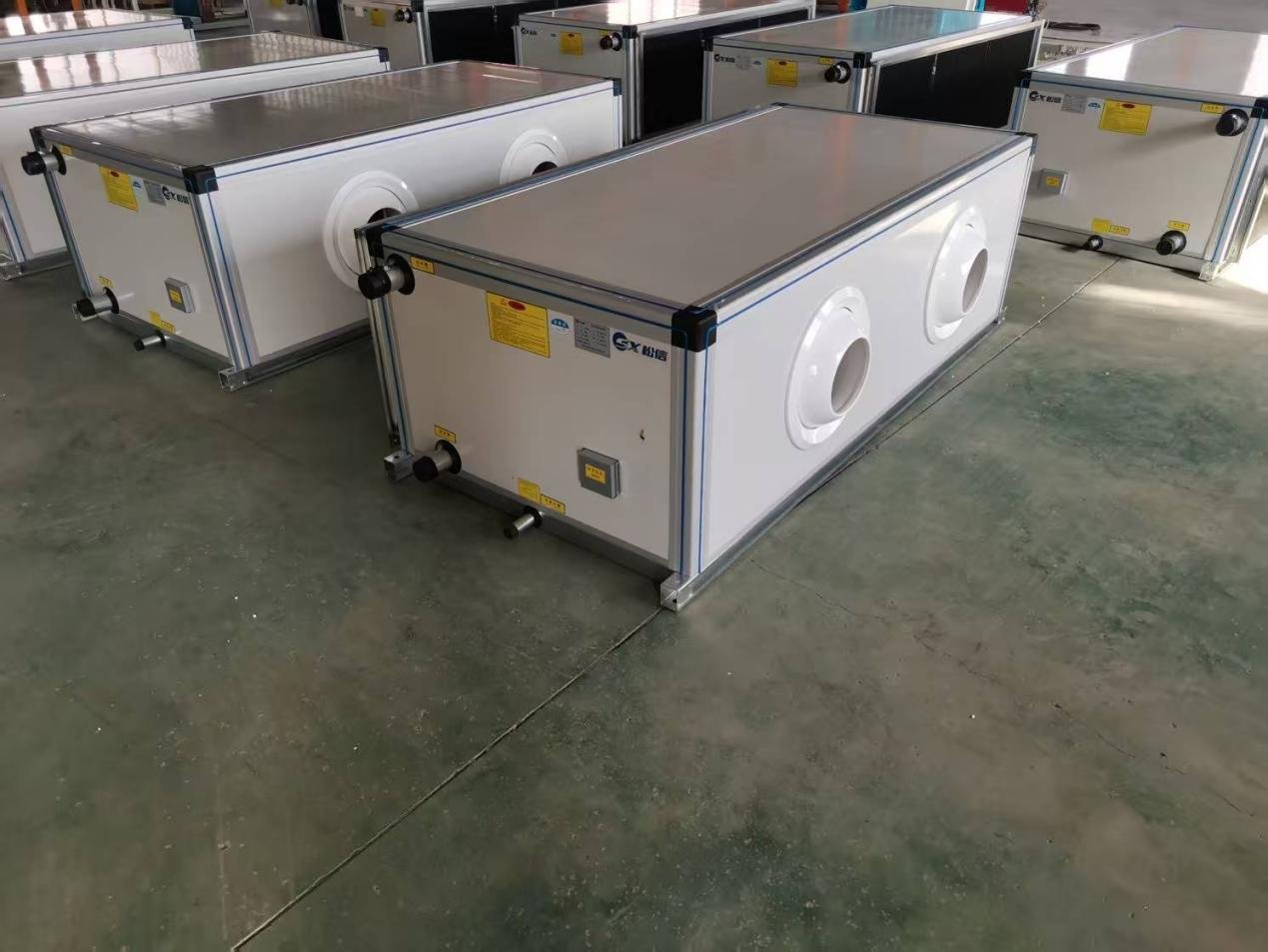
1. Quick Answer: What Determines a Custom AHU Price?
A custom air handling unit (AHU) cannot be priced reliably from airflow alone. The quotation depends on the selected operating duty, construction, accessories, testing and supply boundary.
The main factors are design airflow and fan pressure; cooling and heating loads; filtration; casing performance; heat recovery and additional treatment sections; automation; custom dimensions; factory tests; and the quantity, packing, freight and warranty included in the offer.
Procurement rule: first specify the actual airflow, external static pressure, total and sensible coil duties, filtration and operating conditions. Then ask every supplier to quote on the same technical and commercial basis.
A generic price per CFM or m³/h may help an early comparison between near-identical equipment, but it cannot establish technical equivalence. For configuration options, explore SongXin commercial and industrial air handling units.
2. Why Can Two AHUs With the Same Airflow Have Different Prices?
Consider two hypothetical AHUs sized for the same air volume. Both suppliers might advertise the same airflow rating, but the equipment they propose could have different performance and scope.
| Technical item | AHU A | AHU B |
|---|---|---|
| Design airflow | Same project requirement | Same project requirement |
| External static pressure | Lower duct pressure | Higher duct pressure |
| Cooling coil | Standard comfort duty | Higher latent or total duty |
| Filtration | General ventilation | Additional stages |
| Fan controls | Basic specified controls | Variable-speed / monitoring options |
| Casing | Indoor arrangement | Enhanced construction requirements |
| Testing | Standard records | Extra inspection or witness testing |
| Installation | Accessible plant room | Restricted site or sectional delivery |
Swipe horizontally to view all quotation columns.
This comparison is illustrative, not a pair of actual SongXin prices. AHU B may cost more because of its specification, but only real component selections and quotations could establish the amount. A higher-priced unit is not automatically better, and a lower-priced unit can be suitable if it meets the same approved duty.
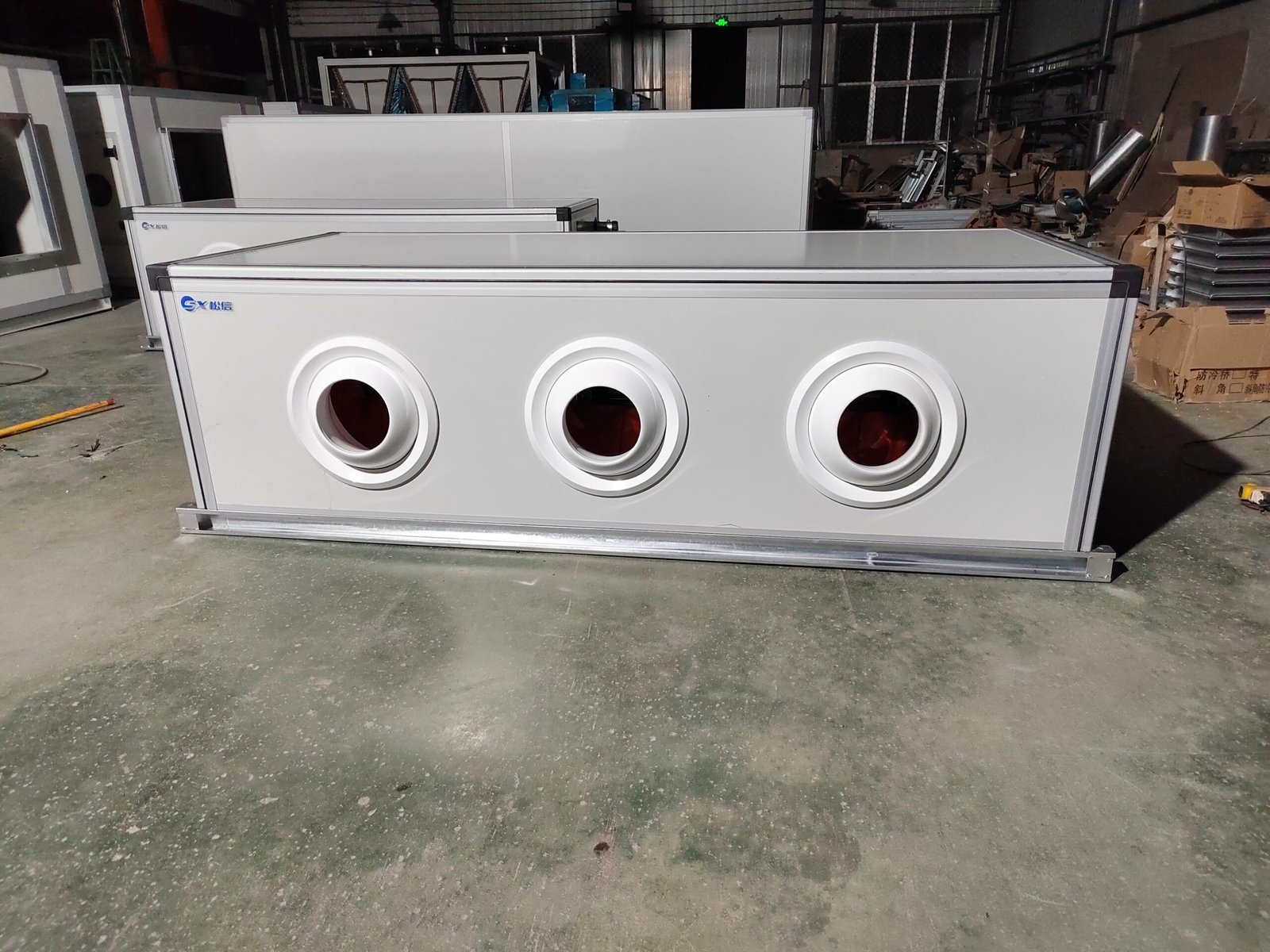
What a price must include
Same airflow does not mean the same equipment.
Examine fan duty, coil leaving-air conditions, filter resistance, casing requirements and the services included in the offered supply scope.
3. Nine Major Factors That Influence Custom AHU Prices
These variables are interdependent: changing a filter can change the pressure duty of the fan; changing outdoor-air fraction may alter coil load; changing the access constraints may require a different AHU module layout.
Operating point, fan selection, motor input.
Fan/motor technology, modulation, sound.
Total/sensible duty, temperature, medium.
Class, stages, resistance, service access.
Leakage, mechanical and thermal classes.
Added sections, losses and hygiene.
Instruments, safety controls, BMS boundary.
Dimensions, modular access, construction.
Testing, drawings, freight and warranty.
3.1 Airflow, External Static Pressure and Fan Selection
AHU airflow is normally specified in cubic metres per hour (m³/h) or cubic feet per minute (CFM). External static pressure (ESP), expressed in pascals (Pa), describes the pressure available or required at the AHU’s external connection according to the agreed rating boundary. The fan must also overcome relevant internal resistance and system effects.
Two AHUs delivering the same airflow at different ESP values may require different fan operating points, sizes, speeds and electrical inputs.
Important: these are idealized pressure/airflow components, not fan shaft power, motor rating or electricity consumption. Real electrical input depends on complete fan pressure duty, internal resistance, system effects, fan and motor efficiency and the actual operating point.
ASHRAE’s Fans handbook chapter describes fan and system pressure relationships. For a meaningful AHU quotation request: design airflow + required ESP + fan performance curve or selection output + electrical input at that point.
3.2 Fan Technology, Motor and Speed Control
AHUs may use belt-driven centrifugal fans, direct-driven centrifugal fans, plug/plenum fans or electronically commutated (EC) motor arrangements, according to the actual duty and available product configuration.
The cost difference can arise from the motor and drive, operating speed, fan selection, vibration and sound treatment, controls and maintenance access. Variable-speed operation can be useful where airflow falls below peak demand, but EC and VFD-controlled alternatives should be compared at the project’s real operating profile rather than through generic efficiency claims.
Ask for the fan curves, electrical input, speed, efficiency and sound data at the design point and at important part-load conditions.
3.3 Cooling and Heating Coil Specifications
The cooling or heating coil can materially influence the equipment’s construction and price. A project may require chilled-water cooling, hot-water heating, a matched direct expansion (DX) coil or another arrangement.
For cooling, distinguish total cooling capacity from sensible cooling capacity. Total duty includes applicable sensible and latent heat removal; sensible duty is the temperature-related portion. In humid climates, two nominally equivalent coils can yield different leaving-air moisture conditions.
| Coil input | Why it changes selection and cost |
|---|---|
| Airflow | Defines coil air quantity, face area and velocity. |
| Entering dry-bulb and humidity | Defines the incoming psychrometric state and latent load. |
| Required leaving air | Establishes the supply air temperature and moisture target. |
| Total and sensible kW | Determines coil thermal duty at the stated rating point. |
| Chilled-water conditions | Water supply/return temperature, fluid properties and flow. |
| Air-side / fluid-side pressure drop | Influences fan/pump duty and circuit selection. |
| Materials, space and drainage | Influences corrosion resistance, cleanability and casing layout. |
Swipe to view the complete coil specification.
Coil rows, fin spacing, face dimensions and circuiting should be determined by engineering selection—not treated as universal requirements. A higher number of rows does not automatically mean better performance. For DX coils, the matched refrigeration circuit, expansion control and refrigerant safety basis must also be checked.
AHRI Standard 410 provides a rating framework for covered forced-circulation coils, with scope exclusions; it does not certify every coil design automatically. See the AHU Cooling Coil Selection Guide for a more technical discussion.
3.4 Filtration Efficiency and Filter Arrangement
Filtration changes the equipment configuration and its operating cost. General ventilation filters may be specified using ISO 16890 particulate-matter efficiency classes. Other classifications or higher-efficiency stages may be required for a particular building or process.
The quotation must identify actual filter efficiency, media arrangement, number of stages, initial pressure drop, specified replacement/final pressure-drop limit, available area, access space and included spare filters. A higher filter class does not automatically offer the best value for every project: filter resistance affects fan duty and maintenance.
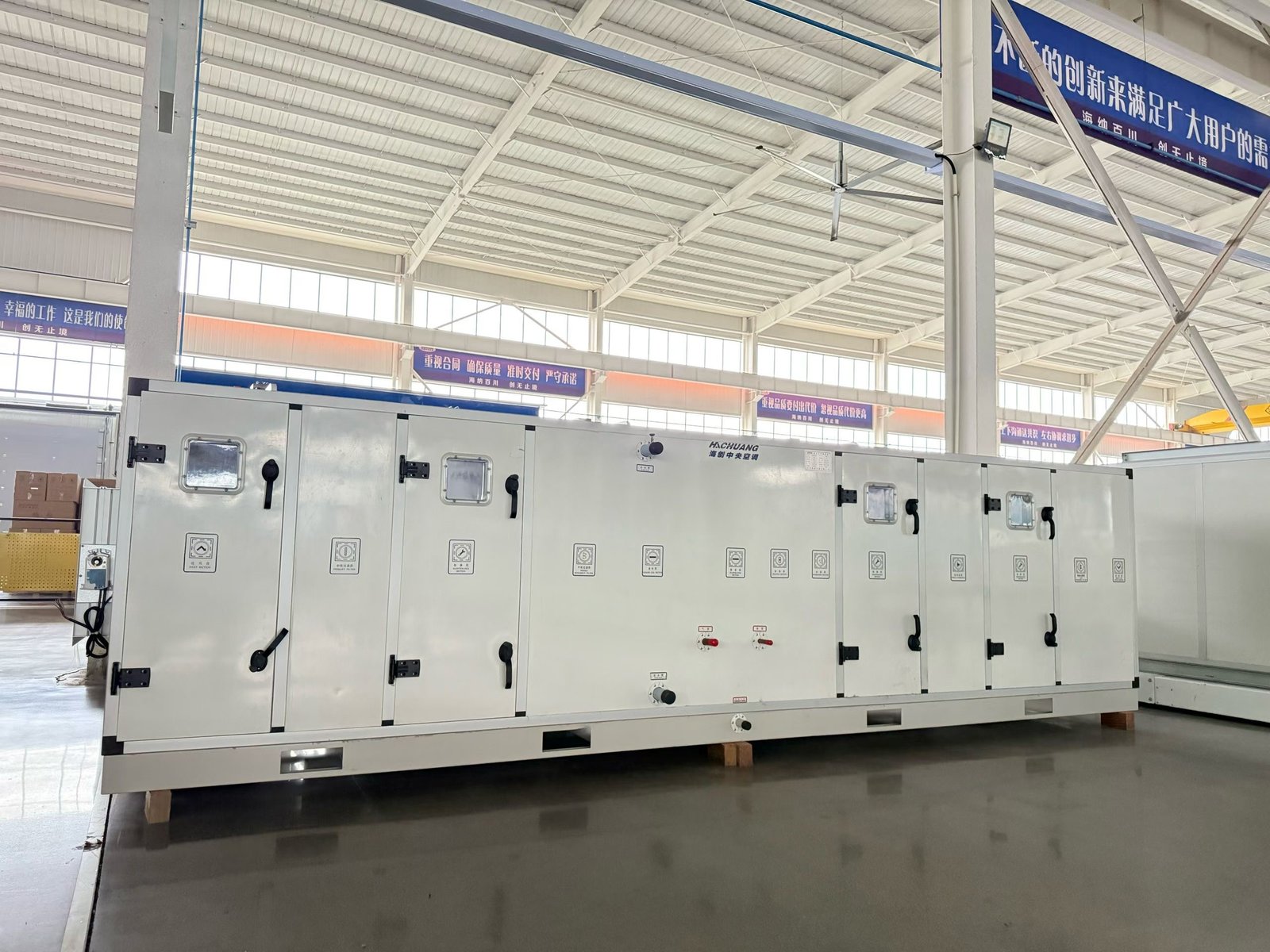
Specify filtration according to the air-quality objective, pressure-drop allowance and replacement strategy. For more guidance see the AHU Filter Selection Guide.
3.5 Casing Construction, Insulation and Leakage Performance
An AHU casing contributes to structural integrity, air leakage, thermal insulation, condensation behavior, sound performance and maintenance access. Depending on the project, the specification may call for casing strength, leakage performance, filter bypass control, thermal transmittance, thermal bridging and acoustic requirements.
Eurovent’s explanation of AHU certification references EN 1886 for applicable mechanical performance and EN 13053 for relevant AHU performance. Check their exact scope before inserting a standard requirement into a project specification; special-purpose process equipment may have different obligations.
Compare documented mechanical and thermal characteristics rather than casing thickness alone. Indoor AHUs, rooftop equipment and humidity-sensitive installations may need very different construction or weather and corrosion considerations.
3.6 Heat Recovery and Additional Air-Treatment Sections
Additional sections may include plate-type heat exchangers, rotary energy recovery, run-around coils, humidification, enhanced dehumidification and sound attenuation. These affect the initial cost, pressure losses, unit length, cleaning access, controls and maintenance.
Heat recovery can reduce heating or cooling energy demand under suitable operating conditions, but a universal energy-saving percentage should not be assumed. Request the recovery technology, tested rating basis, actual design airflow, efficiency, added pressure losses and controls. Where hygiene or contamination is critical, evaluate air leakage, exhaust segregation, frost risk and local requirements.
Price mandatory sections and optional features separately where feasible. This gives buyers a transparent basis for value engineering without silently removing essential functions.
3.7 Automation, Controls and BMS Integration
Control packages range from local fan and temperature operation to coordinated building automation. They may include temperature and humidity sensors, filter differential-pressure monitoring, variable-speed control, dampers, actuators, freeze protection, alarms and a communication interface.
Important quotation boundary: “BMS ready” is not equivalent to a complete central BMS integration package. Ask who supplies sensors, controls, cabling, network programming, integration and commissioning—and who is responsible for troubleshooting the interface.
For overseas procurement also confirm voltage, phase, frequency and the required control protocol. Compare precisely what the AHU manufacturer includes and excludes.
3.8 Custom Dimensions, Modular Construction and Installation Access
An AHU must fit its actual installed location. Plant rooms, rooftops, basements and restricted-access facilities can impose height, width, module length, lifting weight, doorway or service-space limits.
Sectional or modular construction can solve an access problem, but it may also change packaging, field assembly, joint sealing and commissioning responsibilities. Provide installation drawings, available dimensions, lifting details and the required coil/filter removal space before accepting a final equipment design.
3.9 Factory Testing, Documentation, Quantity and Delivery Scope
Two AHU quotations may include different testing and documentation. Depending on the contract, a buyer may require construction checks, operational verification, specific instrument readings, commissioning support or factory acceptance testing (FAT).
Define the agreed inspection and witness scope in advance. A general factory certificate, a standard number and an independently certified AHU product range are different kinds of evidence. Where Eurovent certification is specified, confirm the exact model/range and rated characteristics from the certification programme.
Quantity, nonstandard electrical supplies, packing, transportation, additional drawings and support obligations can affect the offer. See the AHU Factory Acceptance Test Checklist before issuing a purchase order.
4. Standard Commercial AHU vs Custom Process AHU: What Changes the Quotation?
A comfort-focused commercial AHU and a specialized process AHU can have different performance and documentation requirements despite identical nominal airflow.
| Requirement | Commercial comfort AHU | Custom process AHU |
|---|---|---|
| Main objective | Comfort conditioning and ventilation | Defined process or environmental duty |
| Airflow | Building design value | Process design value |
| Cooling / humidity | Specified comfort conditions | Potentially tighter process requirements |
| Filtration | Building IAQ objective | Application-specific contamination control |
| Casing | Applicable building requirements | Potential special hygiene/corrosion construction |
| Controls | Comfort and BMS integration | Potential process interlocks and alarms |
| Documentation | Standard agreed equipment submittal | Possible enhanced validation or inspection |
| Quotation | Actual configuration and supply scope | Actual configuration and process specification |
Swipe horizontally to compare the configurations.
A process AHU is not automatically more expensive in every case. The real difference depends on the performance, materials, controls and testing actually specified. Avoid both over-specifying process-grade construction where it is unnecessary and accepting an ordinary comfort unit where the required process conditions cannot be met.
Use-case fit
Specification follows the room duty.
Comfort, cleanliness, humidity control, pressure stability and maintenance requirements should define the AHU. The application label alone is not a reliable cost multiplier.
5. How to Compare Custom AHU Supplier Quotations on an Equal Basis
Before comparing prices, issue one shared technical RFQ to every supplier. Ask for written deviations and exclusions. The following matrix gives a realistic procurement method without inventing supplier prices.
| Comparison item | Supplier A | Supplier B |
|---|---|---|
| Exact offered AHU model/revision | Identify | Identify |
| Airflow and ESP | Confirm same operating point | Confirm same operating point |
| Fan input, sound and controls | Selection output | Selection output |
| Coil total / sensible duty | Same inlet/outlet conditions | Same inlet/outlet conditions |
| Heating requirements | Medium and duty specified | Medium and duty specified |
| Filter class / resistance | Clean and final basis | Clean and final basis |
| Casing and insulation | Documented performance | Documented performance |
| Heat recovery / extra sections | Explicitly included/excluded | Explicitly included/excluded |
| Controls / BMS | Hardware and programming scope | Hardware and programming scope |
| Dimensions / access | Approved arrangement drawing | Approved arrangement drawing |
| Testing / compliance | Specific test and valid evidence | Specific test and valid evidence |
| Warranty / spare parts | Written scope and exclusions | Written scope and exclusions |
| Freight / Incoterms | Named delivery place and scope | Named delivery place and scope |
| Commissioning | Identify responsible party | Identify responsible party |
| Currency and price validity | Record conditions | Record conditions |
Swipe sideways to compare all supplier quote items.
Three questions to ask before awarding a low-price bid
- Does the offered AHU meet the full design point? Airflow alone is not enough; check external fan pressure, coil conditions, electrical input, acoustic limits and humidity where required.
- What is included in the offer? Confirm controls, sensors, packing, drawings, tests, local installation support and spare parts.
- Who is responsible if performance falls short? Agree on acceptance tests, commissioning responsibility, contractual deviations, warranty exclusions and corrective action before ordering.
Need help comparing AHU bids?
Share airflow, ESP, coil conditions and your quotation scope. Request a model-specific technical selection without completing a form.
6. Budgetary AHU Price vs Firm Equipment Quotation
An early-stage buyer may not yet have final airflow, coil data or installation drawings. A preliminary budget can be helpful, but only if assumptions and missing values are visible. A budget estimate is not a binding, compliant engineering selection.
| Budgetary price | Firm technical quotation |
|---|---|
| May use incomplete or assumed design inputs | Uses agreed engineering requirements |
| Configuration may be provisional | Identifies the offered unit/model and options |
| Accessories may be excluded | Explicit inclusions and exclusions |
| Performance may require later verification | Selected-model performance at stated conditions |
| Delivery scope may be indicative | Named place, carriage scope and responsibilities |
| Useful for feasibility and cost planning | Suitable for procurement review, subject to contract |
Ask the supplier to identify any assumed airflow, pressure, outdoor-air fraction, cooling medium, control package or service scope. Missing parameters should remain openly listed until a final selection is prepared.
7. EXW, FCA, FOB, CIF and CIP: International AHU Quotation Costs
When purchasing from overseas, the shipment rule and delivery boundary can change which costs the buyer must still pay. The following summary is for Incoterms 2020; the exact rule and named delivery place must appear in the agreement.
| Trade rule | Practical point for AHU buyers |
|---|---|
| EXW — named place | The seller makes goods available at the named location. The buyer assumes extensive obligations; clarify loading and export formalities. |
| FCA — named place | Seller delivers goods to the nominated carrier/person at the named point. Often suitable for containerized shipments. |
| FOB — named shipment port | Seller delivers goods on board the nominated vessel. Intended for sea and inland-waterway transport. |
| CIF — named destination port | Seller arranges defined carriage and insurance to the named port; transfer of risk normally occurs when goods are on board at shipment, not at destination. |
| CIP — named destination | Seller arranges carriage and specified insurance to the named destination under a multimodal rule; risk transfers according to the carrier-delivery provisions. |
Container-shipping warning: if an AHU is handed over to a carrier or terminal before loading aboard a vessel, FCA or CIP may fit the actual transaction better than mechanically choosing FOB or CIF. Confirm the contractual handover point, insurance terms and applicable shipping mode.
Do not treat CIF as a delivered-to-installation-site price. Inland delivery, unloading, lifting, import duties, taxes, commissioning and controls work may remain excluded.

International procurement
Compare the delivered scope—not only the factory price.
Itemize equipment, packing, freight and insurance, import charges, inland haulage, crane/lifting, installation, BMS integration, commissioning and spare parts. Do not count an item twice if it is already included.
See the ICC Incoterms 2020 rules for formal allocation of risk and cost.
Comparative installed project cost = equipment + nonincluded packing/carriage/insurance + applicable import costs + local delivery/lifting + installation + control integration + commissioning + project spares/support. Only include amounts not already covered by the quoted trade and supply scope.
8. AHU Purchase Price vs Operating Cost: An Illustrative Calculation
Fan electrical consumption is influenced by airflow, external and internal resistance, fan efficiency, motor and drive efficiency, filter condition and operating schedule. A cheaper AHU may use more energy, but a higher-priced unit is not automatically more efficient.
Consider a hypothetical AHU operating at 10,000 m³/h. Suppose one design has an additional 100 Pa of total relevant pressure loss at the same airflow, and suppose a combined fan/motor/drive efficiency of 60% is used only as a simple engineering assumption.
Both 60% combined efficiency and 3,000 annual hours are explicit hypothetical assumptions. The estimate is not a guaranteed energy saving or a product test. A real fan selection must account for actual efficiency curves, filter loading, system losses, speed variation and operating schedule.
A broader ownership-cost comparison may include purchase, shipping, installation, electrical energy, filter replacements, maintenance, anticipated repairs and downtime considerations. Use the same evaluation period and clearly state the assumed energy tariff and operating profile.
9. How to Reduce Custom AHU Cost Without Compromising Performance
Useful value engineering starts with the actual project duty rather than simply removing components from a quotation.
- Validate airflow and ESP. An oversized airflow requirement or unjustified pressure allowance can affect fan purchase and operating costs.
- Size coils by air conditions. Define sensible and total cooling at the specified entering and leaving air states; let the engineering selection determine rows, fins and circuiting.
- Choose appropriate filtration. Select filter performance to meet air-quality requirements while considering pressure drop, cleaning and replacement.
- Use practical modules. Prefer standard equipment/section dimensions when they fit the site without compromising access and serviceability.
- Make optional items visible. Request separate prices for enhanced controls, recovery, finishes or extra testing when these are not mandatory.
- Normalize shipping and service. Compare the same Incoterms boundary, packing scope, warranty terms and commissioning responsibility.
Cost savings must never remove required hygiene, fire safety, refrigerant safety, electrical protection, corrosion provisions or maintenance access.
10. Custom AHU RFQ Checklist: What International Buyers Should Send
An accurate quotation starts with complete project information. Use the same values and rating definitions for every supplier. If an item is not yet defined, clearly mark it as unknown rather than leaving a supplier to make an invisible assumption.
| RFQ parameter | Information to provide |
|---|---|
| Application | Commercial comfort, industrial process, healthcare, food, laboratory or other use |
| Destination | Country, city, climate and applicable project standards |
| Quantity | Number of units, identical or individually customized |
| Design supply airflow | Required m³/h or CFM |
| External static pressure | Pa at the agreed design airflow and pressure boundary |
| Outdoor-air requirement | Required fresh-air volume or fraction |
| Entering-air condition | Dry-bulb and wet-bulb temperature, or dry-bulb/RH with site altitude |
| Leaving-air target | Supply air temperature and moisture target |
| Cooling-coil duty | Total and sensible kW, chilled-water conditions or matched DX refrigerant circuit |
| Heating duty | Required load and heating medium if applicable |
| Filtration | Filter classification, stages and initial/final pressure-drop allowance |
| Fan / controls | VFD/EC requirements, sensors, safety interlocks, alarms and BMS scope |
| Casing / materials | Indoor/outdoor location, thermal/leakage performance and hygiene/exposure needs |
| Space and access | Maximum transport sizes, lifting, door access and maintenance clearance |
| Electrical | Voltage, frequency, phase and any local compliance requirements |
| Documents and tests | Drawings, performance outputs, QA/FAT scope and applicable certificates or reports |
| Commercial details | Currency, quantity, desired delivery window, named Incoterms rule/place and warranty requests |
On smaller screens, swipe horizontally across the engineering checklist.
At concept stage, a supplier may be able to discuss a preliminary configuration. That discussion should list the assumptions and missing inputs. For a final purchase, request the model-specific performance and a clear commercial offer.
11. Ready-to-Send Custom AHU Quotation Request
Use the following standard RFQ message with each supplier. It is a template, not a customer case study or confirmed SongXin model quotation.
Subject: Custom Air Handling Unit Quotation — Commercial / Industrial HVAC Project
Hello SongXin HVAC,
We are sourcing custom air handling units for an upcoming HVAC project. Please review our requirements and recommend a suitable configuration.
- Application: [Commercial / Industrial / Process]
- Destination: [Country and city]
- Quantity: [Number of units]
- Required airflow: [m³/h]
- External static pressure: [Pa]
- Outdoor-air fraction: [m³/h or %]
- Entering-air condition: [DB / WB or RH]
- Leaving-air condition: [Temperature / Humidity]
- Cooling-coil duty: [Total / Sensible kW]
- Cooling medium: [Water temperatures / DX]
- Heating duty: [If applicable]
- Filter classification: [Class and stages]
- Installation: [Indoor / Outdoor]
- Electrical supply: [V / Phase / Hz]
- Controls / BMS: [Required interface]
- Special dimensions, hygiene or materials: [Details]
Requested delivery terms: [Named place and Incoterms rule]. Thank you.
WhatsApp is the primary enquiry channel. This article does not collect enquiries using a web form.
12. Frequently Asked Questions About Custom AHU Prices
How much does a custom air handling unit cost?
A custom AHU has no dependable universal price. Cost depends on selected airflow, fan pressure, thermal duty, filtration, casing, controls, testing and the agreed delivery boundary. A specific price needs a supplier quotation for a defined configuration.
Is AHU price per CFM or per m³/h a reliable benchmark?
Not by itself. Airflow-based cost may help compare near-identical units preliminarily, but it does not normalize fan pressure, coil performance, filter resistance, casing or included controls and services.
Does higher external static pressure increase AHU price?
It may require a different fan/motor operating point, drive selection, acoustics or construction. Actual cost impact must be evaluated from the fan performance selection and supplier quote.
Is an EC fan always cheaper to operate than a VFD-controlled fan?
No universal answer applies. Compare input power and expected operating hours across the project’s real airflow/pressure range, including motor and drive characteristics.
Does a higher filtration class always increase AHU price?
Not in a simple fixed proportion. Price depends on filter type, media area, stages, pressure drop, replacement access and any required casing change.
Why does humidity control influence AHU cost?
It can change cooling coil total and sensible loads, dehumidification conditions, drainage, controls and additional treatment sections. The effect follows from the actual entering and target leaving air states.
Are custom process AHUs always more expensive than comfort AHUs?
No. A process application may require additional functions, but the actual price is driven by the selected equipment and required performance, not the label alone.
What separates a budgetary AHU price from a firm quotation?
A budget estimate may use preliminary assumptions. A firm technical quotation identifies the proposed model, design-point performance, inclusions, deviations, delivery terms and commercial conditions.
Is factory acceptance testing included in a standard AHU quotation?
That depends on the contract. Define factory tests, witness requirements, instrumentation, record delivery and any costs before approving competing offers.
Can SongXin discuss an AHU quotation without a final specification?
Available project information can start a technical enquiry. Any preliminary advice should state assumptions; actual model availability, performance, lead time, price, testing and warranties require confirmation from the supplier.
SongXin HVAC · Engineering procurement
13. Request a Custom Air Handling Unit Quotation
A reliable AHU quotation starts with operating requirements, not a generic equipment price list. Compare the selected model at the required airflow, external static pressure, coil conditions and installation boundary. Ask for the complete specification, applicable evidence and a clear commercial scope.
SongXin HVAC publishes information about commercial and industrial AHU equipment. Contact the sales and technical team with your application, airflow, fan pressure, cooling/heating duties, filtration, quantity and destination.
No enquiry form · No unverified model-specific prices or certifications are claimed.
Technical References and Source Notes
These sources provide technical and trade guidance, but referring to a standard does not mean a SongXin product is certified under that standard.
- Eurovent Recommendation 6/18 (2022) — quality criteria for air handling units, construction, controls, maintainability and documentation.
- ASHRAE Handbook: Fans — fan operating points, pressure relationships, power and system effects.
- ASHRAE Handbook: Air-Cooling and Dehumidifying Coils — coil conditions, capacity and selection principles.
- Eurovent Certified Performance: AHU programme focus — independent certification context, EN 1886 and EN 13053 standards.
- ISO 16890-1:2016 — general ventilation filter classification by particulate-matter efficiency; confirm current edition for future project specifications.
- AHRI Standard 410-2023 — rating of in-scope forced-circulation air-cooling and heating coils and its exclusions.
- ICC Incoterms 2020 — allocation of delivery, carriage, insurance and risk responsibilities in international sale contracts.
Editorial scope: all calculation examples are illustrative, not SongXin equipment test results, customer projects, guarantees or binding quotations. Confirm actual pricing, availability, performance, certification, installation obligations and warranty from the selected equipment submittal and signed contract. Project engineering and regulatory approval remain the responsibility of the appropriate qualified parties.
Suggested internal navigation: AHU product range · Custom/process AHU · Coil selection · Filter selection · Factory acceptance tests.