

High Ambient DX Air Conditioner Selection Guide: 43 °C / 46 °C / 50 °C Hot Climate Projects
A high ambient DX air conditioner should be selected by its rated capacity at the project’s outdoor design temperature, not by nominal capacity at a mild catalog condition. This matters in the Middle East, North Africa, South Asia, Southeast Asia, Sub-Saharan Africa, rooftop installations, industrial yards and containerized sites where condenser inlet air often reaches 43 °C to 50 °C – and in some Middle East rooftops, 55 °C on a black-roof afternoon.

This guide connects the topic to SongXin’s direct expansion unit, direct expansion air handler selection guide, ducted DX unit selection guide, DX rooftop unit vs DX split system and DX unit load calculation worksheet resources for product selection, internal linking and buyer verification.
A high ambient DX air conditioner should be selected by its rated capacity at the project’s outdoor design temperature, not by nominal capacity at a mild catalog condition. This matters in the Middle East, North Africa, South Asia, Southeast Asia, Sub-Saharan Africa, rooftop installations, industrial yards and containerized sites where condenser inlet air often reaches 43 °C to 50 °C – and in some Middle East rooftops, 55 °C on a black-roof afternoon.
The short rule is practical: if the outdoor design dry-bulb is above 40 °C, ask for capacity, power input and compressor operating envelope at that exact condition. A unit that is acceptable at 35 °C can lose 10–22% of useful capacity at 46 °C because condenser pressure rises and compressor work increases.
This guide connects high ambient selection to SongXin’s direct expansion unit, direct expansion air handler selection guide, DX rooftop unit vs DX split system, ducted DX unit selection guide and air-cooled screw chiller ambient temperature capacity resources.


Quick Answer for Buyers
A high ambient DX air conditioner is needed when the outdoor condenser works in hot air above 40 °C, on exposed rooftops, near heat discharge, or inside restricted equipment yards. The buyer should request performance at 43 °C, 46 °C or the local design ambient, plus airflow clearance, compressor protection, refrigerant choice and condenser coil coating.
The core risk is heat rejection. A DX unit rejects indoor heat to outdoor air. As outdoor air temperature rises, the condenser has less temperature difference to reject heat, which raises condensing pressure and reduces compressor safety margin. That is why high ambient selection requires condenser sizing, fan airflow, refrigerant selection, coil protection and control logic – not only a larger nominal capacity.
Buyer’s 30-second rule:
- Design ambient 35–40 °C → standard DX unit (T1 / T2 rating)
- Design ambient 40–46 °C → T3 high-ambient DX with oversized condenser
- Design ambient 46–52 °C → T3+ high-ambient DX with R410A/R454B + e-coated coil + high-pressure-tolerant compressor
- Design ambient > 52 °C or coastal/dusty → special design review: stainless or marine-grade coil + redundant compressors
Country / Region Design Temperatures (Reference)
The “outdoor design dry-bulb” is not a global constant. Use the table below as a starting reference, then confirm with the local code / ASHRAE Weather Data Center for the exact site.
| Region | Country / city example | Typical design dry-bulb (peak) | Recommended selection class |
|---|---|---|---|
| Gulf / Middle East | Saudi Arabia (Riyadh, Jeddah) | 46–48 °C | T3+ high-ambient, e-coated coil |
| Gulf / Middle East | UAE (Dubai, Abu Dhabi) | 46–48 °C, rooftop 50–55 °C | T3+, marine-grade if coastal |
| Gulf / Middle East | Kuwait, Qatar, Bahrain, Oman | 46–50 °C | T3+ with discharge-air shielding |
| North Africa | Egypt (Cairo), Algeria, Libya | 43–46 °C | T3 high-ambient |
| North Africa | Sudan, Mauritania, Niger | 46–50 °C | T3+ high-ambient |
| Sub-Saharan Africa | Nigeria, Ghana, Kenya | 38–42 °C + humidity | T2/T3 with corrosion protection |
| South Asia | India (Delhi, Rajasthan), Pakistan | 45–48 °C | T3 high-ambient + dust filtration |
| Southeast Asia | Thailand, Vietnam, Indonesia | 36–40 °C + 80% RH | T2/T3 with strong latent capability |
| Australia inland | Western Australia mining sites | 45–50 °C | T3+, dust-resistant |
| Americas | Mexico (north), Arizona, Texas | 43–47 °C | T3 high-ambient |
T-class designations come from ISO 5151 / ISO 13253 climate-test classification for air conditioners and heat pumps: T1 (21–35 °C), T2 (10–35 °C), T3 (21–46 °C). Many manufacturers also offer “T3+” or “Tropical” variants tested up to 50–55 °C – confirm with the supplier datasheet what their T3 rating envelope actually is.
What Changes in High Ambient Operation
High ambient operation changes the refrigeration balance, electrical load and service risk. The unit needs enough condenser surface and airflow to reject heat under the local design condition.
| Condition | Mild climate selection | High ambient selection | Buyer rule |
|---|---|---|---|
| Outdoor design | 30-35 °C | 43-50 °C | Use the project design dry-bulb in the RFQ. |
| Condenser airflow | Standard clearance | Larger free-air path | Avoid discharge-air recirculation. |
| Condenser face area | Baseline | +20–35% larger | Required to maintain condensing temperature margin. |
| Condenser fan airflow | Baseline | +15–25% higher CFM | Maintains coil approach temperature. |
| Compressor envelope | Standard operating region | High pressure margin required | Ask for operating-envelope confirmation. |
| Refrigerant | R410A/R32/R134a (project) | R410A or R454B preferred over R32 at >50 °C | R32 critical temperature 78.1 °C limits high-pressure margin. |
| Coil coating | Standard aluminum fins | E-coat / blue-fin / gold-fin | Required for dust/salt/acid environments. |
| Electrical load | Lower input current | Higher input current (+15–25%) | Size cables and protection at hot condition. |
| Controls | Standard safeties | High-pressure and discharge-temp protection | Request alarm and shutdown logic. |
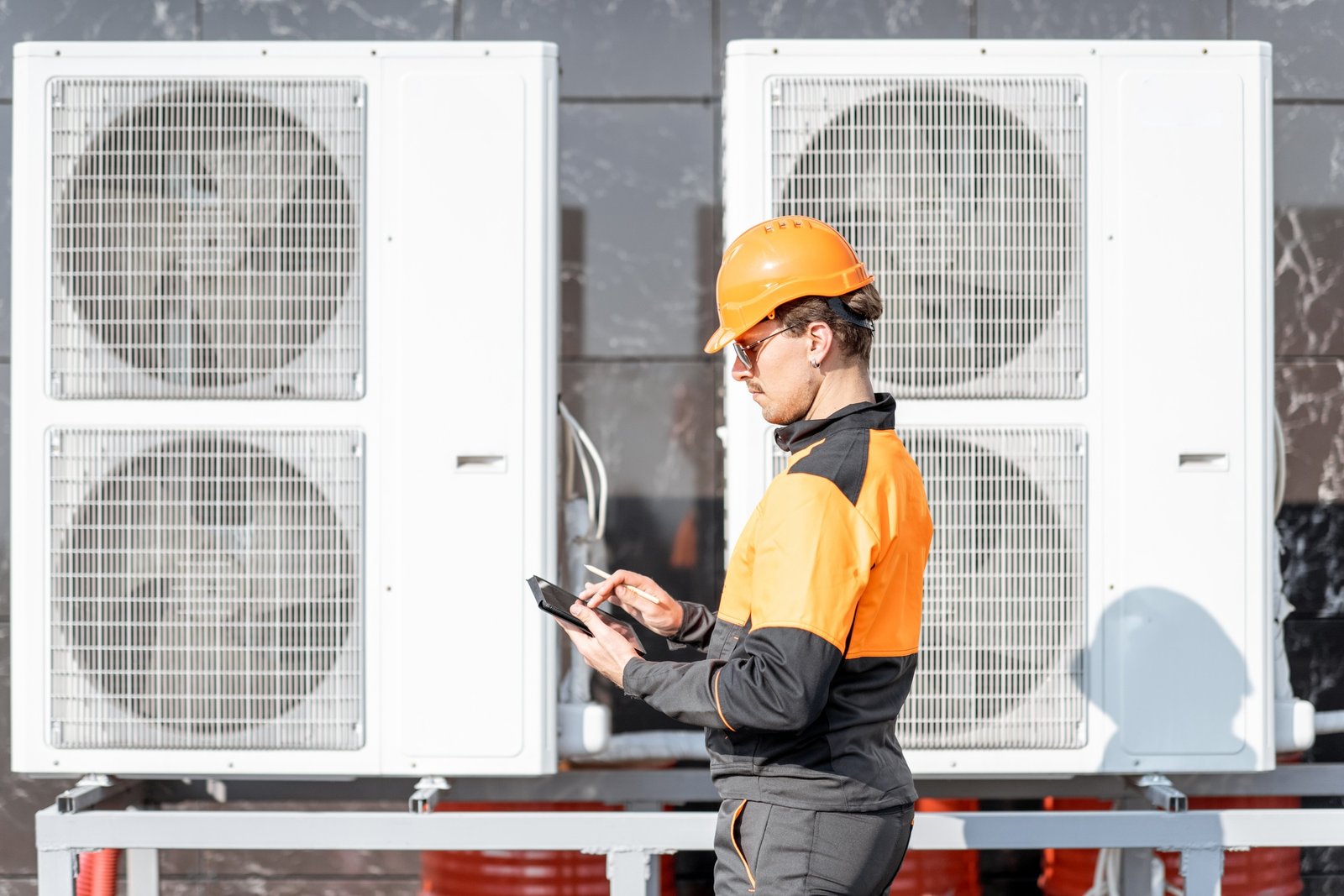
High ambient performance is also affected by installation. A unit on a dark roof, between parapet walls or near kitchen exhaust receives hotter condenser inlet air than the weather file. That site condition reduces margin because hot discharge air returns to the coil.
Capacity Derating Table (35 → 50 °C)
This is the table every high-ambient buyer needs. Use these factors as a screening reference; final values must come from the manufacturer’s selection software at the project condition.
| Outdoor dry-bulb | Capacity factor (vs 35 °C) | Power input factor | EER vs 35 °C | Selection action |
|---|---|---|---|---|
| 35 °C | 1.00 (baseline) | 1.00 | 100% | Standard rating point (T1 catalog) |
| 40 °C | ~0.94–0.96 | 1.08–1.12 | 84–89% | Confirm T2 rating |
| 43 °C | ~0.90–0.93 | 1.15–1.20 | 75–81% | T3 high-ambient required |
| 46 °C | ~0.85–0.88 | 1.22–1.28 | 66–72% | T3+ with oversized condenser |
| 48 °C | ~0.82–0.85 | 1.28–1.35 | 61–66% | Confirm compressor envelope |
| 50 °C | ~0.78–0.82 | 1.35–1.42 | 55–61% | Project-specific selection, dual-circuit recommended |
| 52 °C+ | ~0.72–0.78 | 1.45–1.55 | 47–54% | Engineering review; redundancy advised |
Capacity derating happens because the compressor works against higher condensing pressure. That higher pressure increases power input and discharge temperature, which leads to protection trips when the condenser and control logic are not designed for the condition.
Refrigerant Choice for Hot Climates
Refrigerant choice matters more at high ambient than at mild conditions because condensing pressure approaches the refrigerant’s critical temperature.
| Refrigerant | GWP | Critical temp | Discharge temp at 50 °C condenser | High-ambient suitability |
|---|---|---|---|---|
| R410A | 2088 | 71.4 °C | Moderate (~95–110 °C) | Standard for T3 high-ambient (industry mainstream) |
| R32 | 675 | 78.1 °C | High (~110–130 °C) | Limited acceptance: Suitable up to ~46 °C; check discharge-temp limit above 50 °C |
| R454B | 466 | 77.1 °C | Moderate-High | R410A replacement, A2L; check local code |
| R134a | 1430 | 101 °C | Lower | Excellent margin; preferred for screw chillers, less for DX comfort |
| R290 (propane) | 3 | 96.7 °C | Lower | Excellent margin but A3 flammability limits charge size |
| R744 (CO₂) | 1 | 31.1 °C | – | ✗ Below critical temp at 35 °C; not used for hot-climate DX comfort |
Practical rule: for 50 °C+ rooftop DX, R410A remains the safest mainstream choice today. R32 works to ~46 °C with careful discharge-line protection. R454B is increasingly used as the lower-GWP successor to R410A. Confirm with local F-gas / refrigerant regulations (EU F-gas, GCC Gulf Standards, India BEE) before ordering.
See ISO 817 refrigerant designation and safety classification for the formal A1/A2L/A3 framework.[6]
Condenser Coil Coating Options
In hot climates, the condenser coil sees not only heat but also dust, salt spray (coastal), acid rain (industrial) and UV. The coil coating decision affects 10-year service life directly.
| Coating | Material / process | Corrosion resistance | Typical lifespan | Best for |
|---|---|---|---|---|
| Standard aluminum fins | Bare AL fins, Cu tubes | Low | 5–8 years | Inland dry sites, low corrosion risk |
| Blue fin | Hydrophilic blue coating | Moderate | 7–10 years | General commercial high-ambient |
| Gold fin | Hydrophilic gold coating | Moderate-High | 8–12 years | Mild coastal, moderate pollution |
| E-coat / cataphoretic | Cathodic electrocoated polymer | High | 12–15 years | Coastal, industrial, desert dust |
| Heresite / phenolic | Phenolic resin spray | Very High | 15–20 years | Petrochemical, refinery, coastal industrial |
| Copper-on-copper coil | All-Cu fins + Cu tubes | High (no galvanic) | 12–18 years | Severe coastal / saline water spray |
| Stainless steel coil | SS 304/316 fins | Extreme | 20+ years | Offshore, marine, chemical plants |
Field rule: within 5 km of a coastline → minimum e-coat; within 1 km → e-coat + extended-life fan motor; offshore → Cu/Cu or stainless. In desert sand sites, e-coat plus a removable inlet screen reduces coil cleaning labor by 40–60%.
Worked Example: Correcting Nominal Capacity at 46 °C
A quick calculation shows why nominal capacity is risky. Assume a project needs 100 kW of cooling at a 46 °C outdoor design condition. A supplier offers a DX unit rated 100 kW at 35 °C, and the high ambient selection table shows a 12% capacity reduction at 46 °C.
Step 1 – Apply derating.
Formula: usable capacity = nominal capacity × (1 − derating fraction). Substitution: 100 × (1 − 0.12) = 88 kW (shortfall 12 kW).
Step 2 – Resize nominal capacity.
Required nominal capacity = required capacity / (1 − derating fraction). Substitution: 100 / 0.88 = 113.6 kW nominal at 35 °C → choose a 115–125 kW class unit.
Step 3 – Verify input power.
Power input factor at 46 °C ≈ 1.25 vs 35 °C. If the catalog 100 kW unit draws 32 kW at 35 °C, the 115 kW unit at 46 °C draws ~46 kW. Size cables, breakers and contactors at this hot-condition current.
Step 4 – Add site safety margin.
For rooftop installation with parapet walls or with discharge air potentially recirculating, add another 5–10% capacity margin. Final selection: 125 kW nominal for a 100 kW guaranteed delivery at 46 °C rooftop.
Step 5 – Confirm coil protection.
Site is Middle East (sand + salt-trace), inland 8 km from coast. Specification: e-coat condenser coil + removable inlet screen + IP54 electrical box.
In a recent SongXin project RFQ review for a 100 kW rooftop DX site at 46 °C, the first proposed unit was rejected because its corrected capacity screened at 88 kW and the standard aluminum fin would have required cleaning every 4–6 weeks. The final selection moved to a 125 kW class with e-coat, and projected cleaning interval extended to 10–12 weeks.
Condenser Installation: Avoiding Recirculation
Even a correctly-sized high-ambient unit can fail in the field if hot discharge air re-enters the condenser. This is the #1 high-ambient field failure mode.
| Layout problem | Effect on inlet temp | Capacity loss |
|---|---|---|
| Unit in parapet-walled rooftop pocket | +3 to +8 °C above ambient | 5–18% |
| Multiple units side-by-side, < 1.5 m apart | +2 to +5 °C above ambient | 4–12% |
| Discharge facing prevailing wind | +1 to +3 °C | 2–7% |
| Adjacent kitchen / generator / cooling tower | +5 to +12 °C | 10–25% |
| Dark roof surface, no shading | +3 to +6 °C | 6–15% |
| Restricted side clearance < 0.5 m | +2 to +6 °C | 5–15% |
Minimum clearances for high-ambient DX outdoor units:
| Direction | Minimum clearance |
|---|---|
| Front (coil intake) | 1,500–2,000 mm |
| Back | 600 mm |
| Sides | 1,000 mm (each side) |
| Top (above discharge fan) | 3,000 mm clear sky preferred |
| Between adjacent units | 2,000 mm |
If parapet walls are unavoidable, install discharge ducting / hoods to redirect hot air above the wall line.
High Ambient Selection Matrix
A high ambient DX selection should quantify site exposure, maintenance interval and operating risk. The table below gives procurement teams a first decision map.
| Site condition | Ambient range | Selection requirement | Maintenance interval | Risk if ignored |
|---|---|---|---|---|
| Normal outdoor yard | 35-40 °C | Standard outdoor clearance | Coil cleaning every 3-6 months | Moderate power rise. |
| Exposed roof | 40-46 °C | High ambient capacity table | Coil inspection every 1-3 months | Discharge-air recirculation. |
| Desert / dusty site | 43-50 °C | Larger condenser + dust plan + e-coat | Coil cleaning every 1-2 months | Blocked condenser airflow. |
| Industrial hot yard | 43-50 °C plus process heat | Project-specific condenser location | Monthly inlet-air review | Compressor high-pressure trips. |
| Coastal high-ambient | 38-46 °C + salt | E-coat or Cu/Cu coil, marine-grade | Coil inspection every 1-2 months | Galvanic corrosion failure 3–5 yrs |
| Container / remote shelter | 40-50 °C | Remote alarms + service clearance | 1-3 month inspection | Unnoticed fault escalation. |
The lifecycle issue is condenser cleanliness. Dust and debris reduce heat transfer because they block coil surface and airflow. In hot climates, the same dirt layer creates more damage because the condenser already operates close to its pressure limit.
RFQ Data and Specification Checklist
A high ambient DX RFQ should force the supplier to rate the unit at the site condition. Send the data below before accepting a quotation.
RFQ input list
- Required cooling capacity in kW or RT at the hot design condition (not at 35 °C).
- Outdoor design dry-bulb temperature and rooftop / parapet exposure.
- Indoor entering-air dry-bulb, wet-bulb or RH target.
- Installation altitude (high altitude = thinner air = less condenser airflow).
- Distance to coastline (km) and any industrial pollution exposure.
- Dust level (light / moderate / desert / sandstorm-prone).
- Condenser installation location, clearance and nearby heat sources.
- Power supply, maximum current requirement at hot condition.
- Operating schedule, redundancy need and remote alarm requirement.
- Refrigerant preference / local regulation (EU F-gas, GCC, India BEE, etc.).
- Requested documents: datasheet, high-ambient selection table, wiring diagram, O&M manual and packing list.
Specification checklist
| Item | Minimum answer before purchase |
|---|---|
| Rated capacity | Capacity at 43 °C, 46 °C or specified site ambient. |
| Input power | Power and current at high ambient condition. |
| Compressor envelope | Operating limit and high-pressure protection logic. |
| Condenser face area | +20–35% over baseline if site > 43 °C. |
| Condenser fan airflow | Confirmed CFM and total static pressure. |
| Coil coating | E-coat / blue-fin / gold-fin / Cu-Cu per site exposure. |
| Refrigerant | R410A / R32 / R454B with high-ambient suitability stated. |
| Test certification | T3 climate class per ISO 5151 / ISO 13253. |
| Certifications | ISO 9001, CE, AHRI rating basis. |
| Documents | High ambient selection data, installation manual, hot-climate commissioning notes. |
If your project is in a hot region, send the site ambient and an installation photo or sketch to SongXin for engineering support. The team can compare standard DX, T3 high-ambient DX and chilled-water options before the order is finalized.
Common Mistakes
The first mistake is buying nominal capacity at 35 °C for a 46 °C site. The calculation above shows that a 100 kW catalog unit with 12% derating delivers only 88 kW at the hot condition.
The second mistake is placing the condenser where hot discharge air returns to the coil. Recirculation raises inlet temperature, which increases pressure and leads to trips. Always provide 1,500–2,000 mm front clearance and 3,000 mm clear above the fan.
The third mistake is ignoring dust. Dust blocks condenser fins and filters because hot, dry sites usually carry airborne sand or construction particles. Use e-coated coils plus a removable inlet screen.
The fourth mistake is leaving electrical design at standard current. High ambient operation increases compressor work and fan demand 15–25%, so cable sizing and protection should use the hot-condition input data.
The fifth mistake is choosing a refrigerant without checking the discharge-temperature limit. R32 at >50 °C condenser can hit compressor discharge protection. R410A remains safer at extreme ambient.
The sixth mistake is specifying standard aluminum fins within 5 km of a coastline. Coil failure from salt corrosion can be visible within 3–5 years; e-coat or Cu/Cu doubles or triples that life.
FAQ
What is a high ambient DX air conditioner?
A high ambient DX air conditioner is a direct expansion unit selected to deliver rated cooling capacity at hot outdoor temperatures such as 43 °C, 46 °C or 50 °C. It uses condenser, fan, compressor, refrigerant and control selections that match the local design ambient – typically T3 climate-class tested per ISO 5151 / ISO 13253 – instead of relying on a mild T1/T2 catalog rating.
What is a T3 DX air conditioner?
T3 is the climate-class designation in ISO 5151 / ISO 13253 for air conditioners tested up to 46 °C outdoor dry-bulb (versus T1’s 35 °C and T2’s 27 °C). T3-rated units have larger condensers, higher-airflow fans, high-pressure-tolerant compressors and extended operating envelopes for Middle East, North Africa, South Asia and similar hot markets.
How much capacity does a DX air conditioner lose at 46 °C and 50 °C?
A typical DX unit loses about 12–15% capacity at 46 °C and 18–22% capacity at 50 °C compared to its 35 °C rating, while power input rises 22–28% (46 °C) and 35–42% (50 °C). EER at 50 °C is often only 55–61% of the 35 °C value. Always confirm with the manufacturer’s high-ambient selection table.
What outdoor temperature should I use for selection?
Use the project’s outdoor design dry-bulb temperature, not a generic climate label. For hot export projects, request performance at 43 °C, 46 °C or the specified local design condition (Saudi tenders often require 50 °C; UAE rooftops often need 50–55 °C). If the unit sits on a roof or near heat discharge, add site exposure information because condenser inlet air is hotter than weather data.
Which refrigerant is best for high ambient DX?
For 35–46 °C, R410A, R32 and R454B all work. For 46–50 °C, R410A is the safest mainstream choice. For 50 °C+, R410A or R454B with high-discharge-temperature compressor protection is preferred over R32. R134a is excellent on screw chillers. Always check local F-gas / refrigerant regulations and the supplier’s compressor envelope.
Why does high ambient reduce DX capacity?
High ambient reduces DX capacity because the condenser rejects heat to hotter air. Higher condenser temperature raises compressor pressure ratio and power input, which reduces capacity margin. When the condenser is undersized or airflow is blocked, the system reaches high-pressure protection before the room load is satisfied.
Do I need a special coil coating for hot climates?
You need a special coating when the site has coastal salt (within 5 km of coast), industrial pollution, or heavy desert dust. E-coat is the most common high-ambient choice and gives 12–15 year coil life. Cu-Cu or stainless coils are required offshore or in petrochemical environments. Standard aluminum fins are acceptable only for inland dry sites with low pollution.
What should I send for a high ambient DX quotation?
Send required capacity, outdoor design temperature, indoor condition, installation photo or sketch, condenser clearance, parapet/rooftop exposure, distance to coast, dust level, voltage, operating schedule, refrigerant preference and remote alarm requirement. This data lets SongXin rate the DX unit at the real site condition instead of quoting a standard catalog unit.
When is a chiller better than high ambient DX?
A chiller is better when the project has large central load, many zones or long annual operating hours. For projects above about 500 kW or more than 10 major zones, compare high ambient DX with an air-cooled or water-cooled chiller. SongXin’s air-cooled screw chiller operating range covers -35 °C to +48 °C, with specific high-ambient configurations available. See DX unit vs chilled water system for the full comparison.
Review Record
Technical review: SongXin HVAC Engineering Team, high ambient DX unit selection review, 2026-08-03. SongXin has supplied T3 high-ambient DX, rooftop and chiller equipment to projects across the Gulf (Saudi Arabia, UAE, Kuwait, Qatar, Oman), North Africa (Egypt, Algeria), South Asia (India, Pakistan, Bangladesh) and Southeast Asia (Thailand, Vietnam, Indonesia, Philippines).
Sources
- AHRI 340/360, “Performance Rating of Commercial and Industrial Unitary Air-conditioning and Heat Pump Equipment,” https://www.ahrinet.org/search-standards/ahri-340360-i-p-performance-rating-commercial-and-industrial-unitary-air-conditioning-and-heat-pump
- European Commission policy reference for EN 14511-2 rating conditions, https://webgate.ec.europa.eu/single-market-compliance-space/notified-bodies/notified-body/standards/standard/3474
- ASHRAE Weather Data Center, https://www.ashrae.org/technical-resources/bookstore/weather-data-center
- ISO 5149-1:2014, “Refrigerating systems and heat pumps – Safety and environmental requirements – Part 1,” https://www.iso.org/standard/54979.html
- ISO 5149-2:2014, “Refrigerating systems and heat pumps – Safety and environmental requirements – Part 2,” https://www.iso.org/standard/54980.html
- ISO 817:2024, “Refrigerants – Designation and safety classification,” https://www.iso.org/standard/83452.html