

1. Engineering Context: Why AHU Installation and Commissioning Matter
In commercial HVAC systems, Air Handling Units (AHUs) are central to delivering conditioned air to occupied spaces. Even when AHUs are correctly selected and manufactured to specification, poor installation and incomplete commissioning can significantly compromise performance.
Common operational issues—uneven airflow distribution, excessive noise, unstable temperature control, or higher-than-expected energy consumption—are frequently caused by deficiencies during installation and commissioning rather than equipment defects.
From an engineering perspective, AHU installation and commissioning should be treated as an integral part of system design, not a final procedural task.
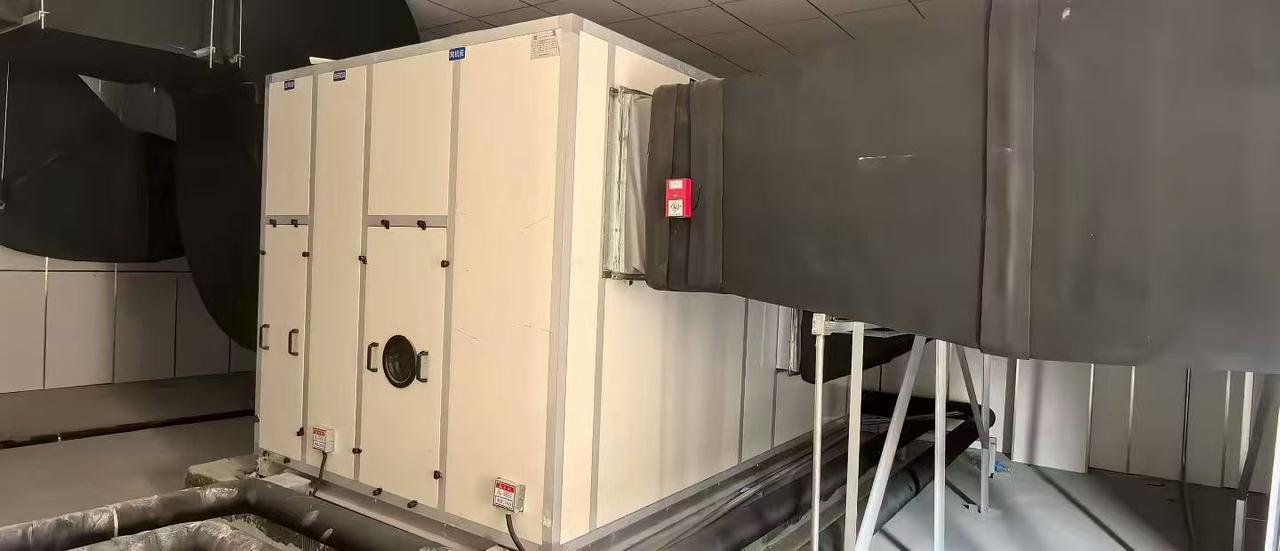
Project reality: Most post-handover complaints are installation/controls issues. Build verification and functional testing into the schedule early.
2. Pre-Installation Engineering Review
2.1 Verification Against Design Documents
Before installation begins, verify that the AHU is aligned with approved submittals and design intent. Engineers and project managers should confirm:
- AHU model and configuration match approved submittals
- Airflow rate, external static pressure (ESP), and coil parameters match design calculations
- Power supply and control interface requirements are defined and coordinated
Skipping verification often leads to late modifications (duct rework, control changes, rebalancing) and extended commissioning time.
2.2 Site Condition Assessment
Evaluate installation location for structural and operational feasibility:
- Structural load capacity and anchoring points
- Access routes for delivery, lifting, and handling
- Service clearance for filters, coils, fans, and control panels
Maintainability rule: If you cannot safely remove filters/coil sections or access motors after handover, the design is not finished—regardless of whether the unit is running.
3. AHU Placement, Mounting, and Alignment
3.1 Foundation and Support
Install AHUs on rigid, level foundations or steel frames designed for operational loads. Improper support can cause vibration, misalignment, and premature wear of fans and bearings.
- Confirm base/floor flatness and stiffness
- Select vibration isolators based on unit weight and operating frequency
- Verify isolation does not compromise drainage slope or duct alignment
3.2 Alignment and Leveling
Accurate leveling supports proper condensate drainage, uniform airflow across coils, and reduced mechanical stress on casing panels. Even small alignment errors can create long-term performance degradation.
4. Ductwork Connection and Airflow Integrity
4.1 Flexible Connections and Leakage Control
Use flexible duct connections at AHU inlets/outlets to prevent vibration transmission. Seal all joints to control air leakage—leakage reduces delivered airflow, increases fan power, and complicates achieving design ESP during testing.
- Confirm flexible connectors are installed without sagging or twisting
- Seal flanges, access panels, and duct joints per specification
- Verify casing and ductwork integrity before TAB (Testing, Adjusting, Balancing)
4.2 Airflow Distribution Considerations
Duct configuration should promote stable airflow into and out of the AHU. Insufficient straight duct length or poor transitions can cause non-uniform coil face velocity, higher pressure drop, and noise/vibration issues.
Field tip: If you must place elbows close to the fan outlet, use properly designed turning vanes and transitions, and plan additional time for balancing and troubleshooting.
5. Electrical and Control System Integration
5.1 Power and Protection
Electrical installation should verify correct voltage/phase, grounding, and protection settings. Motors and control panels must be commissioned together to avoid overload or unstable operation.
- Check supply voltage, phase rotation, and earthing
- Validate motor protection settings (overload, short-circuit, thermal)
- Confirm VFD parameters and minimum/maximum speed limits (if applicable)
5.2 Control Interface and BMS Integration
Modern AHUs typically integrate with a Building Management System (BMS). Commissioning should confirm:
- Correct sensor installation location and calibration
- Accurate signal scaling and communication (protocol mapping)
- Proper response to control commands and setpoint changes
Control logic errors are among the most common causes of post-handover complaints (hunting, unstable discharge temperature, poor humidity control).
6. Coil, Filter, and Drainage System Checks
6.1 Heat Exchanger Inspection
Cooling/heating coils should be inspected for cleanliness, correct connection orientation, and future maintenance access. Restricted airflow through coils reduces heat transfer and can drive up fan energy.
- Inspect fins for damage and construction dust
- Confirm coil piping orientation (supply/return) matches design
- Verify access doors allow coil face and drain pan inspection
6.2 Filtration and Condensate Management
Filters must be installed correctly to prevent bypass airflow. Drain pans and condensate piping should be tested under operating conditions to prevent overflow, water carryover, and microbial growth.
- Confirm filter frames/seals prevent bypass
- Verify drain trap configuration (negative pressure sections require correct trap depth)
- Test drainage during cooling operation and at reduced airflow
7. Commissioning Procedure and Performance Verification
7.1 Initial Start-Up
- Verify fan rotation direction
- Ramp speed gradually (especially with VFD)
- Monitor vibration, noise, and motor current
- Stop and correct abnormalities before proceeding
7.2 Airflow and Pressure Balancing (TAB)
Commissioning should include airflow measurement and confirmation of external static pressure. Adjust balancing dampers so the AHU operates within its design envelope.
- Measure total supply/return airflow and critical branch flows
- Verify ESP and fan operating point against the fan curve
- Confirm stable ΔP control for VAV systems (if applicable)
7.3 Functional Testing
Functional testing validates that the AHU performs as a controlled system, not just a running fan. Tests should cover:
- Control sequences (start/stop, warm-up, economizer, humidity logic if used)
- Alarm and safety responses (freeze stat, smoke, dirty filter, high static)
- Operation under different load conditions and setpoints
Documentation requirement: Record readings, setpoints, alarm thresholds, and final balancing data. This becomes the baseline for O&M and troubleshooting.
8. Common Installation and Commissioning Pitfalls
Typical AHU issues in commercial projects are predictable. Use the table below as a pre-handover risk check.
| Pitfall | What It Causes | Best Practice Mitigation |
|---|---|---|
| Inadequate service clearance | High maintenance cost, skipped filter changes, coil fouling | Verify access envelopes pre-install; coordinate doors/panels/route for component removal |
| Improper sensor placement | Hunting, unstable discharge temperature, false alarms | Follow control drawings; avoid turbulence zones; calibrate and validate scaling |
| Skipped TAB (air balancing) | Uneven airflow, comfort complaints, high fan energy | Schedule TAB with completed sealing; verify ESP and fan curve operating point |
| Poor duct sealing / leakage | Low delivered airflow, higher fan power, inability to meet setpoints | Seal joints and casing penetrations; inspect before insulation and ceiling closure |
| Drain trap errors | Overflow, water carryover, microbial growth risk | Set trap depth for pressure regime; test drainage during operation |
| Weak mech-controls coordination | Commissioning delays, unstable sequences, rework | Joint commissioning plan, integrated point-to-point test, documented sequences |
Quality gate: Do not accept “it runs” as completion. Accept “it meets design airflow, ESP, controls sequences, and safety responses with documented evidence.”
9. Songxin HVAC Engineering Support
Songxin HVAC designs AHUs with installation and commissioning practicality in mind. From an engineering perspective, Songxin emphasizes:
- Clear configuration and documentation
- Flexible control integration
- Structural robustness for transport and installation
Need AHU Installation or Commissioning Support?
Songxin HVAC can support submittal verification, installation guidance, controls integration checks, and functional test planning tailored to your project conditions.
See Next Step10. Summary and Next Step
Successful AHU installation and commissioning require coordination between design intent, site conditions, and operational requirements. Treating commissioning as a structured engineering process—not a checklist exercise—reduces operational risk and improves long-term system performance.
Next step for your project: Prepare the approved submittals, airside schematic, control points list, and TAB plan. These documents enable faster verification and smoother commissioning.
FAQ: Installing and Commissioning AHUs
Why do AHUs fail to meet airflow and ESP during commissioning?
Common causes include duct leakage, poor transitions near the AHU, incorrect fan/VFD settings, dirty filters/coils, and skipped TAB. Verify airside integrity and confirm the fan operating point against the fan curve.
What is the most important pre-installation check for an AHU?
Confirm the AHU model/configuration matches approved submittals and that airflow, external static pressure, coil parameters, power requirements, and controls interfaces align with design documents.
How can AHU noise and vibration be reduced during installation?
Use a rigid and level foundation, select correct vibration isolators, install flexible duct connections, avoid turbulent duct layouts near inlets/outlets, and validate fan balance and rotation during start-up.
What should be included in AHU functional testing?
Functional tests should verify control sequences, setpoint tracking, alarms and safety responses (freeze, smoke, high static, dirty filter), and operation under different load conditions—with documented results.