Selecting the wrong screw chiller type for a commercial or industrial project locks the facility into suboptimal energy costs and maintenance complexity for 15 to 25 years. The decision between air-cooled screw chillers and water-cooled screw chillers affects not just the equipment budget, but the entire mechanical plant layout, auxiliary system scope, water supply requirements, and long-term operational strategy.
Both types use the same vapor-compression refrigeration cycle with screw compressors. The critical difference is how they reject condenser heat — through ambient air or through a condenser water loop connected to a cooling tower. That single distinction drives most of the tradeoffs contractors, consulting engineers, and procurement teams must evaluate before committing to a system.
This guide covers the engineering parameters, cost structure, maintenance realities, and application boundaries that matter most when choosing between air-cooled and water-cooled screw chillers for commercial HVAC and industrial process cooling.
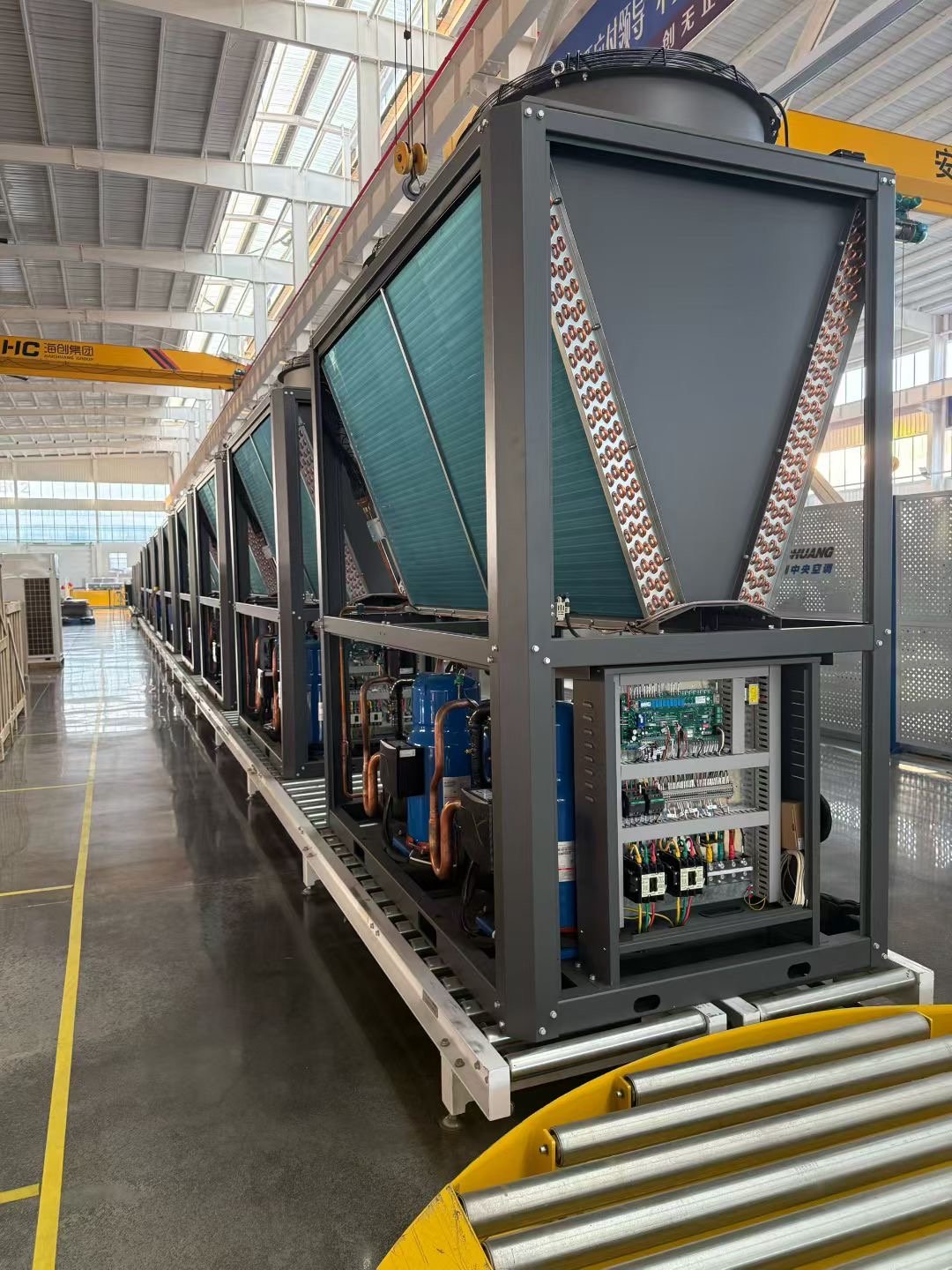
The table below summarizes the core decision factors. Each is expanded in the sections that follow.
| Parameter | Air-cooled screw chiller | Water-cooled screw chiller |
|---|---|---|
| Heat rejection method | Ambient air via condenser coils and fans | Condenser water loop via cooling tower |
| Typical capacity range | 30–500+ TR | 100–2,000+ TR |
| System components | Self-contained unit | Chiller + cooling tower + condenser water pumps + water treatment |
| Initial cost (CapEx) | Lower — fewer auxiliary components | Higher — additional infrastructure required |
| Energy efficiency (full load COP) | Moderate — affected by ambient dry-bulb temperature | Higher — benefits from lower condensing temperature via wet-bulb |
| Part-load efficiency (IPLV/NPLV) | Competitive in mild climates | Typically superior in most operating profiles |
| Equipment lifespan | 15–20 years (outdoor exposure) | 20–25 years (indoor installation, protected from weather) |
| Installation space | Outdoor — roof or ground pad | Indoor mechanical room + outdoor cooling tower footprint |
| Maintenance complexity | Lower — no water treatment system | Higher — requires water quality management and tower upkeep |
| Climate sensitivity | Efficiency drops as ambient temperature rises | Less sensitive to ambient — depends on wet-bulb and tower performance |
| Noise profile | Fan noise at outdoor location | Lower noise at chiller; tower noise at separate location |
The heat rejection method is the engineering foundation that determines almost everything else about system performance, layout, and operating cost.
An air-cooled screw chiller is a packaged unit. The condenser coils and axial fans are integrated into the same chassis as the compressors. Heat from the refrigerant is transferred to the condenser coils and rejected directly to the surrounding air.
Because the system relies on dry-bulb ambient temperature for heat rejection, condensing temperatures rise as outdoor air gets hotter. In regions where summer dry-bulb temperatures regularly exceed 40°C, the compressor must work harder to maintain the same cooling output, reducing both capacity and efficiency.
The upside: no cooling tower, no condenser water piping, no water treatment chemicals, and no makeup water supply. The unit is essentially plug-and-play from a system architecture perspective.
Water-cooled screw chiller systems reject condenser heat to a separate water loop. That heated water is pumped to an external cooling tower, where heat is dissipated primarily through evaporation.
Because evaporative cooling tracks the wet-bulb temperature rather than the dry-bulb, the condenser water entering the chiller is typically much cooler than the outdoor air temperature. This allows the compressor to operate at lower condensing pressures, which directly improves energy efficiency.
The tradeoff is system complexity. A water-cooled screw chiller plant is not a single piece of equipment — it is a coordinated system involving the chiller, cooling tower, condenser water pumps, piping, controls, and a continuous water treatment program. Each component adds cost, maintenance scope, and potential failure points.
Rated full-load COP is the number most often quoted in chiller datasheets, but it rarely reflects actual operating conditions. Commercial buildings and many industrial facilities run chillers at partial load for the majority of their operating hours. That makes part-load efficiency and climate sensitivity the more meaningful evaluation criteria.
The Integrated Part Load Value (IPLV) and Non-Standard Part Load Value (NPLV) provide a weighted measure of chiller efficiency across 25%, 50%, 75%, and 100% load conditions. For most commercial applications, IPLV is a better predictor of annual energy consumption than full-load COP.
Water-cooled screw chillers generally achieve higher IPLV ratings because the cooling tower can deliver progressively colder condenser water as the outdoor wet-bulb temperature drops — which happens naturally as building cooling loads decrease in shoulder seasons and at night.
Air-cooled screw chillers with modern variable-speed drives (VSD) and intelligent fan staging have improved their part-load performance significantly. In mild climates with moderate summer peaks, the IPLV gap between a well-specified air-cooled unit and a water-cooled system narrows considerably — sometimes to the point where the total plant efficiency (including tower fan and condenser pump energy for the water-cooled option) is comparable.
This is where project location becomes a hard constraint rather than a soft preference.
In hot, dry climates (high dry-bulb, low wet-bulb), water-cooled systems retain a large efficiency advantage because evaporative cooling remains effective. Air-cooled systems face their worst operating conditions precisely when cooling demand is highest.
In hot, humid climates (high dry-bulb and high wet-bulb), the efficiency gap between the two systems narrows because the cooling tower’s evaporative performance is limited by the elevated wet-bulb temperature.
In temperate climates with mild summers, air-cooled screw chillers can perform well and may not justify the added cost and complexity of a water-cooled plant — particularly for buildings that do not operate around the clock.
For deeper engineering detail, see our engineering comparison of water-cooled and air-cooled chillers.
Comparing only the purchase price of the chiller unit is the most common procurement mistake in commercial HVAC projects.
An air-cooled screw chiller typically has a lower initial cost because it is a self-contained system. There are no cooling towers to purchase and install, no condenser water piping to route, and no water treatment system to commission. Installation labor is reduced, and the construction schedule is shorter.
A water-cooled screw chiller plant costs more upfront — often significantly more. The cooling tower, condenser water pumps, associated piping, electrical connections, water treatment equipment, and the dedicated mechanical room all add to the capital budget.
However, the operational cost picture often reverses over time. In facilities that run chillers for extended hours — hospitals, data centers, large manufacturing plants, 24/7 commercial operations — the annual energy savings from a water-cooled plant’s higher efficiency accumulate quickly. In many of these cases, the energy savings offset the additional CapEx within 3 to 7 years, depending on local electricity rates and operating hours.
For facilities with seasonal or intermittent cooling loads — office buildings that operate only during business hours, retail spaces with limited summer peaks — the payback period may extend beyond the practical investment horizon, making the simpler air-cooled system the more rational financial choice.
The right financial comparison is Total Cost of Ownership (TCO): initial equipment and installation cost + annual energy cost + annual maintenance cost + anticipated replacement and major repair costs, projected over the expected service life.
Site conditions frequently eliminate one option before the cost or efficiency analysis even begins.
Air-cooled screw chillers require outdoor installation — typically on the roof or a ground-level concrete pad. They need substantial clearance around the unit for airflow and maintenance access. Roof installations must account for structural loading (these units are heavy) and vibration isolation. In dense urban environments, available roof space, weight capacity, and noise ordinances can all become limiting factors.
Water-cooled screw chillers are installed indoors in a mechanical room, which protects them from weather exposure and extends equipment life. However, the cooling tower still requires outdoor space, and the condenser water piping must be routed between the mechanical room and the tower location. Projects that have no feasible cooling tower siting — whether due to space, height restrictions, or local regulations — cannot use a water-cooled configuration regardless of its efficiency advantages.
For retrofit projects in existing buildings, the installation question often comes down to what infrastructure already exists. If the building has no mechanical room and no cooling tower pad, converting to a water-cooled plant involves major structural and plumbing work. In these situations, replacing or upgrading to a modern air-cooled screw chiller is often the faster and less disruptive path.
Maintenance capability is an under-evaluated selection factor. The most efficient chiller plant in the world underperforms if the facility does not have the resources to maintain it properly.
Air-cooled screw chillers require regular condenser coil cleaning (dust, debris, and environmental contamination reduce airflow and heat transfer), fan motor inspection, compressor oil analysis, and refrigerant charge checks. These are standard HVAC maintenance tasks that most building operations teams or contracted service providers can handle.
The primary risk is neglecting coil cleaning. Dirty coils raise condensing pressure, increase energy consumption, and accelerate compressor wear. In dusty or coastal environments, coil cleaning frequency must increase accordingly.
Water-cooled plants carry a heavier maintenance burden. The condenser water loop is an open system (exposed to atmosphere at the cooling tower), which means it is continuously subject to scaling, corrosion, and biological growth — including the risk of Legionella if water treatment lapses.
A disciplined water treatment program is not optional; it is a core operating requirement. Failing to maintain water quality degrades the condenser’s heat transfer surfaces, reduces chiller efficiency, and shortens equipment life. Cooling tower maintenance — fill media inspection, basin cleaning, drift eliminator checks, fan and motor servicing — adds further to the maintenance scope.
For organizations with a dedicated facilities engineering team or a reliable maintenance contractor, these requirements are manageable. For owner-operators with limited technical staff or remote sites without ready access to water treatment specialists, the maintenance demands of a water-cooled plant represent a real operational risk.
The right chiller type depends on the boundary conditions of the specific project — not on a general ranking of which technology is “better.”
This is a common pattern in warm-climate hospital HVAC solutions and healthcare projects, for example. SongXin HVAC has supplied air-cooled chiller solutions for hospital projects in southern China’s hot-summer, warm-winter climate zones — such as the 253,036 m² Pingguo Municipal Hospital campus in Guangxi — where the mild winter climate and site layout made cooling tower infrastructure unnecessary. In these conditions, the air-cooled configuration reduced both CapEx and maintenance scope without compromising the cooling reliability required for clinical operations, including an independent negative-pressure ventilation system for the infectious disease building.
Large multi-building campuses with centralized energy stations are the classic water-cooled use case. In SongXin HVAC’s project portfolio, the 103,000 m² Dacheng County Hospital in Hebei Province illustrates this pattern: a dedicated on-site energy station houses the central chiller plant and heating plant, distributing chilled water and hot water to all campus buildings through a full hydronic network. At this scale — with clinical buildings, surgical suites, cleanroom environments, and an infectious disease building all drawing from the same central plant — the efficiency and redundancy advantages of a water-cooled configuration are difficult to replicate with distributed air-cooled units.
Once you have determined which cooling method fits the project, the next decision is which manufacturer to work with. For B2B buyers sourcing screw chillers — especially from international suppliers — several evaluation criteria separate reliable partners from risky ones.
Factory testing protocols matter. A credible manufacturer should provide witnessed or certified factory performance testing before shipment, verifying cooling capacity, power input, and COP against the rated datasheet values. Ask for actual test reports, not just catalog specifications.
Configuration flexibility is important for international projects. Voltage, frequency, refrigerant type, ambient design conditions, and control interface requirements vary by market. A manufacturer that only offers fixed standard models may not meet the specific conditions of your project site. Look for suppliers that support project-specific engineering and customization.
Certification alignment should match your destination market. Depending on the project location, relevant certifications may include CE, AHRI, and compliance with standards such as EN 14511 or ASHRAE 90.1. Verify that the supplier can provide the documentation your project requires.
Product line depth is worth evaluating, particularly for large or phased projects. Some projects that begin with a screw chiller assumption end up better served by centrifugal or magnetic-levitation solutions after a detailed load analysis. A manufacturer that offers screw chillers, centrifugal chillers, and magnetic-levitation chiller plant solutions — as SongXin HVAC does — allows system selection to follow engineering analysis rather than being constrained by the supplier’s catalog. SongXin has delivered complete magnetic-levitation chiller plant solutions for 24/7 industrial process cooling applications, alongside its screw and centrifugal chiller lines.
After-sales support and spare parts availability outside the manufacturer’s home market is a practical concern that many buyers discover too late. Confirm the supplier’s service network, spare parts logistics, and technical support responsiveness for your region before placing the order.
In most operating conditions, yes — water-cooled screw chillers achieve higher full-load and part-load efficiency because evaporative cooling enables lower condensing temperatures. However, the efficiency advantage depends on climate, load profile, and whether the total plant energy (including cooling tower fans and condenser pumps) is included in the comparison. In mild climates with moderate loads, modern air-cooled screw chillers with variable-speed drives can close the gap significantly.
Air-cooled screw chillers typically last 15 to 20 years, with outdoor weather exposure being the main factor that limits lifespan. Water-cooled screw chillers, housed indoors, commonly reach 20 to 25 years with proper maintenance. In both cases, compressor condition, maintenance quality, and operating environment are the primary variables.
Water-cooled chiller plants consume water continuously through evaporation, drift, and blowdown at the cooling tower. Actual consumption depends on the cooling load, local climate, and tower design, but as a rough reference, a 500 TR water-cooled plant may consume several cubic meters of water per hour at peak load. This makes water-cooled systems less practical in water-scarce regions or where water costs are high.
Screw chillers use helical rotary compressors and are designed for medium to large capacity ranges, typically starting around 30 TR and scaling well above 500 TR. Scroll chillers use scroll-type compressors and are suited for smaller capacities, usually below 60–80 TR. For large commercial and industrial projects, screw compressors offer better part-load modulation and longer service intervals.
Standard air-cooled screw chillers are typically rated for ambient temperatures up to about 43–46°C. Beyond that, capacity derates and efficiency drops. For projects in extreme-heat regions (Middle East, parts of Africa and South Asia), specify high-ambient models designed and tested for operation at 50°C or above, and confirm the manufacturer’s test data for those conditions.
When a project involves multiple buildings served from a single energy center — such as a hospital campus, industrial park, or district cooling system — a centralized water-cooled plant typically offers better efficiency, easier redundancy management, and lower aggregate maintenance cost compared to placing individual air-cooled chillers on each building. The breakeven depends on total campus cooling load, piping distance, and the owner’s willingness to invest in centralized infrastructure and water treatment.
Need help comparing air-cooled and water-cooled screw chiller configurations for a specific project? Contact SongXin HVAC’s engineering team for load-based system sizing and a side-by-side efficiency analysis tailored to your site conditions.
Contact engineeringExplore SongXin HVAC’s full range of air-cooled screw chillers (173–1475 kW) and water-cooled screw chillers (190–3600 kW) — with factory testing, project-specific configuration, and documentation support for international procurement.
Planning a factory visit or supplier audit? Schedule a visit to SongXin HVAC’s production facility and testing laboratory to verify manufacturing capability and quality control firsthand.
Schedule factory visit