

SONGXIN HVAC · B2B BUYER INTELLIGENCE / DX ROOFTOP UNITS
Commercial DX Rooftop Unit Price and Specifications: A B2B Buyer’s Guide
How to compare packaged rooftop air conditioner quotations, verify corrected cooling capacity, calculate airflow requirements and avoid hidden installation or freight costs.
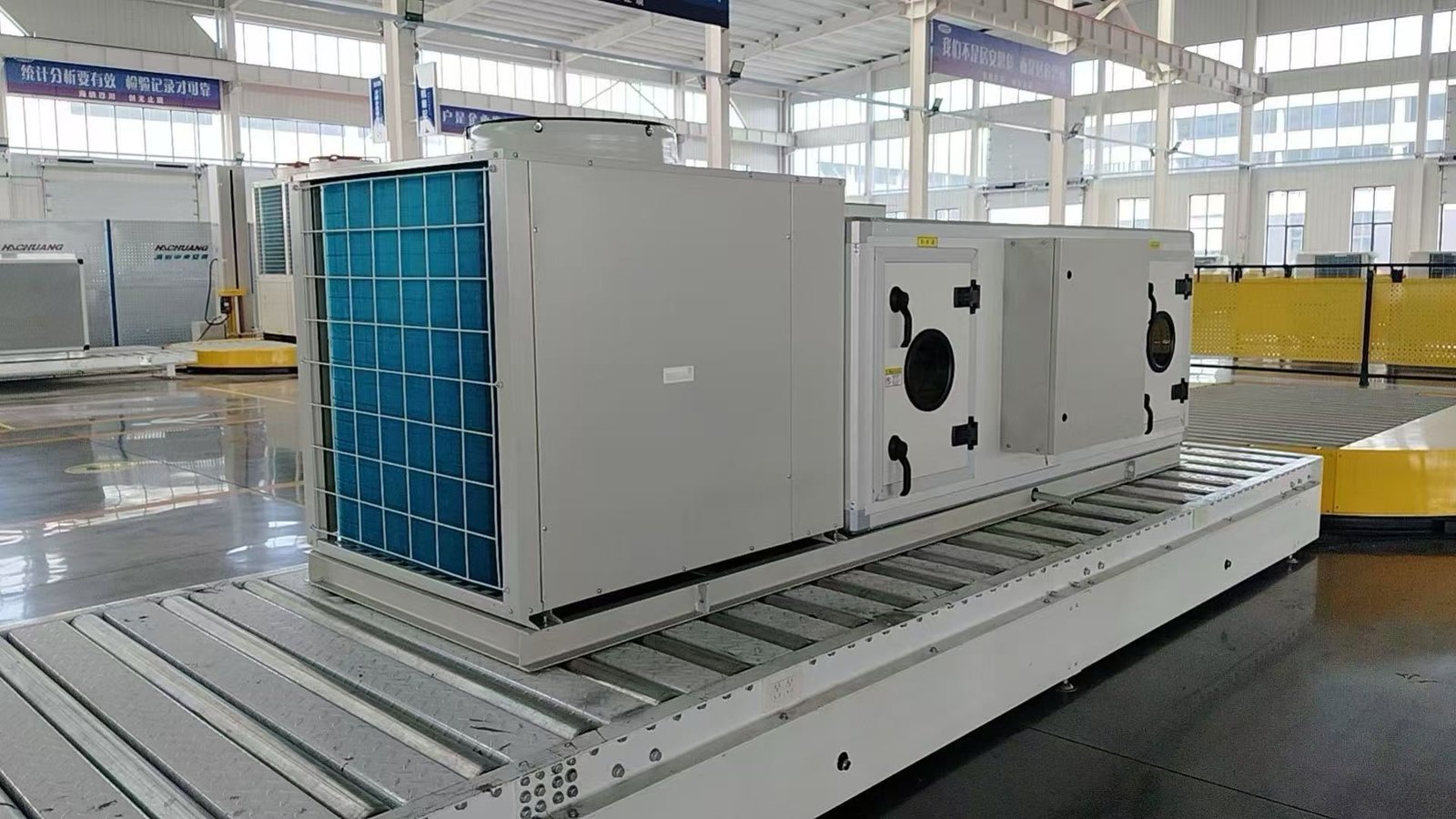
How much does a commercial DX rooftop air conditioning unit cost? There is no universally reliable price without knowing the unit’s required cooling performance, airflow, external static pressure, operating conditions and equipment configuration.
Two rooftop units with similar nominal cooling capacities can have very different quotations because their refrigeration circuits, fans, controls, filtration, heating functions, construction and supply scopes are not necessarily equivalent.
For international HVAC contractors, EPC companies, consulting engineers and equipment procurement managers, the key question is not simply “What is the price per kW?” It is “What will this unit actually deliver at our design conditions, and what is included in the price?”
This guide explains what drives commercial DX rooftop unit prices, how to interpret technical specifications, and how to obtain comparable international quotations.
01 / QUICK ANSWER
What Determines a Commercial DX Rooftop Unit Price?
A commercial rooftop unit price depends on the technical configuration required to meet the project and the agreed supply scope. The following inputs create the most significant differences between quotations.
| Cost factor | What changes the quotation |
|---|---|
| Cooling capacity | Actual total and sensible duty at agreed indoor/outdoor rating conditions |
| Outdoor design temperature | Corrected capacity, condenser selection and approved operating envelope |
| Airflow and external static pressure | Supply fan, motor, drive and duct-pressure requirements |
| Compressor and capacity control | Refrigeration circuit configuration and full-/part-load behaviour |
| Ventilation and filtration | Outdoor-air intake, filter stages, dampers and controls |
| Heating capability | Cooling-only, reversible heat pump or additional heating equipment |
| Efficiency, refrigerant and electrical | Required performance, operating power, safety and destination-country requirements |
| Outdoor casing and installation | Corrosion resistance, roof curb, equipment dimensions and lifting plan |
| Testing, customization and logistics | Factory documentation, accessories, quantity, packing, transport and commissioning scope |
For current SongXin configurations, see the DX Rooftop Units product page. A final equipment price requires a model-specific technical offer.
02 / PRODUCT CONTEXT
What Is a Commercial DX Rooftop Air Conditioning Unit?
A commercial direct expansion (DX) rooftop unit is typically a packaged air-conditioning system installed outdoors, often on a roof or suitable external platform.
In a conventional vapor-compression DX circuit, an expansion device reduces refrigerant pressure. The refrigerant then evaporates in the cooling coil and absorbs heat from the airstream. The compressor and condenser complete the refrigeration cycle and reject the captured heat outdoors.
A packaged rooftop unit may contain a compressor, condenser, evaporator coil, supply fan, filters, condensate provisions, electrical protection and controls in an outdoor-rated assembly. Additional functions depend on the exact model.
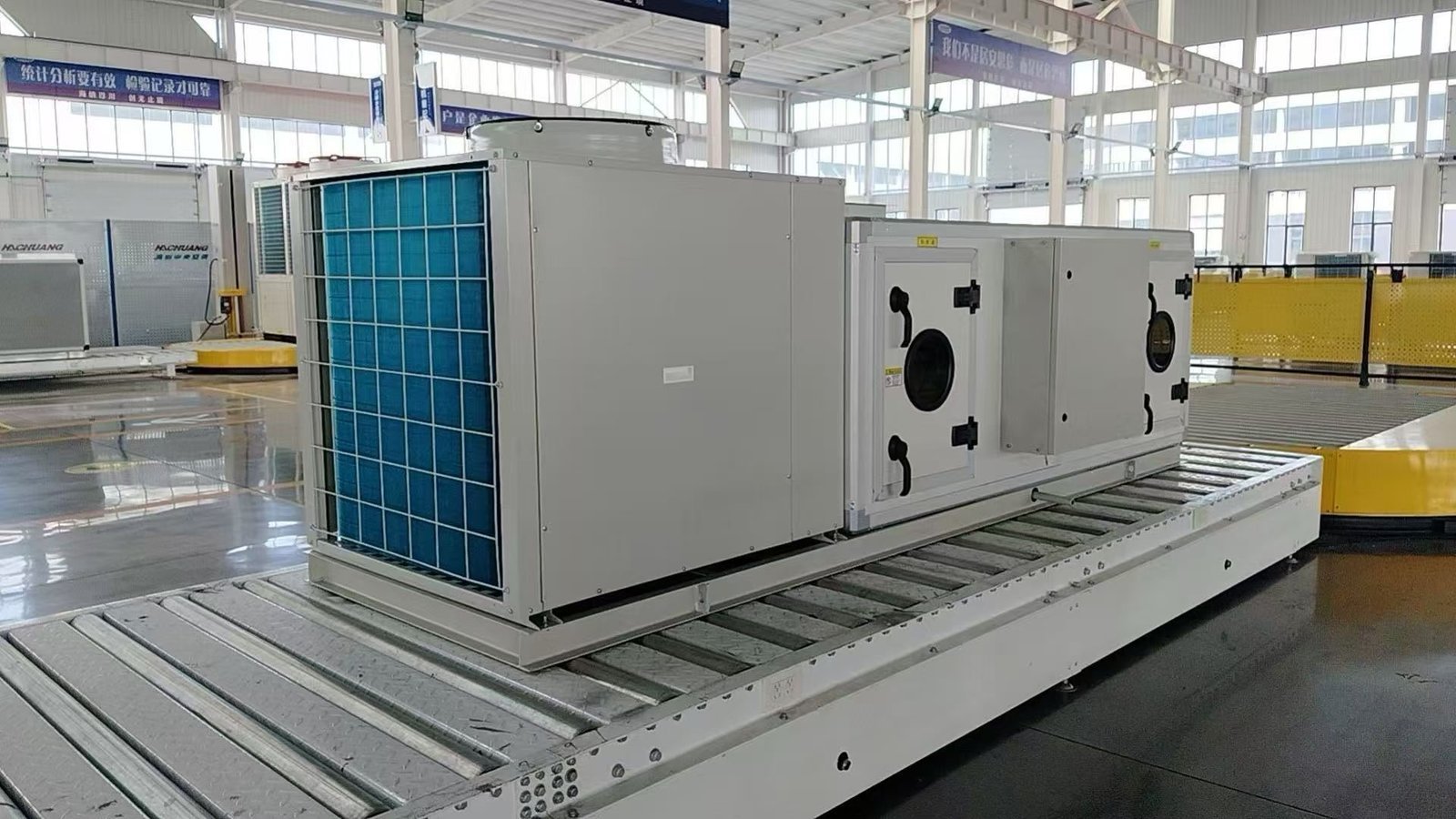
Cooling-only vs heat-pump rooftop units
A cooling-only unit provides refrigeration-based cooling. A reversible heat-pump rooftop model can also provide heating within its approved operating envelope. Other models may use separately specified heating sections. Heating must not be assumed from the word “rooftop.” Request heating capacity at winter design conditions, operating limits, control sequence and defrost information where applicable.
Rooftop DX vs split DX
A typical packaged rooftop assembly concentrates its main refrigeration and air-conditioning components in one outdoor cabinet. A split DX arrangement separates indoor and outdoor equipment and requires matched refrigerant pipework and controls. Both approaches can serve commercial sites, but they have different access and installation risks. See DX Rooftop vs DX Split System for that specific comparison; this guide focuses on pricing and procurement.
03 / PRICE TRANSPARENCY
Why Can Two Rooftop Units With Similar kW Ratings Have Different Prices?
A capacity label alone does not establish technical equivalence. Consider two hypothetical rooftop unit quotations.
| Requirement | Unit A | Unit B |
|---|---|---|
| Nominal capacity label | Similar | Similar |
| Outdoor conditions | Standard catalogue rating | Documented at the higher project ambient |
| Corrected total / sensible duty | Needs confirmation | Matched to project data |
| Airflow and ESP | Lower fan-pressure allowance | Higher specified operating pressure |
| Outdoor air and filters | Basic arrangement | Additional defined functions |
| Controls | Local control | Additional monitoring / BMS scope |
| Casing, tests and freight | Standard unit-only offer | Extra specified provisions / services |
Illustrative procurement comparison only; these are not actual SongXin quotations or validated product specifications.
Unit B may cost more because of its equipment and included services. But Unit A could be equally appropriate if it satisfies the approved project requirements. The goal is to identify the least-cost technically compliant and commercially transparent offer—not automatically the most complex machine.
04 / TECHNICAL SELECTION
Nine Technical Factors That Influence DX Rooftop Unit Prices
4.1 Corrected cooling capacity at actual outdoor temperature
Nominal cooling kW is a starting point, not proof that the same duty will be available under all operating conditions. Actual cooling and electrical input depend on the design and the specified outdoor condenser-inlet and indoor entering-air states.
A unit quoted at a 35°C outdoor test condition may deliver a different capacity at a 46°C project rating point. The change is model-specific; a universal derating percentage should not be assumed.
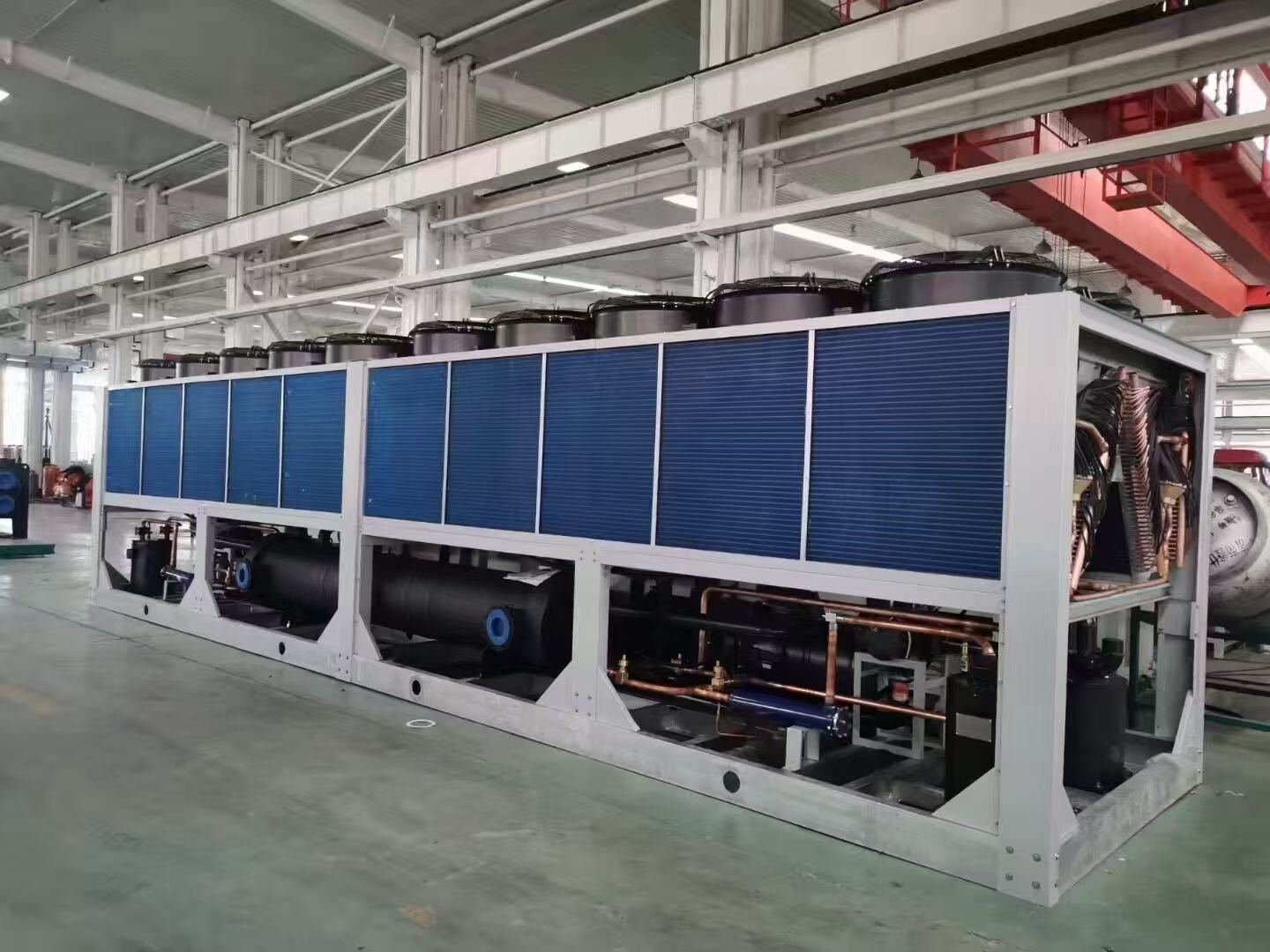
For high-temperature sites, obtain:
- Exact proposed model and corrected total/sensible cooling output
- Indoor DB/WB or equivalent humidity and outdoor condenser-inlet temperature
- Complete unit power input at the same point
- Compressor and condenser-fan limits and continuous operating envelope
- Required condenser-air discharge and service clearances
Condenser discharge recirculation, roof parapets and adjacent equipment can raise entering-air temperature above the nominal weather design condition.
Desert certification distinction: Eurovent’s Desert Certification option includes performance ratings at 35°C and 46°C and a two-hour operability test at 52°C. That operability test is not a guarantee of continuous full-load cooling at 52°C, and it does not establish certification for any particular SongXin model. Request exact-model evidence. See the High-Ambient DX Selection Guide.
4.2 Total cooling capacity, sensible cooling and humidity
Both sensible and latent cooling requirements matter. Total capacity represents the relevant combined sensible and latent duty; sensible capacity represents temperature-related cooling. The sensible heat ratio (SHR) is:
SHR = sensible cooling capacity ÷ total cooling capacity
An illustrative 100 kW total / 72 kW sensible selection has an SHR of 0.72 at that stated rating point—not a generic rating for every 100 kW rooftop system.
In humid climates, a unit with adequate nominal total capacity can still fail to satisfy the specified temperature and moisture duty. Ask for total and sensible output, entering and leaving air conditions, condensate provision and outdoor-air contribution at the same agreed design point.
Distinguish space load from coil duty: outdoor-air conditioning, fan heat and system layout may make cooling-coil requirements different from the room sensible load.
4.3 Airflow, external static pressure and fan power
Cooling capacity alone does not determine airflow. Airflow follows from the space sensible requirement, selected room/supply-air difference, ventilation and system design. External static pressure (ESP) must also match the duct system and filters.
Hypothetical space-airflow screening example: 72 kW space sensible load, 26°C room temperature, 16°C supply air, assumed density 1.20 kg/m³ and specific heat 1.005 kJ/(kg·K).
The simplified steady-state relationship is:
Qs ≈ V̇ × ρ × cp × ΔT
V̇ ≈ 72 ÷ (1.20 × 1.005 × 10) ≈ 5.97 m³/s, or 21,500 m³/h.
5.97 m³/s × 500 Pa ÷ 1,000 ≈ 3.0 kW
For an illustrative 500 Pa ESP, this is only theoretical air power associated with external pressure. It is not total fan electrical input; real fan selection also requires internal resistance, system effects, fan/motor/drive efficiency and the rated operating point.
4.4 Compressor arrangement and capacity control
Rooftop models may use fixed-speed, staged or modulating capacity control, subject to actual model availability. The refrigeration architecture affects part-load behavior, control functions, maintenance and power requirements. A variable-speed arrangement is not automatically the most economical choice at every load.
Compare the available operating range, relevant full- and part-load ratings, compressor cycling and protection strategy, starting/inrush characteristics and actual building load profile.
4.5 Outdoor air, filtration and economizer functions
Not every rooftop unit provides the same ventilation capability. Define required outdoor airflow and confirm whether damper sections, filtration, economizer operation, exhaust or relief arrangements and humidity controls are included.
Economizer operation may reduce mechanical cooling at suitable outdoor conditions, but it is climate- and controls-dependent. ASHRAE Standard 62.1-2025 provides ventilation/IAQ guidance for relevant applications in jurisdictions using that framework; elsewhere check the adopted local rules. A rooftop supply fan by itself does not establish compliance with required ventilation.
4.6 Heating, heat recovery and additional air treatment
Depending on the project and offered model, additional features may include a reversible heat-pump circuit, auxiliary heating, energy recovery, extra filtration, humidity treatment or acoustic provisions. Do not assume any option is standard equipment.
Specify each optional section separately where possible. Heat-recovery value depends on operating conditions, air-stream separation, pressure losses, maintenance and actual heat-transfer performance; no universal saving percentage applies.
4.7 Electrical supply, frequency and controls
Provide voltage, phases, frequency and control requirements before a firm international quote. Ask for a selected-model electrical schedule showing maximum current, starting characteristics, protective-device information and control architecture. Equipment rated for one power frequency cannot automatically be assumed suitable for another.
“BMS compatible” does not necessarily include supervisory software, field wiring, network integration and commissioning. The contract must define the supplied control scope and its interfaces.
4.8 Refrigerant type and safety
Refrigerant selection affects equipment arrangement, service, charge management and applicable safety provisions. Request the refrigerant designation, safety classification, unit charge where relevant, leakage-related safeguards and applicable model documentation.
ASHRAE 34 classifies refrigerants; ASHRAE 15 addresses refrigeration-system safety within its scope. Other jurisdictions may use ISO 5149, EN 378, relevant IEC product standards or local rules. Neither a refrigerant label nor a general “environmentally friendly” claim proves that every installation is compliant.
4.9 Outdoor construction, sound and service access
Rooftop systems are exposed to rain, dust, salt deposits, wind and solar heating, with maintenance often performed at height. Casing materials, corrosion treatment, vibration isolation and filter/coil/compressor access affect supply scope and ownership cost.
Sound power and sound pressure are different metrics. Sound-power data characterize source emissions under defined methods; sound pressure depends on distance, barriers and the surroundings. Ask for the stated acoustic metric and measurement basis rather than comparing unlike brochure numbers.
05 / TECHNICAL SUBMITTAL
What Must Be Included in a DX Rooftop Unit Datasheet?
A generic product brochure is not an adequate technical selection for a commercial procurement. Request equipment identification and performance at the agreed project duty point.
| Item | Supplier must identify |
|---|---|
| Exact manufacturer / model | Offered configuration and document revision |
| Cooling / heating operation | Cooling-only, reversible heat pump or separately specified heater |
| Total and sensible cooling | Both kW values at the defined indoor/outdoor conditions |
| Indoor / outdoor rating | Indoor DB/WB or humidity and condenser-inlet dry bulb |
| Supply airflow / ESP | m³/h (or CFM) and Pa at selected fan duty |
| Total unit electrical input | Input kW and the measurement boundary |
| Efficiency | Metric, units, test method and applicable rating standard |
| Compressor and control | Capacity-control steps/range and operating limits |
| Refrigerant | Designation, charge where relevant and safety documents |
| Ventilation / filtration | Outdoor-air provisions, filters, associated pressure losses and options |
| Electrical / noise | Voltage/frequency/phase, operating/starting values, acoustic basis |
| Dimensions / lifting | Overall size, operating weight, centre of gravity and lifting points if supplied |
| Roof installation | Curb interfaces, clearances, drainage and maintenance requirements |
| Controls / compliance | Included controller and BMS scope; actual reports or certificates when required |
Technical approval gate: the selected model must deliver the required corrected cooling and airside performance at the specified conditions, with a clearly agreed power, safety, controls, documentation and delivery scope.
06 / TESTING & STANDARDS
Rooftop Unit Efficiency and Certification: What Buyers Must Verify
Efficiency numbers depend on test conditions, product category, units of measurement and the relevant rating procedure. EER, IEER, IVEC, DSEER and seasonal metrics cannot be compared as if they were identical.
| Metric | Meaning / procurement caution |
|---|---|
| COP | Thermal output divided by electrical input within a stated performance boundary, expressed in consistent units |
| EER | Cooling efficiency at specified conditions; check whether units are W/W or Btu/h per watt |
| IEER | Integrated part-load efficiency under its applicable unitary-equipment rating method |
| IVEC / IVHE | Integrated ventilation/economizing/cooling and ventilation/heating metrics defined under AHRI 1340 |
| SEER / SCOP | Seasonal cooling or heating indicators defined by their respective procedures |
| DSEER | Desert seasonal efficiency metric developed around specified hot-climate test conditions |
AHRI 340/360 and AHRI 1340 are distinct rating frameworks
AHRI 340/360-2022 covers defined factory-made commercial and industrial unitary air conditioners and heat pumps and their associated rating requirements. AHRI 1340-2024 defines IVEC and IVHE procedures for eligible commercial/industrial equipment. They are not universally interchangeable, and rating/certification requirements depend on the product and destination market.
Eurovent Rooftops coverage has defined limits
The Eurovent Rooftops certification programme has scope criteria for eligible rooftop equipment, including defined unit types and capacity ranges. Its public programme information describes qualifying air-to-air and water-to-air units rated up to 200 kW, subject to the applicable sub-programme and exclusions; certain custom or additional features are outside the certified scope. Buyers must check the current programme rules and the exact model rather than assuming every size and optional section is certified.
Hot-climate operability is not continuous rated capacity
The Eurovent Desert option includes specified tests at 35°C and 46°C, as well as a two-hour operability check at 52°C. A two-hour operability result is not proof of continuous full-load cooling duty at 52°C. It must not be attributed to a SongXin model without corresponding evidence.
Do not equate “tested to a standard,” “manufacturer declaration” and “independently certified.” Ask for exact-model data, applicable testing records and a current third-party certificate if certification is a contractual requirement.
07 / BID COMPARISON
Compare Two Rooftop Unit Quotations on the Same Basis
Issue one common RFQ. Require each supplier to provide the offered model, technical deviations and all included and excluded services in writing. Use the schedule below when evaluating offers.
| Evaluation item | Supplier A | Supplier B |
|---|---|---|
| Exact model / configuration | Record model | Record model |
| Cooling vs heating functions | Verify scope | Verify scope |
| Corrected total / sensible kW | Record design point | Record design point |
| Indoor and outdoor rating states | Record conditions | Record conditions |
| Supply airflow and ESP | Record fan output | Record fan output |
| Total electrical input | Record kW / boundary | Record kW / boundary |
| Efficiency metric and standard | Record basis | Record basis |
| Outdoor air, filters, economizer | Included / excluded | Included / excluded |
| Refrigerant, controls, BMS | Specify scope | Specify scope |
| Roof curb and installation options | Included / excluded | Included / excluded |
| Testing and certification records | Identify evidence | Identify evidence |
| Warranty and spare parts | Record terms | Record terms |
| Delivery / insurance / commissioning | Specify included services | Specify included services |
| Price / currency / offer validity | Record offer | Record offer |
| Technical deviations | List in writing | List in writing |
Resolve technical deviations before approving the price
A nominally cheaper offer may omit corrected high-ambient output, required fan pressure, refrigerant safeguards or export/commissioning responsibilities. Equally, a more expensive unit may include unnecessary options. Compare the technically compliant base first, then evaluate options and lifecycle implications separately.
Send the model, duty point and inclusions for a project-specific technical discussion.
08 / COMMERCIAL TERMS
Budgetary Rooftop Unit Price vs Firm Quotation
A price discussed during project feasibility may use assumptions. Buyers should not treat a preliminary budget as a model-approved offer.
Budgetary estimate
May use incomplete capacity, airflow, ambient and accessory inputs. Requires a clearly stated list of assumptions and exclusions. Useful for feasibility, not equipment approval.
Firm technical offer
Identifies the specific model, verified design point, itemized options, commercial boundary, validity, delivery basis, warranty and required documents.
A budget may be discussed before the full duct pressure, outdoor-air fraction or building load is available. But a purchase order should follow a model-specific selection and written agreement on conditions and scope.
09 / INTERNATIONAL SHIPPING
EXW, FCA, FOB, CIF and CIP: What Is Really Included?
The quoted Incoterms rule determines where delivery occurs, which party arranges certain services, and when risks transfer. Always identify the named place/port and the Incoterms edition.

Under Incoterms 2020:
- EXW — named place: goods made available, with extensive collection and export responsibilities placed on the buyer.
- FCA — named place: delivery to the agreed carrier/person at the specified point; often useful for containerized shipments.
- FOB — named port: delivery occurs on board the vessel; sea/inland-waterway rule.
- CIF — named destination port: seller arranges specified freight and insurance, while risk transfers earlier under the rule.
- CIP — named destination: carriage and insurance arranged under a multimodal rule, with its defined earlier risk transfer.
| Rule | Procurement clarification |
|---|---|
| EXW | Confirm collection location, loading and export-clearance responsibilities |
| FCA | Identify the precise carrier handover point; may better reflect container terminal deliveries |
| FOB | Delivery/risk on board the nominated vessel at named loading port, not a generic container terminal handover |
| CIF | Seller arranges carriage and default insurance to destination port; destination arrival is not when risk transfers |
| CIP | Seller arranges multimodal carriage/required insurance to named destination, while risk transfers under carrier-delivery provisions |
FOB/CIF are not always ideal for container shipments
When goods are handed to a carrier at a terminal before being placed on a vessel, FCA or CIP can better reflect the physical delivery procedure. Choose terms according to the contract and actual handover, not just the presence of ocean freight.
CIF and CIP insurance differ
Under Incoterms 2020, CIF generally calls for the default minimum cargo cover corresponding to Institute Cargo Clauses (C), while CIP generally calls for broader cover under Clauses (A), subject to any agreed changes and policy terms. Confirm insurer, amount, exclusions and evidence, rather than assuming every “insured freight” offer is equivalent.
CIF does not automatically mean delivered, crane-lifted, installed and commissioned at the building. Import clearance, duties, inland carriage, roof reinforcement, crane lifts, ductwork, electrical installation and training may be outside the quotation.
See ICC: Incoterms 2020 for any mode and ICC: sea/inland-waterway rules for the authoritative rule wording.
10 / INSTALLATION BOUNDARY
Rooftop Installation Requirements That Can Change Total Project Cost
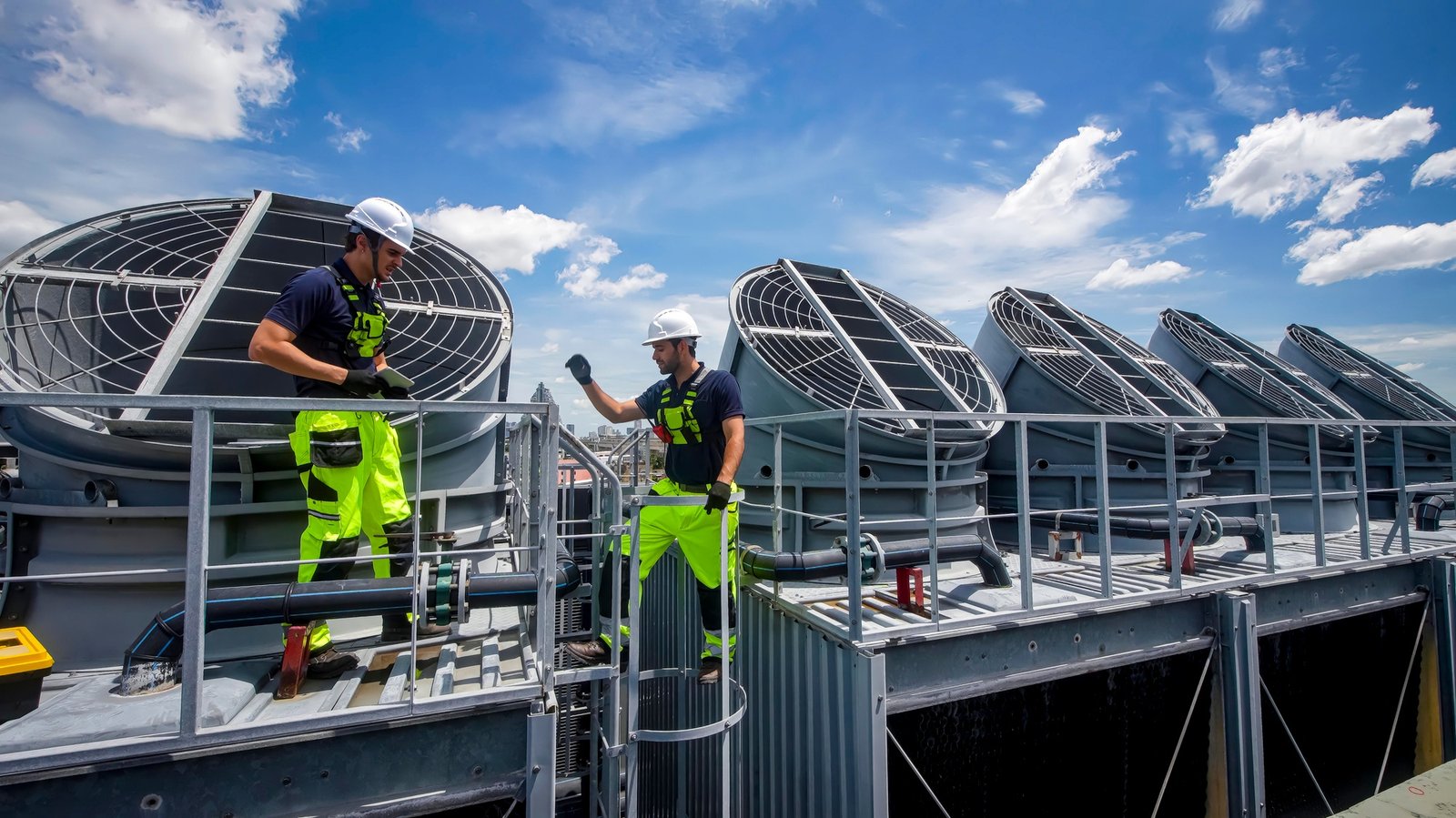
A packaged rooftop system can simplify some HVAC arrangements, but it still requires site coordination. The structural engineer must evaluate operating weight, support points, vibration and applicable wind/seismic effects.
The supplier should provide model-specific dimensions, operating weight and support/lifting information. The project team must coordinate roof openings, curb or platform, waterproofing, electrical feeder, ductwork, drainage and safe access.

Roof strength and operating mass
Confirm support/weight data and have the project structural engineer approve capacity, loads and vibration controls.
Curb, duct openings and roof seal
Coordinate curb height/type, discharge and return ducts, weather sealing and which party supplies each component.
Condenser intake and recirculation
Check parapets, discharge clearance, neighboring units and permitted maintenance zones to avoid performance loss.
Crane access and safe maintenance
Provide safe routes to filters, coils, controls and refrigeration components, plus a lifting/commissioning plan.
11 / LIFE-CYCLE VIEW
Purchase Price vs Lifecycle Cost: A Practical Calculation
Initial equipment price is one component of total ownership cost. Annual electricity, filtration, service, parts and downtime exposure also matter. For changing loads, energy use should be estimated from the actual power input and hours at each representative duty point:
Annual electrical energy (kWh) = Σ [unit electrical input (kW) × hours at that condition]
Use the selected equipment’s part-load and site-condition data. A constant full-load kW assumption may misrepresent actual annual consumption.
Hypothetical comparison: 2 kW input difference
Suppose two otherwise compliant units differ by an assumed average input of 2 kW over a 3,000-hour operating period. The difference would be 6,000 kWh per year. This is illustrative arithmetic, not measured or predicted SongXin equipment savings.
Actual inputs vary with ambient temperature, part load, supply fan speed and other conditions. An accurate lifecycle comparison uses the building schedule and manufacturer selection outputs rather than a universal “% energy-saving” claim.
Right-sizing can reduce purchasing and operating risks
The U.S. Department of Energy rooftop-unit sizing guidance emphasizes load-based sizing. Excessive oversizing can raise capital costs and lead to unfavorable compressor cycling or humidity performance, depending on the design; an undersized unit can fail comfort requirements. Evaluate the project load and realistic part-load profile before selecting nominal tonnage.
12 / VALUE ENGINEERING
Reduce Rooftop Unit Cost Without Sacrificing Required Performance
Value engineering should remove unnecessary specification while preserving approved mechanical, electrical and safety requirements.
Size from calculations, not nameplate replacement or floor area alone. Confirm total and sensible demand.
Use duct calculations and filter resistance; avoid excessive unverified fan margins.
Itemize heat pump, economizer, heat recovery, special coating, controls and extra tests.
Resolve structure, curb, lifting and safe service access before placing the order.
Confirm voltage, frequency, circuit and motor/compressor compatibility for the destination.
Do not remove required ventilation, refrigerant safety, fire or electrical provisions for a lower price.
A supplier quote should show the base compliant configuration and optional enhancements separately. The objective is transparent equipment value, not the lowest isolated factory price.
13 / TECHNICAL PROCUREMENT
Commercial DX Rooftop Unit RFQ Checklist
Use this checklist when contacting rooftop equipment manufacturers and suppliers. Unknown project values should be marked as open rather than silently assumed.
| Required information | What the buyer should provide |
|---|---|
| Application | Office, mall, warehouse, factory or other intended use |
| Site | Country, city, outdoor design conditions and altitude |
| Quantity | Number of units, identical or mixed configurations |
| Cooling duty | Total/sensible load in kW and load-calculation basis |
| Indoor/mixed air | Dry-bulb and wet-bulb/RH or equivalent psychrometric state |
| Outdoor design | Dry-bulb and condenser inlet-air constraints |
| Supply air and ESP | m³/h or CFM, and required Pa |
| Ventilation | Outdoor-air rate or percentage; filtration stages |
| Heating | Cooling-only, heat pump, or other defined heating function |
| Electrical | Voltage, phase, frequency and restrictions |
| Refrigerant | Destination-market/project restrictions |
| Controls | BMS interface, points, alarm and monitoring requirements |
| Roof installation | Available dimensions, structural limits, curb and access |
| Noise | Required criteria and assessment basis |
| Verification | Reports, certificates and factory witness testing required |
| Commercial scope | Named Incoterms place, delivery window, warranty and commissioning expectations |
Buyer instruction: request model-identified corrected total/sensible cooling kW, fan duty, complete electrical input, general-arrangement and roof-interface drawings, refrigerant/safety evidence, any applicable certification documentation, itemized equipment price, warranty and supply exclusions.
14 / READY-TO-SEND MESSAGE
A Commercial DX Rooftop Unit Quotation Request You Can Copy
The following is an RFQ template, not a real customer project or a statement of SongXin inventory.
Subject: Commercial DX Rooftop Air Conditioner — Technical Selection and Quotation
Hello SongXin HVAC,
We are sourcing commercial DX rooftop units for a project. Please review the following requirements and recommend a suitable configuration.
- Application and location: [project type, country/city]
- Equipment quantity: [units]
- Total cooling load / sensible cooling load: [kW / kW]
- Indoor/mixed-air rating point: [DB / WB or RH]
- Outdoor design temperature: [°C]
- Supply airflow and ESP: [m³/h, Pa]
- Outdoor air and filtration: [quantity / specification]
- Cooling-only / heating arrangement: [requirement]
- Electrical supply: [voltage, phase, frequency]
- Roof dimensions, load or access restrictions: [details]
- Refrigerant and controls requirements: [details]
- Testing, certification and documentation requested: [details]
- Destination and preferred Incoterms: [named place/port]
Please supply the exact model, corrected total/sensible performance at the design point, fan and electrical selection, refrigerant/controls documents, installation drawings, itemized price, warranty, factory-testing scope and commercial exclusions. Please identify any missing project data and assumptions.
Thank you.
WhatsApp opens with key design-data prompts; no website form or contact-page detour.
15 / ANSWERS FOR BUYERS
Frequently Asked Questions About DX Rooftop Unit Prices
How much does a commercial DX rooftop unit cost?
There is no universal price without the selected model, corrected cooling capacity, design ambient, airflow, ESP, accessories, quantity and delivery scope. Obtain an itemized supplier quote based on a defined technical RFQ rather than assuming a generic per-kW price.
Can I compare rooftop air conditioners by price per kW or ton?
Only as an early indicator when configurations and rating conditions are genuinely equivalent. Price per kW does not normalize high-ambient performance, sensible cooling, fan pressure, ventilation or included services.
Does a high-ambient rooftop unit always cost more?
Hot-climate requirements may change equipment selection, but no universal price surcharge or capacity-derating percentage applies. Request corrected performance and electrical input at the exact site design temperature.
What is the difference between total and sensible cooling?
Total cooling includes the relevant sensible and latent portions; sensible cooling relates to temperature. Both must be reviewed at the same entering-air conditions, especially for high outdoor-air or humidity loads.
Why does external static pressure affect the quotation?
ESP affects supply fan operating point. It can change fan, drive, motor, controls and power requirements. The real difference depends on the complete selected fan duty, not a nameplate alone.
Is an inverter rooftop unit always more efficient?
No universal conclusion applies. The selected compressor/fan technology, load profile, controls and applicable test data determine part-load energy performance. Compare like-for-like rated or verified values.
Can every DX rooftop unit provide heating?
No. Heating requires an explicitly specified and rated heat-pump or other heating arrangement. Confirm capacity and operating envelope at the required winter conditions.
Are outdoor-air ventilation and economizer functions included?
Not necessarily. Outdoor-air dampers, filters, economizer controls and related functions may be options or separate systems. Confirm the exact ventilation scope and the applicable project rules.
Does the quotation include roof curb, crane and installation?
Not automatically. Roof support/curb, lifting, waterproofing, ducts, electrical works, controls integration and commissioning must be written into the offer or assigned to the appropriate site contractor.
Which efficiency rating should an international buyer use?
Use the metric and standard appropriate to the exact product category and destination. AHRI 340/360 and AHRI 1340 describe different rating frameworks; EN 14511, EN 14825 and specific certification programmes may apply elsewhere. Avoid comparing differently defined values directly.
Are all SongXin DX rooftop units AHRI or Eurovent certified?
No blanket certification is claimed. Buyers should request valid exact-model evidence and check whether that particular configuration falls within the relevant programme scope and optional-equipment exclusions.
What is the difference between FOB and CIF?
Under Incoterms 2020, both are sea/inland-waterway rules. FOB delivery/risk transfer occurs on board at the loading port. Under CIF the seller arranges stated carriage/insurance to the destination port, while risk transfers earlier on shipment. Neither term automatically covers site installation.
Can SongXin discuss a customized DX rooftop quotation?
SongXin lists rooftop DX equipment. Send your project conditions for technical discussion; exact model availability, selected performance, certification, price, warranty, lead time and services require a real supplier offer.
TECHNICAL BASIS
Technical References and Further Reading
These official or industry references support general engineering and trade practices. Referencing a standard does not imply that any specific SongXin product is certified or independently tested to it.
- AHRI 340/360 — Commercial and industrial unitary equipment rating and IEER-related requirements within scope.
- AHRI 1340 — IVEC / IVHE rating framework and exclusions.
- Eurovent Certified Performance — Rooftops — Programme scope, declared equipment and eligible certified characteristics.
- Eurovent Desert Certification — Defined hot-climate cooling ratings and limited-duration operability.
- ASHRAE Standard 62.1 — Ventilation and acceptable indoor air quality within the relevant building/jurisdiction scope.
- ASHRAE Refrigeration Resources (Standards 15 and 34) — Refrigeration safety and refrigerant designations.
- U.S. Department of Energy — Rooftop Unit Sizing Guidance — Load-based equipment sizing and oversizing risks.
- ICC Incoterms 2020 — Rules for any mode and rules for sea/inland waterway — Delivery, risk, carriage and insurance.
Scope and verification notice: all worked calculations and supplier comparisons are hypothetical illustrations. They are not real SongXin model ratings, measured energy savings, customer site records, factory-test results, certifications or binding prices. Final design, compatibility, costs, operating limits and commercial commitments must be confirmed for the exact offered equipment and project.
SONGXIN HVAC · COMMERCIAL DX ROOFTOP EQUIPMENT
Request a Project-Based DX Rooftop Unit Quotation
The best purchasing decision uses corrected cooling performance, real airflow/ESP, a verified technical submittal and a transparent delivery scope. Share your project requirements with SongXin and request an exact-model selection rather than a generic price per ton.
No web forms. The final model, certification status, delivery time and price are subject to actual supplier confirmation.