When procurement teams and consulting engineers compare air source heat pumps (ASHP) and ground source heat pumps (GSHP) for commercial or industrial projects, the question is rarely “which technology is better.” The question that actually drives project decisions is: which system fits this building, this site, this climate, and this budget better?
Both technologies move heat rather than generate it directly. Both can deliver heating and cooling from a single system. But the way they source thermal energy — from outdoor air versus underground loops or water bodies — creates meaningful differences in efficiency, installation complexity, capital cost, and long-term operating economics.
This article breaks down the comparison from a B2B project perspective, covering the factors that matter most to facility owners, EPC contractors, consulting engineers, and procurement managers evaluating heat pump options for commercial, institutional, and industrial buildings.
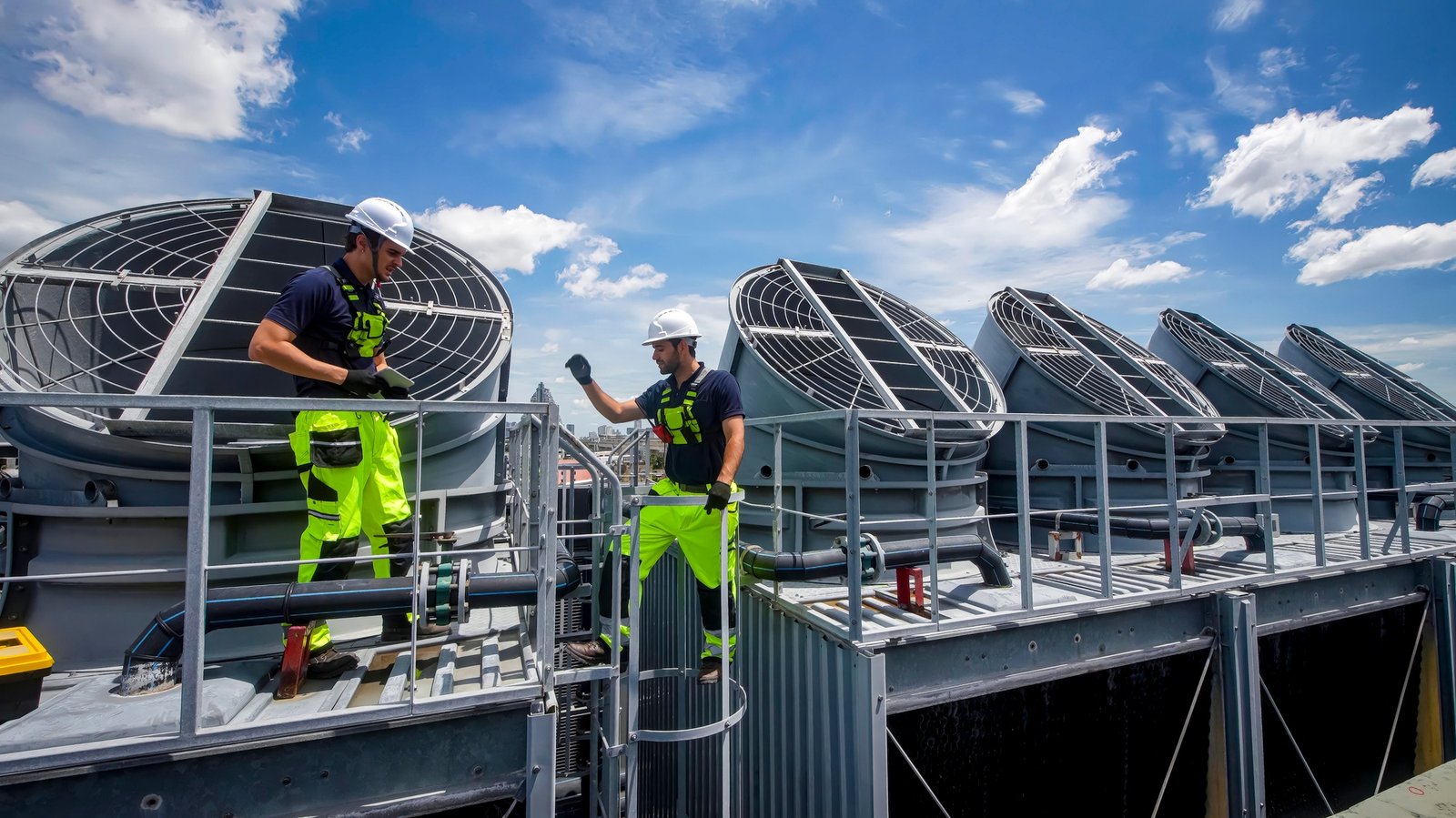
An air source heat pump extracts thermal energy from outdoor air using a refrigeration cycle. It needs an outdoor unit with fan-driven airflow and enough clearance for heat exchange. Installation is relatively straightforward: the system requires minimal civil work, and most buildings can accommodate an ASHP without significant structural modification.
A ground source heat pump — sometimes called a geothermal heat pump or water source heat pump — draws thermal energy from the ground through buried loops (horizontal or vertical boreholes) or from an open water source such as a lake, river, or well. Because ground and water temperatures remain comparatively stable year-round (typically 10–16°C at depth, depending on geography), GSHP systems maintain more consistent performance across seasons. The trade-off is that installation requires drilling, trenching, or access to a suitable water source, which adds civil work, project timeline, and upfront cost.
Both system types use the same underlying thermodynamic principle — the vapor-compression cycle. The real differences show up in where the heat comes from, how much site work is needed, and how performance responds to changing outdoor conditions.
Most comparison articles jump straight into COP numbers. But in commercial project decision-making, efficiency alone rarely determines the outcome. The more critical questions are usually practical ones:
These questions matter because the gap between ASHP and GSHP becomes much clearer — and sometimes narrows significantly — once you anchor the comparison in actual project constraints rather than theoretical peak performance.
Ground source systems generally hold an efficiency advantage. Because subsurface temperatures do not swing with seasons or weather events, a GSHP can maintain a more stable coefficient of performance (COP) across the year. Well-designed commercial GSHP systems can achieve COP values of 4.5 to 5.5 in cooling mode and 3.8 to 4.8 in heating mode, depending on ground conditions, system configuration, and load profile. The U.S. EPA has noted that geothermal heat pumps are among the most efficient and environmentally clean heating and cooling technologies available.
Air source heat pumps, by contrast, are exposed to ambient temperature swings. In moderate climates, modern ASHP systems perform well, with COPs commonly in the range of 3.0 to 4.2 for cooling and 2.5 to 3.5 for heating under standard rating conditions. However, performance can degrade during extreme cold or extreme heat, because the temperature differential between the source (outdoor air) and the delivery (conditioned space or hot water) widens. Low-temperature ASHP models with enhanced vapor injection compressors have improved cold-climate performance significantly — some units now operate reliably down to −35°C — but the COP at those extremes is still lower than what a GSHP delivers from stable ground temperatures.
That said, a higher COP does not automatically mean a better project investment. In moderate climates with shorter heating seasons, or in buildings where the system does not run around the clock, the incremental efficiency gain of GSHP may not justify the added drilling and loop installation cost. This is one reason ASHP remains the more common choice in many international markets.
This is typically where the biggest separation between ASHP and GSHP occurs.
Air source heat pumps are faster and cheaper to deploy. They need outdoor space for the condensing unit — a rooftop, a mechanical yard, or a building façade — and adequate clearance for airflow. In most cases, an ASHP system can be installed without major civil work, making it especially attractive for retrofit projects, urban buildings, and clients who need to minimize disruption. For projects using air-cooled screw chillers or modular ASHP units in the 150–1,500 kW range, the equipment can often be craned into position and connected to the hydronic distribution system within days.
Ground source systems demand more from the site. Vertical borehole fields require drilling rigs, geological surveys, and in some cases environmental permits. Horizontal ground loops need significant land area. Open-loop systems require a suitable water source and often regulatory approval for water abstraction and discharge. The technical merit of GSHP is rarely in question; the challenge is whether the site conditions, budget, and schedule can support the additional infrastructure.
Research on GSHP cost comparisons consistently shows that drilling cost and ground conditions are among the most variable factors in project economics. In some regions, drilling is relatively affordable and ground conditions are favorable, making GSHP cost-competitive. In others, rocky substrata, limited land, or high drilling rates can push GSHP first cost well above the ASHP alternative.
For large-scale projects — campuses, hospitals, resorts, district energy systems — where the building owner has sufficient land, expects long operating hours, and is willing to invest for lower lifecycle cost, GSHP often makes strong economic sense. For many other projects, particularly urban retrofits and budget-constrained developments, ASHP offers a more practical path.
ASHP is usually the stronger choice when capital budget is the primary constraint. It also fits better when the project has limited outdoor land, when drilling is impractical or prohibited, or when the schedule demands fast deployment.
Retrofit projects are a particularly strong use case. Replacing an aging boiler or chiller with an air source heat pump system — whether a split-type unit, a rooftop packaged system, or an air-cooled screw chiller — is often far simpler than redesigning the entire site around a ground loop. In many cases, the ASHP can connect directly to existing hydronic piping, fan coil units, or air handling units with minimal modification.
ASHP also makes sense when the ownership horizon is shorter. A developer planning to sell, reposition, or refinance within five to ten years may not capture enough long-term savings from GSHP to justify the higher first cost. The faster payback profile of ASHP can be a decisive advantage in these scenarios.
In moderate climates — where winter temperatures rarely drop below −10°C and summer peaks are manageable — the performance gap between ASHP and GSHP may be narrow enough that the simpler, lower-cost ASHP solution delivers the best overall value.
GSHP becomes compelling when the project runs for long hours, faces demanding heating or cooling loads, or places high value on predictable long-term energy performance.
Because subsurface temperatures remain relatively constant, GSHP systems avoid the seasonal performance degradation that affects air source equipment. For a hospital running 24/7, a hotel with continuous domestic hot water demand, a data center with year-round cooling loads, or a campus with both heating and cooling needs across seasons, the consistency of GSHP performance can translate into significantly lower annual operating cost.
GSHP also offers advantages where noise is a concern. Without large outdoor fan units, ground source systems produce less external noise — a meaningful benefit for hospitality projects, healthcare buildings, residential campuses, and premium developments that prioritize low visible plant impact. The U.S. Department of Energy notes that geothermal systems are generally quieter and often longer-lasting than air-source alternatives.
For projects that support green building certifications such as LEED, BREEAM, or WELL, GSHP systems can contribute significantly to energy performance credits. When combined with heat recovery, a well-designed GSHP can simultaneously provide chilled water for cooling and recovered heat for domestic hot water or reheat, achieving total system COP values above 6.0.
Most importantly, GSHP rewards owners who think in lifecycle terms. If the building will be held and operated for 20+ years, and the system will run heavily, the extra capital invested in ground loops and drilling is often justified by decades of lower energy bills, reduced maintenance, and lower exposure to weather-driven performance variability. The underground loop infrastructure itself typically lasts 50 years or more.
In some projects, the answer is not one or the other — it is both.
A hybrid design can use GSHP for base load and ASHP for peak demand. This approach reduces the required borehole field capacity while still capturing much of the ground source efficiency advantage during normal operating hours. When the building reaches peak load — during the hottest afternoon or the coldest morning — the air source component handles the additional capacity.
Research on hybrid GSHP systems has shown that combining technologies can reduce capital cost by 20–40% relative to a fully ground-coupled design, particularly in projects where drilling cost is high or land for boreholes is limited. The efficiency penalty is modest because the ASHP component only operates during peak periods, while the GSHP handles the majority of annual runtime.
This approach is worth exploring when a project owner wants better long-term efficiency than a pure ASHP solution can provide, but cannot justify the full drilling investment of an all-GSHP system. A manufacturer that supplies both ASHP and GSHP equipment can support the engineering and integration of these hybrid configurations more effectively than a supplier with only one product line.
Whether the project calls for ASHP, GSHP, or a hybrid configuration, the manufacturer’s capabilities should be evaluated against several criteria that go beyond headline specifications:
Beyond the equipment itself, experienced B2B buyers also evaluate the manufacturer’s documentation capability (test reports, compliance certificates, installation drawings), after-sales support structure (spare parts availability, remote diagnostics, warranty terms), and willingness to support the engineering review process with technical data and selection guidance.
Songxin HVAC manufactures both air source and water/ground source heat pump systems, which positions it to support projects across the full spectrum of commercial and industrial heat pump applications.
On the water/ground source side, Songxin’s water/ground source heat pump units cover a cooling capacity range of 190 to 3,600 kW, with heating capacities from 200 to 3,800 kW. These units use semi-hermetic twin-screw compressors with 25–100% stepless capacity modulation and are available with shell-and-tube, brazed-plate, or falling-film evaporators depending on application requirements. COP ratings reach up to 5.5 in cooling mode and up to 4.8 in heating mode, subject to operating conditions. Refrigerant options include R134a, R1234ze (ultra-low GWP), R407C, and R410A, allowing project teams to match the refrigerant to destination-market regulations and environmental targets. VFD-equipped models are available for projects where part-load efficiency optimization is a priority.
On the air source side, Songxin offers low-temperature air source heat pumps designed for hot water and space heating applications with nominal heating capacities of 40 to 160 kW, operating reliably from −35°C to +48°C ambient with outlet water temperatures up to 60°C and COP above 4.0. For larger commercial cooling and heating loads, Songxin’s air-cooled screw chillers provide cooling capacity from 173 to 1,475 kW with semi-hermetic twin-screw compressors, smart defrost technology, and a wide operating range of −35°C to +48°C. These units require no machine room or cooling tower, making them practical for retrofit and space-constrained projects.
Both product lines are manufactured in ISO 9001-certified facilities with 100% factory testing before shipment. Units undergo performance verification, leak and pressure testing, and environmental simulation across −20°C to +55°C conditions. Songxin also supports OEM/ODM manufacturing, custom voltage and refrigerant configurations, BMS integration (RS485/BACnet/Modbus), and full project documentation including test reports, compliance records, and installation drawings.
For procurement teams evaluating ASHP versus GSHP — or considering a hybrid approach — having access to a manufacturer that covers both product families simplifies the comparison process and provides a single point of engineering accountability.
Ground source heat pumps are generally more efficient because they draw heat from stable underground or water temperatures rather than fluctuating outdoor air. Commercial GSHP systems can achieve COP values of 4.5 to 5.5 in cooling mode, while ASHP systems typically operate in the range of 3.0 to 4.2 under standard conditions. However, the efficiency gap narrows in moderate climates and at partial loads, so the practical difference depends heavily on the project’s location and operating profile.
Air source heat pump installation costs are significantly lower because they require minimal civil work — no drilling, no ground loops, and no geological surveys. Ground source systems carry higher upfront costs due to borehole drilling or horizontal loop installation, but they typically deliver lower annual energy bills. Whether the lifecycle savings of GSHP justify the extra first cost depends on factors such as drilling cost in the project region, expected operating hours, and the building owner’s investment horizon.
Yes. Hybrid configurations use GSHP for base load and ASHP for peak demand, reducing the required borehole field while maintaining most of the ground source efficiency advantage. This approach can lower capital cost by 20–40% compared to a full GSHP installation, making it an attractive option when drilling cost is high or land for boreholes is limited.
Yes. In cooling-dominated climates, GSHP systems reject heat into the ground rather than into hot outdoor air, which gives them an efficiency advantage over ASHP especially when ambient temperatures exceed 40°C. However, thermal imbalance can be a design consideration in buildings that primarily cool and rarely heat, as the ground temperature may gradually rise over years. Proper loop sizing and, where needed, supplemental heat rejection strategies (such as a hybrid design) can address this issue.
Air source heat pump units typically last 15 to 20 years with proper maintenance, though outdoor components such as fans and coils may require attention sooner due to weather exposure. Ground source heat pump units have similar mechanical lifespans, but the underground loop infrastructure — the most expensive part of the installation — typically lasts 50 years or more, providing a long-term asset that outlives several generations of mechanical equipment.
For well-designed commercial GSHP systems, COP values in the range of 4.5 to 5.5 for cooling and 3.8 to 4.8 for heating are achievable depending on ground temperature, loop design, load profile, and refrigerant selection. When heat recovery is incorporated — capturing condenser heat for domestic hot water while simultaneously providing chilled water — total system COP can exceed 6.0. Buyers should ask the manufacturer for verified performance curves rather than relying solely on headline ratings.
Not sure whether ASHP or GSHP is the right fit for your project? Songxin HVAC engineers can help you compare both options based on building type, climate zone, installation conditions, and budget targets. Contact our team for a project-specific recommendation.
Get a Project RecommendationCompare Songxin’s full heat pump range — from 40 kW air source units to 3,600 kW water/ground source systems. View specifications, download catalogs, and request a custom quotation.
Explore Heat Pump Products