A practical guide for overseas buyers to evaluate manufacturers, compare sourcing regions, verify factory capability, and reduce procurement risk.
If you are planning to source DX units from China — whether for distribution, project supply, or private-label resale — the challenge is rarely about finding a factory. It is about finding the right factory, in the right region, with the right capability for your specific order type.
China is home to hundreds of DX unit manufacturers, ranging from large branded commercial lines to flexible OEM factories that cater to overseas distributors and contractors across Asia, Africa, Latin America, and the Middle East. But sourcing outcomes vary widely depending on which region you buy from, which type of supplier you work with, and how thoroughly you verify production capability before committing.
This guide is written for overseas distributors, HVAC project contractors, and OEM buyers who need a structured, practical approach to evaluating China DX unit suppliers — covering manufacturing regions, supplier types, factory audit logic, certification verification, MOQ and lead time norms, and common procurement mistakes.
It is not a general introduction to DX technology. If you need product-level information, you can review our DX rooftop units, DX split systems, or ducted DX units for technical specifications and application guidance.
Not every manufacturing cluster in China serves the same buyer profile. Understanding regional strengths helps you narrow your shortlist before reaching out to individual suppliers.

Guangdong has the deepest concentration of commercial DX unit production in China. Factories here tend to have more mature export processes, multilingual sales teams, and experience with container-level orders. The region also hosts several large branded HVAC manufacturers whose products are already distributed in Southeast Asia and the Middle East.
For buyers who need brand-backed documentation, established after-sales channels, or consistent repeat supply, Guangdong is typically the first region to evaluate.
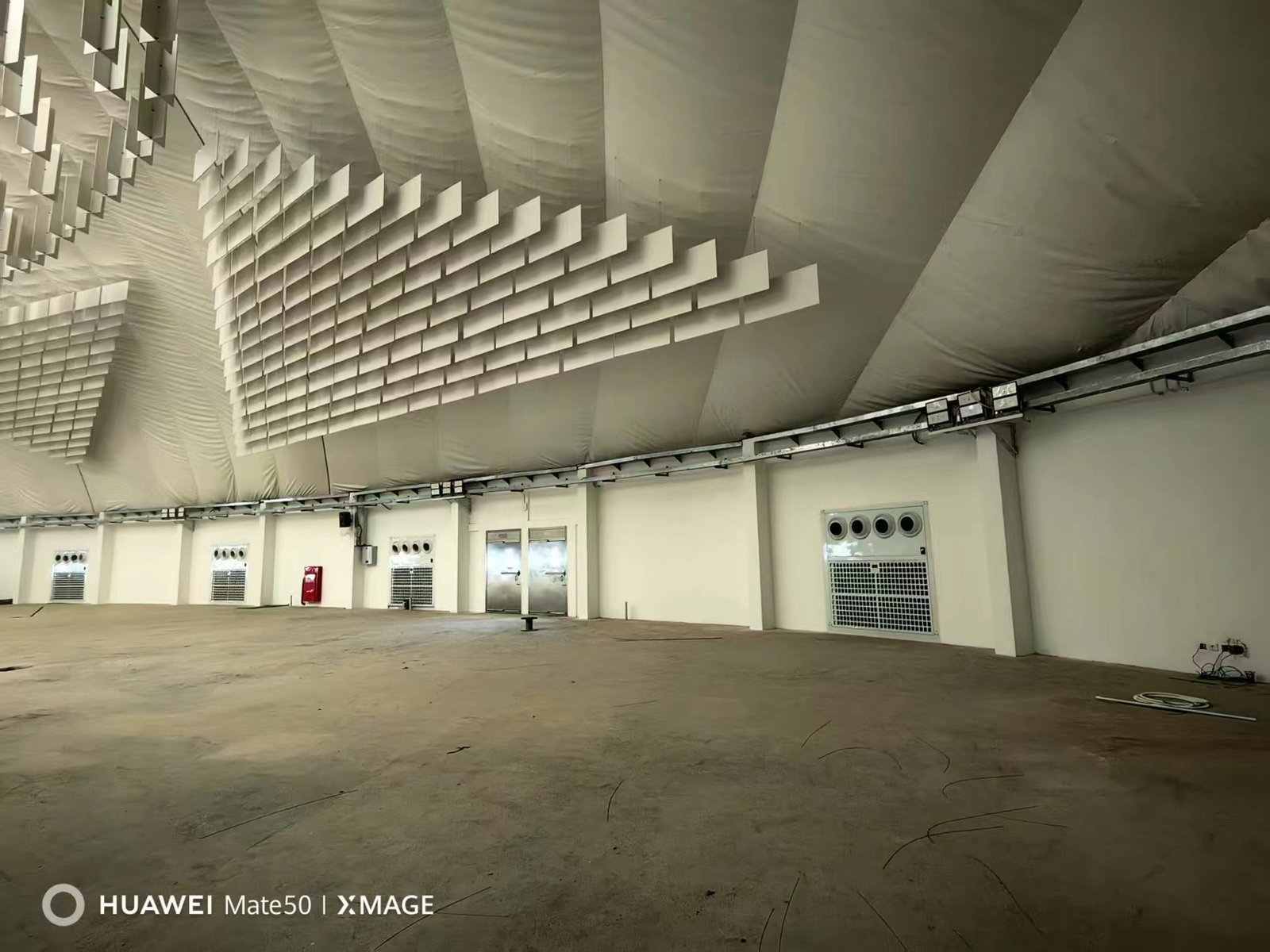
Jiangsu-based manufacturers tend to be stronger in engineered, project-specific HVAC systems rather than high-volume standard models. If your sourcing involves custom airflow design, integrated controls, or non-standard configurations — particularly for institutional or industrial projects — Jiangsu factories are often better equipped to support the engineering phase.
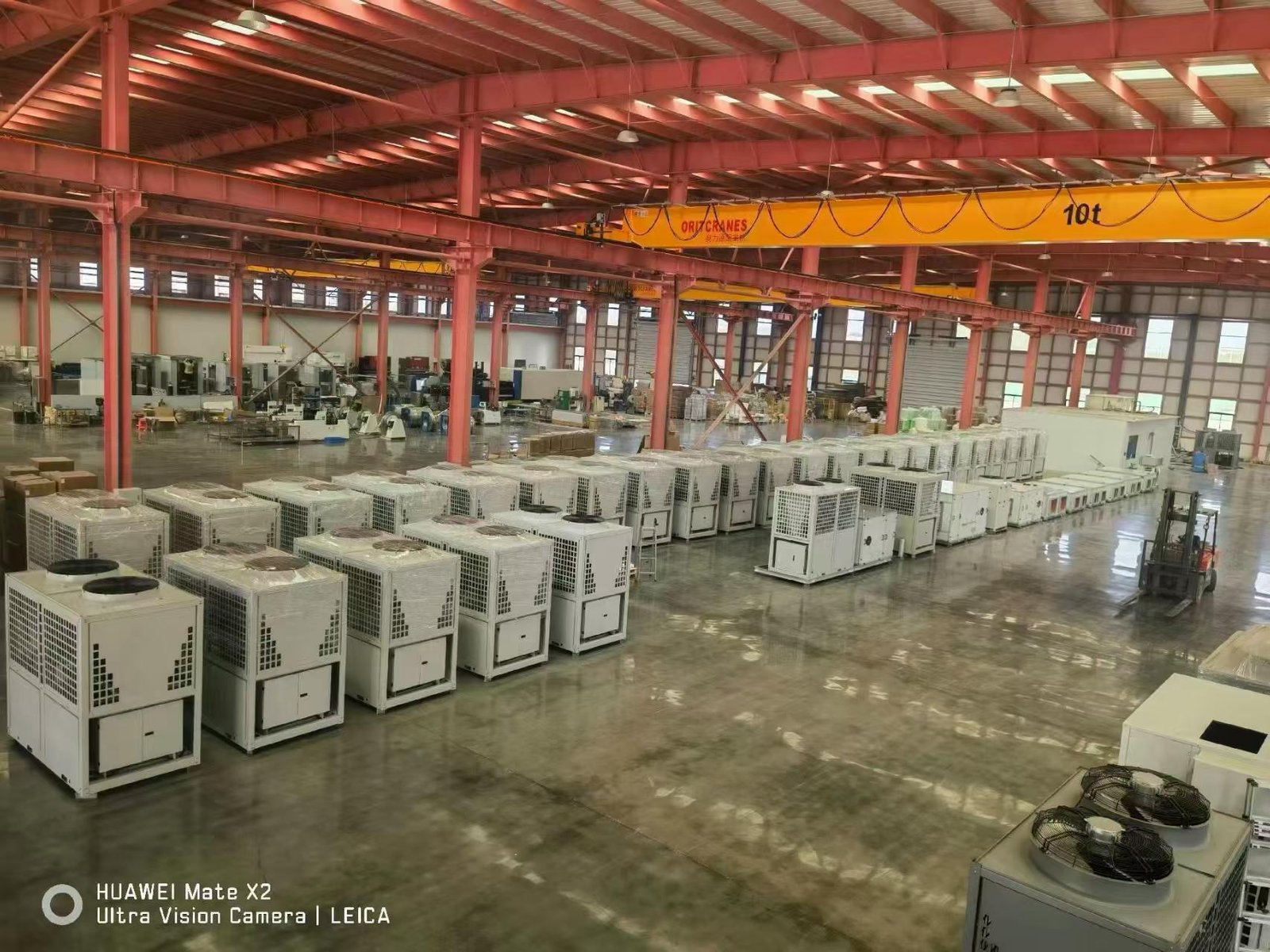
Shandong is one of the more active regions for packaged DX units and project-based HVAC supply. Factories here often compete on price and production speed, which may suit cost-sensitive project orders. However, buyers should confirm export documentation capability separately, as not all Shandong-based factories have the same level of export support as their Guangdong counterparts.
SongXin HVAC operates production bases in both Qingdao (Shandong) and Qingyuan (Guangdong), among other locations — which gives us a practical vantage point on how regional strengths differ.
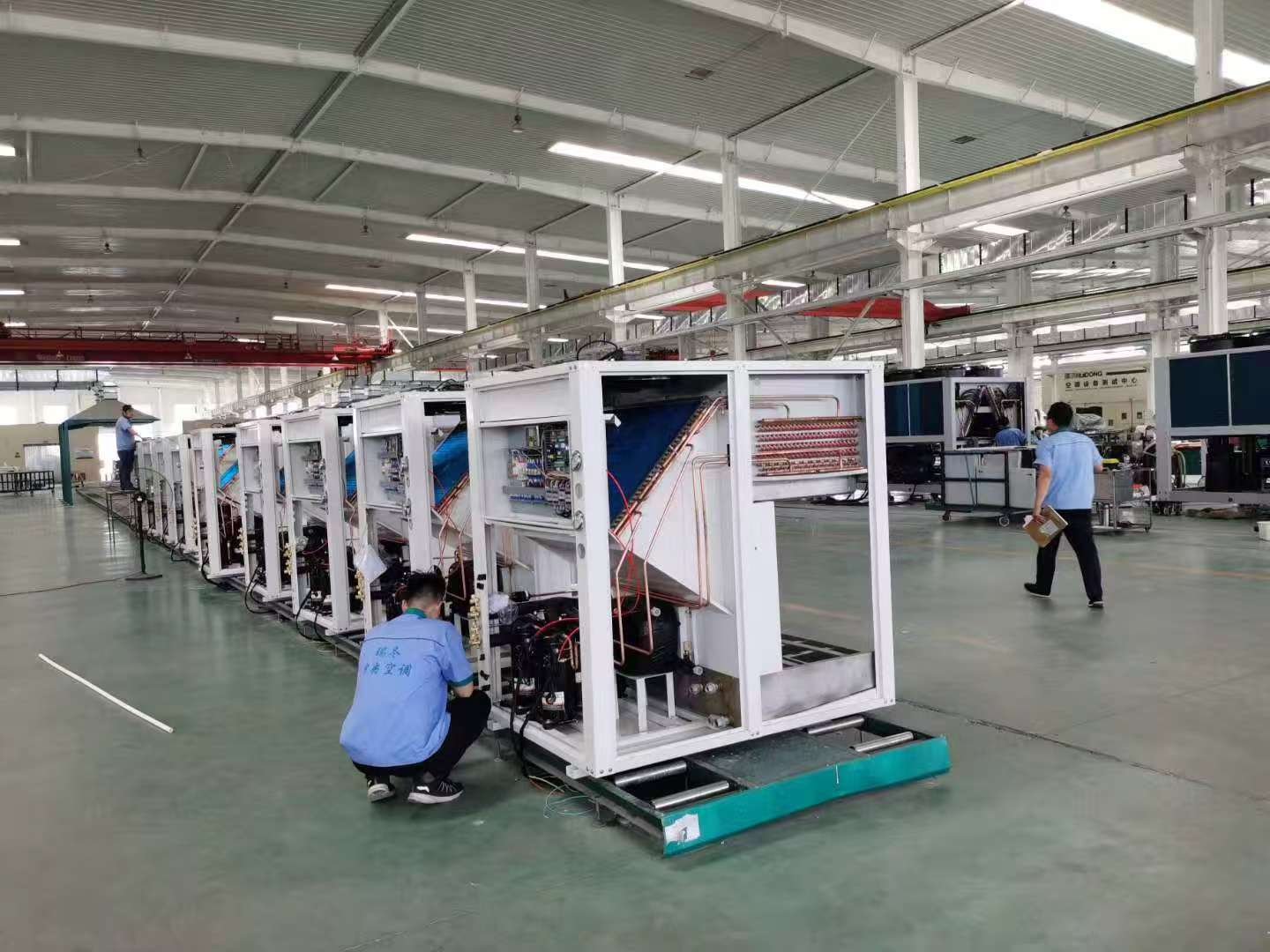
Zhejiang factories are often smaller and more agile. They tend to respond faster to new inquiries, accept lower MOQs, and accommodate customization requests more readily. For buyers exploring private-label or specialized DX products like tent air conditioners, Zhejiang is worth considering — especially for small-to-medium volume orders.
The best region depends less on geography and more on how you buy. Distributors who reorder quarterly in standard models may prioritize Guangdong. Contractors who buy per-project with custom specifications may find better support in Jiangsu or Shandong. OEM buyers with their own branding and packaging requirements often work with Zhejiang or Guangdong factories that have private-label experience.
There is no single “best” region. The right match depends on your order volume, product complexity, documentation needs, and how much engineering involvement you require from the supplier.
This is one of the most consequential decisions in DX unit sourcing, and many buyers underestimate how much it affects pricing, documentation, lead time, and after-sales support.
If your business involves government tenders, institutional projects, or markets where end-users expect to see a recognized brand on the nameplate, sourcing from a branded China DX unit manufacturer may be the safer route.
Branded lines typically come with standardized documentation packages, consistent product configurations, and established warranty structures. The trade-off is less flexibility on pricing, customization, and commercial terms.
For buyers who operate under their own brand, need non-standard voltage or frequency configurations, or compete primarily on value, OEM factories offer a different set of advantages.
These include more negotiable pricing, greater willingness to adjust designs, and more flexible MOQ and payment terms. The risk is that you may need to invest more time in verifying quality systems, component sourcing, and export documentation readiness.
Branded units tend to have fixed price lists with limited discount room. OEM factories often price per order based on volume, components, and customization scope.
Branded suppliers can usually adjust voltage and minor specs. OEM factories can redesign airflow paths, control logic, casing dimensions, and functional modules — but only if they have real engineering staff, not just a sales team.
Branded suppliers almost always provide standard datasheets, test reports, and compliance documents. With OEM factories, you should request and verify these documents explicitly before discussing pricing.
Branded lines may have regional offices or local distributors who can provide installation guidance. OEM factories rarely offer this, which means you need to handle technical support in-market yourself.
OEM sourcing carries higher upfront risk in exchange for better commercial terms. This risk can be managed through factory audits, sample orders, and structured verification — but not eliminated entirely.
Most buyers contact too many suppliers and evaluate too few. A more effective approach is to apply structured filters early — before scheduling calls or factory visits.
A factory that ships regularly to Southeast Asia may not know the documentation requirements for West Africa. Ask specifically about export history to your target region, including past shipment volumes, common order types, and whether they have handled local certification or customs challenges before.
Not every factory that lists “DX units” on its website actually manufactures a full range. Ask for a clear breakdown of which models are manufactured in-house and which are sourced externally. If you need voltage adaptation (e.g., 220V/60Hz for Latin America), confirm whether the factory has done this before.
A good reference is not just a country name on a list. Ask for application type, climate conditions, and buyer profile. A supplier who has shipped DX rooftop units for a warehouse project in Saudi Arabia has very different experience from one that sold residential splits in Vietnam.
Before entering price negotiation, request datasheets, general arrangement drawings, and component lists. Suppliers who cannot provide these documents promptly are either trading companies or factories with limited documentation capability — both of which increase procurement risk.
Some Chinese suppliers operate as “factory-trader hybrids” — they manufacture certain product lines and source others from partner factories. This is not inherently a problem, but you should know which products are made in-house. Ask to see production line photos or video, inquire about annual production capacity, and request a business license that shows manufacturing as the registered scope.
Whether you visit in person or conduct a remote audit, the goal is the same: confirm that the factory can consistently deliver what it promises — at scale, on time, and at the quality level your market requires.
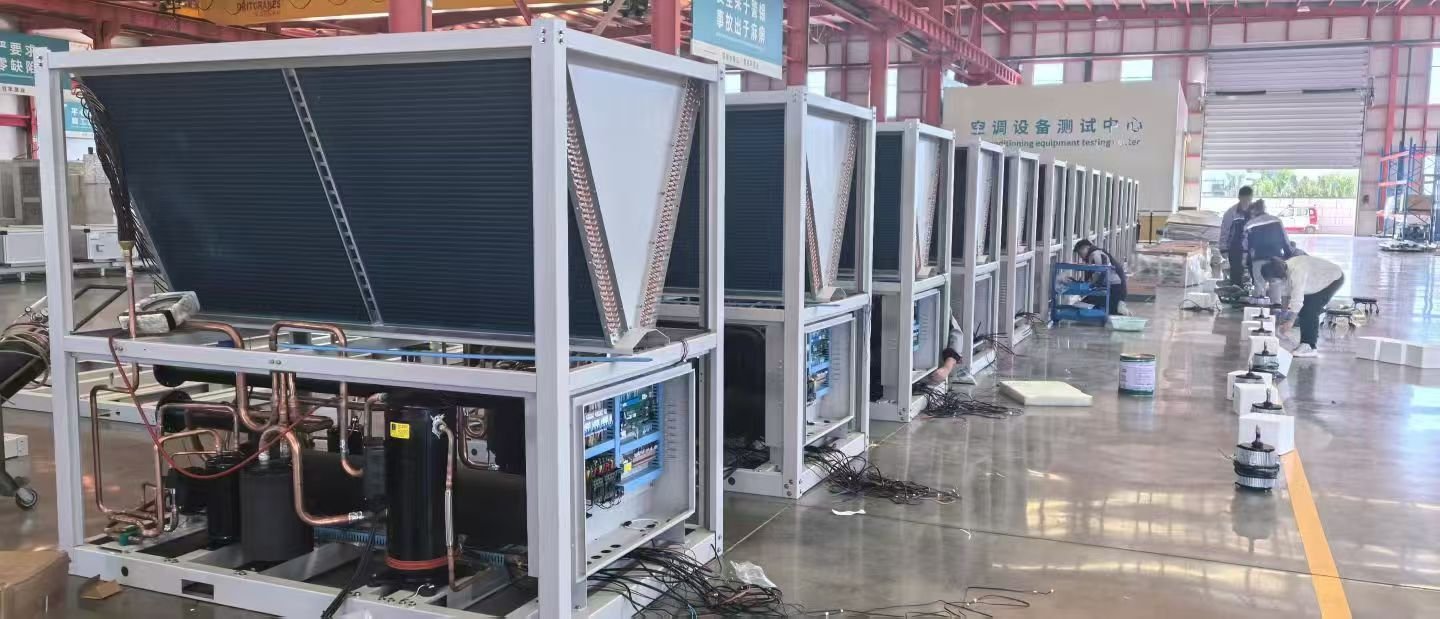
Verify that the factory has active production lines (not dormant ones), realistic capacity scheduling, and the ability to handle peak-season orders without excessive delays. Ask about current order load and expected delivery windows.
Ask to see a sample BOM and a recent engineering drawing. Factories with real customization capability will have these readily available; those that do not are likely outsourcing the design work.
Focus on three critical inspection points: incoming material inspection, in-process inspection (welding, brazing, assembly), and final product testing (refrigerant leak testing, noise measurement, performance validation).
A reliable supplier should disclose the exact brands and models used in your order — not just generic descriptions. SongXin, for example, uses components from Copeland, Danfoss, Siemens, and Fusheng.
Confirm that the factory uses reinforced wooden crates, anti-corrosion wrapping, moisture-proof materials, and clear marking. Also verify standard shipping documents for your freight forwarder and customs authority.
Certification is one of the most misunderstood areas in cross-border HVAC procurement. Many buyers collect certificates without verifying what they actually cover.
When a supplier sends you a certificate, check the following: the certificate number (is it searchable on the issuing body’s website?), the model range covered (does it include your specific unit?), the issuing body (is it an accredited organization?), the validity period (is it current?), and consistency between the certificate details and the actual product you are ordering. A CE certificate for a 50 kW rooftop unit does not automatically cover a 120 kW model from the same factory.
Do not assume that one set of certificates will satisfy all your target markets. A buyer distributing in Nigeria, Indonesia, and Brazil may face three entirely different sets of import and project documentation requirements. Always confirm the specific compliance requirements for your destination before finalizing the order — and ask whether the supplier has experience preparing documents for that market.
These commercial terms are often the most negotiated and least standardized aspects of DX unit sourcing.
For standard catalog-model commercial DX units, most factories accept MOQs as low as 2–5 units. For OEM or private-label orders requiring custom branding, packaging, or configuration, MOQs typically start at 10–20 units. Sample orders (1–2 units) are generally possible for evaluation.
Off-season lead times (Oct–Feb) for standard units typically range from 15–30 days. Peak-season orders (Mar–Aug) can stretch to 30–60+ days, especially if key components like scroll compressors are in short supply. Customized orders may add 7–15 days for engineering.
First-time buyers should expect 30–50% deposit with the balance before shipment (T/T). For larger or repeat orders, some factories accept L/C at sight, or 30% deposit with 70% against B/L copy. Payment flexibility increases as the relationship matures.
Price is only one element of the commercial package. Experienced buyers also negotiate spare parts inclusion, packaging standards, documentation packages (datasheets, test reports, compliance documents), delivery milestones for large orders, warranty scope and duration, and after-sales response commitments. These terms often have more impact on total procurement value than a few percentage points of unit-price discount.
These are not theoretical risks — they are patterns seen repeatedly in buyer inquiries and after-sales cases.
The lowest-quoted supplier is not always the cheapest total-cost option. A unit with a marginally lower FOB price but inferior compressor quality, poor packaging, or missing documentation can cost significantly more in warranty claims, re-certification, or project delays.
Many Chinese HVAC factories are strong domestically but have limited experience preparing export-grade documentation. If your market requires CE declarations, AHRI-certified data, or third-party test reports, confirm this capability explicitly.
A datasheet that says “scroll compressor” without specifying brand and model number is incomplete. Require a detailed BOM before confirming the order, and cross-reference key components against the quotation and test report.
A DX unit designed for temperate buildings may not perform reliably in high-ambient desert conditions. Confirm the operating range, coil design, and refrigerant charge are appropriate for your climate zone. Especially critical for tent air conditioners and rooftop packaged units.
MOQ and lead time are not fixed numbers for most factories — they are starting points that adjust based on order complexity, timing, and commercial relationship. Treating them as rigid constraints can cause you to overlook suppliers who would be flexible with the right project context.
If you have limited time and need to reach a sourcing decision efficiently, the following five-step process provides a workable framework.
Be specific about cooling/heating capacity, voltage, airflow, operating temperature range, and any functional modules (filtration, humidification, heat recovery) your project requires.
Based on your buying model — distributor, project contractor, or OEM — determine whether branded or OEM supply better fits your needs, and which region to focus on.
Apply the filters described earlier: export experience, product range, reference relevance, document readiness, and manufacturer verification.
Request datasheets, GA drawings, component lists, and certificates. Conduct a remote or on-site audit if the order value justifies it.
Finalize pricing, MOQ, lead time, payment terms, documentation package, warranty, and spare parts scope — in writing, before making any deposit.
SongXin is not the right fit for every buyer. If you need the lowest possible unit price with no documentation or engineering support, a pure-cost OEM factory may serve you better. But if your sourcing involves any of the following, we are positioned to help:
We work regularly with overseas distributors who reorder quarterly and contractors who purchase per-project. Our sales and engineering teams are structured to support both models.
If you are not certain which DX configuration fits your project — rooftop packaged, split system, or ducted unit — our engineers can review your application parameters and recommend a suitable option.
We provide complete documentation packages including datasheets, test reports, compliance records, and traceability files. SongXin holds ISO 9001, ISO 14001, CE, AHRI, RoHS, and CCC certifications.
The value of working with SongXin is not that we are always the cheapest — it is that we help you reduce the gap between a quote and a delivered, functioning, documented system.
Branded DX units come with the manufacturer’s own nameplate, standard documentation, and established product configurations. OEM DX units are manufactured to the buyer’s specifications and branded under the buyer’s own label. The trade-off is typically between documentation readiness and pricing flexibility.
It depends on your buying model. Guangdong is strong for export-oriented branded supply. Jiangsu excels at engineered, project-specific systems. Shandong offers competitive pricing for packaged and project-based orders. Zhejiang provides flexibility for private-label and small-volume OEM orders.
At minimum: product datasheets, general arrangement drawings, a bill of materials listing key components, relevant product certifications (CE, AHRI, CCC, etc.), factory certifications (ISO 9001), and recent test reports. For project-based orders, also request reference lists and packaging specifications.
Request the business license and confirm that the registered scope includes manufacturing. Ask for production line photos or a video walkthrough. Inquire about annual production capacity and current order load. Check whether the supplier can produce engineering drawings in-house.
Yes. Standard-model MOQs are typically 2–5 units; OEM/customized orders usually start at 10–20 units. Lead times for standard units range from 15–30 days off-season, extending to 30–60+ days during peak season or for customized orders.
This depends entirely on your destination market. CE is commonly required for Middle East and some African markets. AHRI certification is valued in North America and certain Southeast Asian tenders. CCC is mandatory for China’s domestic market but not for export. Always confirm local requirements before ordering.
Many can, but capability varies widely. Factories with in-house engineering teams can support voltage adaptation, airflow modification, control logic changes, custom casing, and functional module integration. Ask for a recent example of a customized project and review the engineering documents they produced.
China offers a wide and competitive supply base for OEM DX units and commercial-grade direct expansion equipment. But the gap between the best and worst sourcing outcomes in this category is large — and it usually comes down to how well the buyer evaluates supplier capability, documentation readiness, and project fit before placing the order.
Price comparison alone is insufficient. The suppliers who generate the fewest post-order problems tend to be those who can demonstrate real production capability, transparent component sourcing, relevant export experience, and a documentation process that matches the buyer’s market requirements.
A structured sourcing approach — starting from clear technical specifications, through regional and supplier-type selection, to documented verification — does not guarantee a perfect outcome. But it substantially reduces the most common procurement risks that overseas DX unit buyers face.