

1. Why Flexibility Matters in Large Projects
Large commercial and institutional HVAC projects rarely remain static. Changes in building function, phased construction schedules, tenant occupancy variation, and future expansion often cause cooling demand to evolve over time.
Traditional plants are frequently sized for ultimate peak demand from day one. While conservative, this approach can create:
- Oversized equipment during early operation
- Poor part-load efficiency
- Higher initial investment
- Limited adaptability to future changes
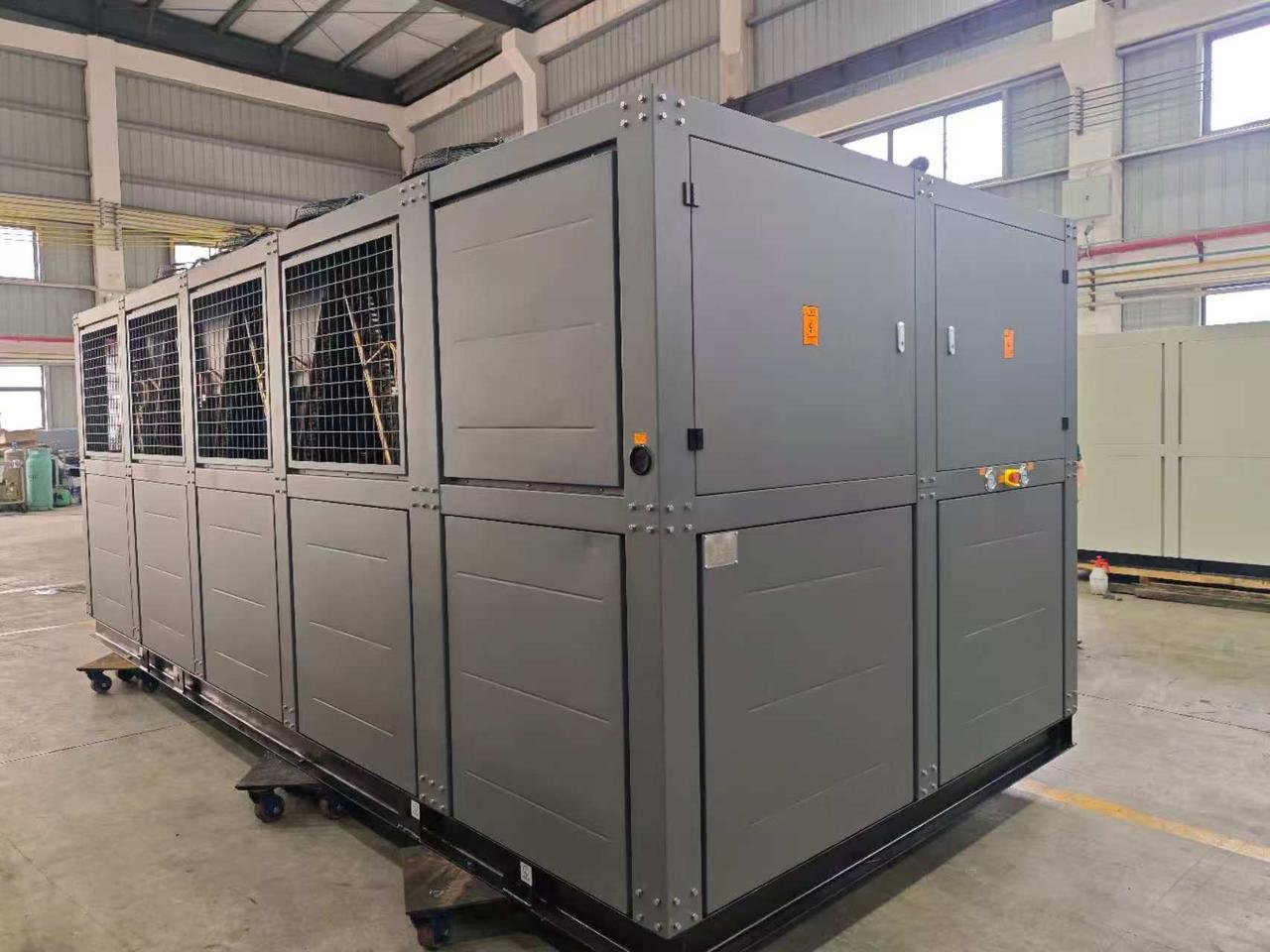
Design objective: Flexibility is now both an engineering and financial requirement—especially when the load profile and project phasing are uncertain.
2. What Is a Modular Chiller System?
A modular chiller system consists of multiple standardized chiller modules connected in parallel to form a single cooling plant. Each module operates independently, while a system controller manages load sharing and sequencing.
- Incremental capacity building (add modules as load grows)
- Redundancy via multiple operating units
- Scalable architecture for future expansion
Key difference: Modular systems let installed capacity and operating capacity follow actual demand much more closely than single large chillers.
3. Capacity Scalability and Phased Construction
3.1 Matching Capacity with Project Phases
In phased developments (campuses, hospitals, mixed-use complexes), cooling demand increases gradually. Modular chillers allow engineers to:
- Install only the capacity needed for initial phases
- Add modules as new buildings come online
- Avoid operating oversized equipment during early stages
This improves both energy efficiency and capital utilization across the project timeline.
3.2 Reducing Financial Risk
By spreading investment over time, owners can reduce upfront capex, align equipment purchases with revenue generation, and improve cash flow. From a lifecycle perspective, staged expansion often outperforms an “ultimate capacity day-one” approach.
4. Part-Load Performance and Energy Efficiency
4.1 Load Matching Through Module Sequencing
Modular systems excel at part-load operation. By staging modules on/off, the plant keeps active modules closer to their optimal efficiency range.
- Reduced compressor cycling
- More stable chilled water temperature
- Lower annual energy consumption
This is especially valuable in commercial buildings with highly variable load profiles.
4.2 Control Strategy Importance
The performance of a modular plant depends heavily on controls. Effective sequencing ensures:
- Balanced operating hours among modules
- Smooth transitions between load steps
- Minimized start-stop losses
Controls takeaway: Modular efficiency is “earned” through sequencing logic. Without proper staging and flow control, modular plants can underperform.
5. Reliability and Redundancy
5.1 Built-In Redundancy
In mission-critical facilities, downtime can be unacceptable. Modular chillers inherently provide redundancy: if one module fails, the remaining modules continue operating at reduced capacity.
5.2 Maintenance Without Full Shutdown
Maintenance can be performed on individual modules while the rest of the plant remains operational—valuable for:
- Hospitals
- Data centers
- Continuous-process facilities
Operational benefit: “Service while running” is a major resilience advantage compared with single-chiller plants that require full shutdown for certain interventions.
6. Space Utilization and Installation Advantages
6.1 Transportation and Handling
Modular units are smaller and lighter than large monoblock chillers, simplifying transportation logistics, site handling, and installation in constrained locations—especially for rooftop and retrofit projects.
6.2 Plant Room Layout Flexibility
Modular plants allow flexible layouts. Engineers can optimize space usage, plan future expansion corridors, and simplify pipe routing based on site constraints.
7. System Integration Considerations
7.1 Hydraulic Design
Proper hydraulic design ensures equal flow distribution among modules, stable ΔT performance, and avoidance of short-circuiting. Key items to engineer carefully include:
- Headers sized for balanced flow distribution
- Isolation valves for service and staging
- Flow control devices and minimum flow protection (as required)
- Air elimination and proper sensor placement for stable control
7.2 Control and Monitoring
Integration with BMS enables real-time monitoring, fault diagnostics, and energy analysis. Modular systems benefit strongly from advanced monitoring because module-level runtime and efficiency data supports better sequencing and proactive maintenance.
Integration warning: Poor header design or incorrect sensor placement can undermine modular benefits by causing flow imbalance, unstable leaving water temperature, or nuisance cycling.
8. Typical Applications for Modular Chillers
Modular chiller systems are particularly well-suited for:
- Hospitals and healthcare facilities
- University and office campuses
- Mixed-use developments
- Data centers with staged capacity requirements
- Retrofit projects with limited installation windows
9. Songxin HVAC Modular Chiller Philosophy
Songxin HVAC develops modular chiller solutions focused on real project requirements rather than theoretical modularity. From an engineering standpoint, Songxin emphasizes:
Robust Parallel Operation
Module design engineered for stable operation when multiple units share headers and sequencing control.
Sequencing-Focused Controls
Reliable logic for load sharing, runtime balancing, and smooth staging to reduce cycling losses.
Hydraulic Compatibility
Supports multiple system configurations with clear guidance on headers, valves, and flow protection.
Phased Expansion Support
Designed to help owners add capacity with minimal disruption as the project grows.
Planning a Modular Chiller Plant?
Songxin HVAC can help evaluate module sizing, staging strategy, header design, and phased expansion planning based on your project load profile.
View Engineering Insight10. Summary and Engineering Insight
Modular chillers provide a practical solution for large HVAC projects where flexibility, reliability, and lifecycle efficiency are priorities. When properly designed and integrated, modular plants can outperform traditional single-unit approaches in many real-world applications.
Success depends on thoughtful system design, sequencing logic, and coordination with the overall HVAC architecture—especially hydraulic balancing and control integration.
Engineering insight: Treat modular plants as a complete system (modules + headers + pumps + sensors + sequencing). The greatest gains come from matching capacity to real load and maintaining stable ΔT and leaving-water control at part load.
FAQ: Modular Chillers in Large HVAC Projects
What is a modular chiller system?
A modular chiller system uses multiple standardized chiller modules in parallel. Each module operates independently, and a controller sequences modules to match load, enabling scalability, redundancy, and efficient part-load operation.
Why do modular chillers improve part-load efficiency?
Because modules can be staged on/off, the plant keeps operating units closer to optimal loading, reducing cycling losses and improving chilled-water temperature stability compared with oversized single units.
What are the biggest design risks for modular chiller plants?
The most common risks are poor header/hydraulic design (flow imbalance, short-circuiting, unstable ΔT) and weak sequencing logic (nuisance cycling, uneven runtime). Proper sensor placement and BMS integration are also critical.
Where are modular chillers most commonly used?
They are widely used in hospitals, campuses, mixed-use developments, data centers with staged capacity, and retrofit projects that need flexible installation and future expansion.